Problems
Filters
3 problems found
2025 Paper 3 Q10
A plank \(AB\) of length \(L\) initially lies horizontally at rest along the \(x\)-axis on a flat surface, with \(A\) at the origin. Point \(C\) on the plank is such that \(AC\) has length \(sL\), where \(0 < s < 1\). End \(A\) is then raised vertically along the \(y\)-axis so that its height above the horizontal surface at time \(t\) is \(h(t)\), while end \(B\) remains in contact with the flat surface and on the \(x\)-axis. The function \(h(t)\) satisfies the differential equation $$\frac{d^2h}{dt^2} = -\omega^2 h, \text{ with } h(0) = 0 \text{ and } \frac{dh}{dt} = \omega L \text{ at } t = 0$$ where \(\omega\) is a positive constant. A particle \(P\) of mass \(m\) remains in contact with the plank at point \(C\).
- Show that the \(x\)-coordinate of \(P\) is \(sL\cos\omega t\), and find a similar expression for its \(y\)-coordinate.
- Find expressions for the \(x\)- and \(y\)-components of the acceleration of the particle.
- \(N\) and \(F\) are the upward normal and frictional components, respectively, of the force of the plank on the particle. Show that $$N = mg(1 - k\sin\omega t)\cos\omega t$$ and that $$F = mgsk\frac{\omega^2}{g}\tan\omega t$$ where \(k = \frac{L\omega^2}{g}\).
- The coefficient of friction between the particle and the plank is \(\tan\alpha\), where \(\alpha\) is an acute angle.
Show that the particle will not slip initially, provided \(sk < \tan\alpha\).
Show further that, in this case, the particle will slip
- while \(N\) is still positive,
- when the plank makes an angle less than \(\alpha\) to the horizontal.
Solution:
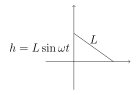
- Since we have \(h'' + \omega^2 h = 0\) we must have that \(h(t) = A \cos \omega t + B \sin \omega t\). The initial conditions tell us that \(A = 0\) and \(B = L\), so \(h(t) = L \sin \omega t\).
Therefore we can see the angle at \(B\) is \(\omega t\) and so \(P\) has \(y\)-coordinate \((1-s)L \sin \omega t\) and \(x\)-coordinate \(sL \cos \omega t\)
- If the position is \(\binom{sL \cos \omega t}{(1-s) L \sin \omega t}\) then the acceleration is \(-\omega^2 \binom{sL \cos \omega t}{(1-s) L \sin \omega t}\)
- \begin{align*} \text{N2}(\rightarrow): && - F\cos \omega t + N \sin \omega t &= -m\omega^2 sL \cos \omega t\\ \text{N2}(\uparrow): && -mg + F\sin \omega t + N \cos \omega t &= -m\omega^2 (1-s) L \sin \omega t \\ \Rightarrow && \begin{pmatrix} \cos \omega t & -\sin \omega t \\ \sin \omega t & \cos \omega t \end{pmatrix} \begin{pmatrix} F \\ N \end{pmatrix} &= \begin{pmatrix} m\omega^2 s L \cos \omega t \\ mg - m\omega^2(1-s)L \sin \omega t \end{pmatrix} \\ \Rightarrow && \begin{pmatrix}F \\ N \end{pmatrix} &= \begin{pmatrix} \cos \omega t & \sin \omega t \\ -\sin \omega t & \cos \omega t \end{pmatrix} \begin{pmatrix} m\omega^2 s L \cos \omega t \\ mg - m\omega^2(1-s)L \sin \omega t \end{pmatrix} \\ \Rightarrow && N &= m \omega^2 s L (-\sin \omega t \cos \omega t) + mg \cos \omega t - m \omega^2 (1-s)L \sin \omega t \cos \omega t \\ &&&=mg \cos \omega t - m \omega^2 L \sin \omega t \cos \omega t \\ &&&= mg \cos \omega t \left (1 - \frac{L \omega^2}{g} \sin \omega t \right) \\ &&&= mg (1 - k \sin \omega t) \cos \omega t \\ \Rightarrow && F &= m \omega^2 s L \cos^2 \omega t + mg \sin \omega t - m \omega^2 (1-s) L \sin ^2 \omega t \\ &&&= m \omega^2 s L + mg \sin \omega t - m \omega^2 L \sin^2 \omega t \\ &&&= mg \frac{\omega^2 L}{g} s + mg(1-\frac{\omega^2 L}{g} \sin \omega t)\sin \omega t \\ &&&= mg sk + mg(1-k \sin \omega t) \cos \omega t \tan \omega t \\ &&&= mgsk + N \tan \omega t \end{align*}
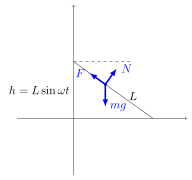
- The particle will not slip if \(F < \tan \alpha N\). When \(t = 0\), \(N = mg, F = mgsk\), but clearly \(sk < \tan \alpha \Rightarrow mgsk = F < \tan \alpha mg = \tan \alpha N\). The particle will slip when: \(F > \tan \alpha N\), but we have \(F = mgsk + N \tan \omega t\). Clearly when \(\omega t = \alpha\) we have reached a point where \(F > \tan \alpha N\). Therefore we must slip before we reach this point, ie at a point where the plank makes an angle of less than \(\alpha\) to the horizontal. Notice also that \(N\) changes sign when \(1-k \sin \omega t = 0\), however, to do this \(N\) must become very small, smaller than \(mgsk\), therefore we must slip before this point too. Since we slip before either condition occurs, we must be in a position when \(N\) is positive AND the plank still makes a shallow angle.
1999 Paper 3 Q11
Calculate the moment of inertia of a uniform thin circular hoop of mass \(m\) and radius \(a\) about an axis perpendicular to the plane of the hoop through a point on its circumference. The hoop, which is rough, rolls with speed \(v\) on a rough horizontal table straight towards the edge and rolls over the edge without initially losing contact with the edge. Show that the hoop will lose contact with the edge when it has rotated about the edge of the table through an angle \(\theta\), where \[ \cos\theta = \frac 12 +\frac {v^2}{2ag}. \] %Give the corresponding result for a smooth hoop and table.
1988 Paper 2 Q13
A librarian wishes to pick up a row of identical books from a shelf, by pressing her hands on the outer covers of the two outermost books and lifting the whole row together. The covers of the books are all in parallel vertical planes, and the weight of each book is \(W\). With each arm, the librarian can exert a maximum force of \(P\) in the vertical direction, and, independently, a maximum force of \(Q\) in the horizontal direction. The coefficient of friction between each pair of books and also between each hand and a book is \(\mu.\) Derive an expression for the maximum number of books that can be picked up without slipping, using this method. {[}You may assume that the books are thin enough for the rotational effect of the couple on each book to be ignored.{]}
Solution:
