Problems
Filters
16 problems found
2023 Paper 2 Q11
- \(X_1\) and \(X_2\) are both random variables which take values \(x_1, x_2, \ldots, x_n\), with probabilities \(a_1, a_2, \ldots, a_n\) and \(b_1, b_2, \ldots, b_n\) respectively. The value of random variable \(Y\) is defined to be that of \(X_1\) with probability \(p\) and that of \(X_2\) with probability \(q = 1-p\). If \(X_1\) has mean \(\mu_1\) and variance \(\sigma_1^2\), and \(X_2\) has mean \(\mu_2\) and variance \(\sigma_2^2\), find the mean of \(Y\) and show that the variance of \(Y\) is \(p\sigma_1^2 + q\sigma_2^2 + pq(\mu_1 - \mu_2)^2\).
- To find the value of random variable \(B\), a fair coin is tossed and a fair six-sided die is rolled. If the coin shows heads, then \(B = 1\) if the die shows a six and \(B = 0\) otherwise; if the coin shows tails, then \(B = 1\) if the die does not show a six and \(B = 0\) if it does. The value of \(Z_1\) is the sum of \(n\) independent values of \(B\), where \(n\) is large. Show that \(Z_1\) is a Binomial random variable with probability of success \(\frac{1}{2}\). Using a Normal approximation, show that the probability that \(Z_1\) is within \(10\%\) of its mean tends to \(1\) as \(n \longrightarrow \infty\).
- To find the value of random variable \(Z_2\), a fair coin is tossed and \(n\) fair six-sided dice are rolled, where \(n\) is large. If the coin shows heads, then the value of \(Z_2\) is the number of dice showing a six; if the coin shows tails, then the value of \(Z_2\) is the number of dice not showing a six. Use part (i) to write down the mean and variance of \(Z_2\). Explain why a Normal distribution with this mean and variance will not be a good approximation to the distribution of \(Z_2\). Show that the probability that \(Z_2\) is within \(10\%\) of its mean tends to \(0\) as \(n \longrightarrow \infty\).
2016 Paper 3 Q13
Given a random variable \(X\) with mean \(\mu\) and standard deviation \(\sigma\), we define the kurtosis, \(\kappa\), of \(X\) by \[ \kappa = \frac{ \E\big((X-\mu)^4\big)}{\sigma^4} -3 \,. \] Show that the random variable \(X-a\), where \(a\) is a constant, has the same kurtosis as \(X\).
- Show by integration that a random variable which is Normally distributed with mean 0 has kurtosis 0.
- Let \(Y_1, Y_2, \ldots, Y_n\) be \(n\) independent, identically distributed, random variables with mean 0, and let \(T = \sum\limits_{r=1}^n Y_r\). Show that \[ \E(T^4) = \sum_{r=1}^n \E(Y_r^4) + 6 \sum_{r=1}^{n-1} \sum_{s=r+1}^{n} \E(Y^2_s) \E(Y^2_r) \,. \]
- Let \(X_1\), \(X_2\), \(\ldots\)\,, \(X_n\) be \(n\) independent, identically distributed, random variables each with kurtosis \(\kappa\). Show that the kurtosis of their sum is \(\dfrac\kappa n\,\).
Solution: \begin{align*} &&\kappa_{X-a} &= \frac{\mathbb{E}\left(\left(X-a-(\mu-a)\right)^4\right)}{\sigma_{X-a}^4}-3 \\ &&&= \frac{\mathbb{E}\left(\left(X-\mu\right)^4\right)}{\sigma_X^4}-3\\ &&&= \kappa_X \end{align*}
- \(\,\) \begin{align*} && \kappa &= \frac{\mathbb{E}((X-\mu)^4)}{\sigma^4} - 3 \\ &&&= \frac{\mathbb{E}((\mu+\sigma Z-\mu)^4)}{\sigma^4} - 3 \\ &&&= \frac{\mathbb{E}((\sigma Z)^4)}{\sigma^4} - 3 \\ &&&= \mathbb{E}(Z^4)-3\\ &&&= \int_{-\infty}^{\infty} x^4\frac{1}{\sqrt{2\pi}} \exp \left ( - \frac12x^2 \right)\d x -3 \\ &&&= \left [\frac{1}{\sqrt{2\pi}}x^{3} \cdot \left ( -\exp \left ( - \frac12x^2 \right)\right) \right]_{-\infty}^{\infty} + \frac{1}{\sqrt{2\pi}} \int_{-\infty}^\infty 3x^2 \exp \left ( - \frac12x^2 \right) \d x - 3 \\ &&&= 0 + 3 \textrm{Var}(Z) - 3 =0 \end{align*}
- \(\,\) \begin{align*} && \mathbb{E}(T^4) &= \mathbb{E} \left [\left ( \sum\limits_{r=1}^n Y_r\right)^4\right] \\ &&&= \mathbb{E} \left [ \sum_{r=1}^n Y_r^4+\sum_{i\neq j} 4Y_iY_j^3+\sum_{i\neq j} 6Y_i^2Y_j^2+\sum_{i\neq j \neq k} 12Y_iY_jY_k^2 +\sum_{i\neq j\neq k \neq l}24 Y_iY_jY_kY_l\right] \\ &&&= \sum_{r=1}^n \mathbb{E} \left [ Y_r^4 \right]+\sum_{i\neq j} \mathbb{E} \left [ 4Y_iY_j^3\right]+\sum_{i\neq j} \mathbb{E} \left [ 6Y_i^2Y_j^2\right]+\sum_{i\neq j \neq k} \mathbb{E} \left [ 12Y_iY_jY_k^2\right] +\sum_{i\neq j\neq k \neq l} \mathbb{E} \left [ 24 Y_iY_jY_kY_l\right] \\ &&&= \sum_{r=1}^n \mathbb{E} \left [ Y_r^4 \right]+4\sum_{i\neq j} \mathbb{E} \left [ Y_i]\mathbb{E}[Y_j^3\right]+6\sum_{i\neq j} \mathbb{E} \left [ Y_i^2]\mathbb{E}[Y_j^2\right]+12\sum_{i\neq j \neq k} \mathbb{E} \left [ Y_i]\mathbb{E}[Y_j]\mathbb{E}[Y_k^2\right] +24\sum_{i\neq j\neq k \neq l} \mathbb{E} \left [ Y_i]\mathbb{E}[Y_j]\mathbb{E}[Y_k]\mathbb{E}[Y_l\right] \\ &&&= \sum_{r=1}^n \mathbb{E} \left [ Y_r^4 \right]+6\sum_{i\neq j} \mathbb{E} \left [ Y_i^2]\mathbb{E}[Y_j^2\right] \end{align*}
- Without loss of generality, we may assume they all have mean zero. Therefore we can consider the sitatuion as in the previous case with \(T\) and \(Y_i\)s. Note that \(\mathbb{E}(Y_i^4) = \sigma^4(\kappa + 3)\) and \(\textrm{Var}(T) = n \sigma^2\) \begin{align*} && \kappa_T &= \frac{\mathbb{E}(T^4)}{(\textrm{Var}(T))^2} - 3 \\ &&&= \frac{\sum_{r=1}^n \mathbb{E} \left [ Y_r^4 \right]+6\sum_{i\neq j} \mathbb{E} \left [ Y_i^2\right]\mathbb{E}\left[Y_j^2\right]}{n^2\sigma^4}-3 \\ &&&= \frac{n\sigma^4(\kappa+3)+6\binom{n}{2}\sigma^4}{n^2\sigma^4} -3\\ &&&= \frac{\kappa}{n} + \frac{3n + \frac{6n(n-1)}{2}}{n^2} - 3 \\ &&&= \frac{\kappa}{n} + \frac{3n^2}{n^2}-3 \\ &&&= \frac{\kappa}{n} \end{align*}
2014 Paper 3 Q12
The random variable \(X\) has probability density function \(f(x)\) (which you may assume is differentiable) and cumulative distribution function \(F(x)\) where \(-\infty < x < \infty \). The random variable \(Y\) is defined by \(Y= \e^X\). You may assume throughout this question that \(X\) and \(Y\) have unique modes.
- Find the median value \(y_m\) of \(Y\) in terms of the median value \(x_m\) of \(X\).
- Show that the probability density function of \(Y\) is \(f(\ln y)/y\), and deduce that the mode \(\lambda\) of \(Y\) satisfies \(\f'(\ln \lambda) = \f(\ln \lambda)\).
- Suppose now that \(X \sim {\rm N} (\mu,\sigma^2)\), so that \[ f(x) = \frac{1}{\sigma \sqrt{2\pi}\,} \e^{-(x-\mu)^2/(2\sigma^2)} \,. \] Explain why \[\frac{1}{\sigma \sqrt{2\pi}\,} \int_{-\infty}^{\infty}\e^{-(x-\mu-\sigma^2)^2/(2\sigma^2)} \d x = 1 \] and hence show that \( \E(Y) = \e ^{\mu+\frac12\sigma^2}\).
- Show that, when \(X \sim {\rm N} (\mu,\sigma^2)\), \[ \lambda < y_m < \E(Y)\,. \]
Solution:
- \begin{align*} && \frac12 &= \mathbb{P}(X \leq x_m) \\ \Leftrightarrow && \frac12 &= \mathbb{P}(e^X \leq e^{x_m} = y_m) \end{align*} Therefore the median is \(y_m = e^{x_m}\)
- \begin{align*} && \mathbb{P}(Y \leq y) &= \mathbb{P}(e^X \leq y) \\ &&&= \mathbb{P}(X \leq \ln y) \\ &&&= F(\ln y) \\ \Rightarrow && f_Y(y) &= f(\ln y)/y \\ \\ && f'_Y(y) &= \frac{f'(\ln y) - f(\ln y)}{y^2} \end{align*} Therefore since the mode satisfies \(f'_Y = 0\) we must have \(f'(\ln \lambda ) = f(\ln \lambda)\)
- This is the integral of the pdf of \(N(\mu + \sigma^2, \sigma^2)\) and therefore is clearly \(1\). \begin{align*} && \E[Y] &= \int_{-\infty}^{\infty} e^x \cdot \frac{1}{\sqrt{2\pi \sigma^2}} e^{-(x-\mu)^2/(2\sigma^2)} \d x \\ &&&= \frac{1}{\sqrt{2\pi \sigma^2}} \int_{-\infty}^{\infty} \exp (x - (x-\mu)^2/(2\sigma^2)) \d x\\ &&&= \frac{1}{\sqrt{2\pi \sigma^2}} \int_{-\infty}^{\infty} \exp ((2x \sigma^2- (x-\mu)^2)/(2\sigma^2)) \d x\\ &&&= \frac{1}{\sqrt{2\pi \sigma^2}} \int_{-\infty}^{\infty} \exp (-(x-\mu-\sigma^2)^2+2\mu \sigma^2-\sigma^4)/(2\sigma^2)) \d x\\ &&&= \frac{1}{\sqrt{2\pi \sigma^2}} \int_{-\infty}^{\infty} \exp (-(x-\mu+\sigma^2)^2)/(2\sigma^2)+\mu +\frac12\sigma^2) \d x\\ &&&= \e^{\mu +\frac12\sigma^2}\frac{1}{\sqrt{2\pi \sigma^2}} \int_{-\infty}^{\infty} \exp (-(x-\mu-\sigma^2)^2)/(2\sigma^2)) \d x\\ &&&= \e^{\mu +\frac12\sigma^2} \end{align*}
- Notice that \(y_m = e^\mu < e^{\mu + \tfrac12 \sigma^2} = \E[Y]\), so it suffices to prove that \(\lambda < e^{\mu}\) Notice that \(f'(x) - f(x) = f(x)[-(x-\mu)/\sigma^2 - 1]\) and therefore \(\ln y - \mu = -\sigma^2\) so \(\lambda = e^{\mu - \sigma^2}\) which is clearly less than \(e^{\mu}\) as required.
2012 Paper 3 Q13
- The random variable \(Z\) has a Normal distribution with mean \(0\) and variance \(1\). Show that the expectation of \(Z\) given that \(a < Z < b\) is \[ \frac{\exp(- \frac12 a^2) - \exp(- \frac12 b^2) } {\sqrt{2\pi\,} \,\big(\Phi(b) - \Phi(a)\big)}, \] where \(\Phi\) denotes the cumulative distribution function for \(Z\).
- The random variable \(X\) has a Normal distribution with mean \(\mu\) and variance \(\sigma^2\). Show that \[ \E(X \,\vert\, X>0) = \mu + \sigma \E(Z \,\vert\,Z > -\mu/\sigma). \] Hence, or otherwise, show that the expectation, \(m\), of \(\vert X\vert \) is given by \[ m= \mu \big(1 - 2 \Phi(- \mu / \sigma)\big) + \sigma \sqrt{2 / \pi}\; \exp(- \tfrac12 \mu^2 / \sigma^2) \,. \] Obtain an expression for the variance of \(\vert X \vert\) in terms of \(\mu \), \(\sigma \) and \(m\).
Solution:
- \(\,\) \begin{align*} && \mathbb{E}(Z| a < Z < b) &= \mathbb{E}(Z\mathbb{1}_{(a,b)}) /\mathbb{E}(\mathbb{1}_{(a,b)}) \\ &&&= \int_a^b z \phi(z) \d z \Big / (\Phi(b) - \Phi(a)) \\ &&&= \frac{\int_a^b \frac{1}{\sqrt{2 \pi}}z e^{-\frac12 z^2} \d z}{\Phi(b) - \Phi(a)} \\ &&&= \frac{\frac1{\sqrt{2\pi}} \left [-e^{-\frac12 z^2} \right]_a^b}{\Phi(b) - \Phi(a)} \\ &&&= \frac{\frac1{\sqrt{2\pi}} \left (e^{-\frac12 a^2}-e^{-\frac12 b^2} \right)}{\Phi(b) - \Phi(a)} \\ \end{align*}
- \(\,\) \begin{align*} && \mathbb{E}(X |X > 0) &= \mathbb{E}(\mu + \sigma Z | \mu + \sigma Z > 0) \\ &&&= \mathbb{E}(\mu + \sigma Z | Z > -\tfrac{\mu}{\sigma}) \\ &&&= \mathbb{E}(\mu| Z > -\tfrac{\mu}{\sigma})+ \sigma \mathbb{E}(Z | Z > -\tfrac{\mu}{\sigma})\\ &&&= \mu+ \sigma \mathbb{E}(Z | Z > -\tfrac{\mu}{\sigma})\\ \end{align*} Hence \begin{align*} &&\mathbb{E}(|X|) &= \mathbb{E}(X | X > 0)\mathbb{P}(X > 0) - \mathbb{E}(X | X < 0)\mathbb{P}(X < 0) \\ &&&=\left ( \mu+ \sigma \mathbb{E}(Z | Z > -\mu /\sigma)\right)(1-\Phi(-\mu/\sigma)) - \left ( \mu+ \sigma \mathbb{E}(Z | Z < -\mu /\sigma)\right)\Phi(-\mu/\sigma) \\ &&&= \mu(1 - 2\Phi(-\mu/\sigma)) + \sigma \frac{e^{-\frac12\mu^2/\sigma^2}}{\sqrt{2\pi}(1-\Phi(-\mu/\sigma))}(1-\Phi(-\mu/\sigma)) + \sigma \frac{e^{-\frac12\mu^2/\sigma^2}}{\sqrt{2 \pi} \Phi(-\mu/\sigma)} \Phi(-\mu/\sigma) \\ &&&= \mu(1 - 2\Phi(-\mu/\sigma)) + \sigma \sqrt{\frac{2}{\pi}} \exp(-\tfrac12 \mu^2/\sigma^2) \end{align*} Finally, \begin{align*} && \textrm{Var}(|X|) &= \mathbb{E}(|X|^2) - [\mathbb{E}(|X|)]^2 \\ &&&= \mu^2 + \sigma^2 - m^2 \end{align*}
2009 Paper 2 Q12
A continuous random variable \(X\) has probability density function given by \[ \f(x) = \begin{cases} 0 & \mbox{for } x<0 \\ k\e^{-2 x^2} & \mbox{for } 0\le x< \infty \;,\\ \end{cases} \] where \(k\) is a constant.
- Sketch the graph of \(\f(x)\).
- Find the value of \(k\).
- Determine \(\E(X)\) and \(\var(X)\).
- Use statistical tables to find, to three significant figures, the median value of \(X\).
Solution:
- \par

- Let \(Y \sim N(0,\frac14)\), then: \begin{align*} &&\int_0^\infty \frac{1}{\sqrt{2 \pi \cdot \frac14}} e^{-2x^2} \, dx &= \frac12\\ \Rightarrow && \int_0^\infty e^{-2x^2} &= \frac{\sqrt{\pi}}{2 \sqrt{2}} \\ \Rightarrow && k &= \boxed{\frac{2\sqrt{2}}{\sqrt{\pi}}} \end{align*}
- \begin{align*} \mathbb{E}[X] &= \int_0^\infty x f(x) \, dx \\ &= \frac{2\sqrt{2}}{\sqrt{\pi}}\int_0^\infty x e^{-2x^2}\, dx \\ &= \frac{2\sqrt{2}}{\sqrt{\pi}} \left [-\frac{1}{4}e^{-2x^2} \right]_0^\infty \\ &= \frac{1}{\sqrt{2\pi}} \\ \end{align*} In order to calculate \(\mathbb{E}(X^2)\) it is useful to consider the related computation \(\mathbb{E}(Y^2)\). In fact, by symmetry, these will be the same values. Therefore \(\mathbb{E}(X^2) = \mathbb{E}(Y^2) = \mathrm{Var}(Y) = \frac{1}{4}\) (since \(\mathbb{E}(Y) = 0\)). Therefore \(\mathrm{Var}(Y) = \mathbb{E}(Y^2) - \mathbb{E}(Y)^2 = \frac14 - \frac{1}{2\pi}\)
- \begin{align*} && \mathbb{P}(X < x) &= \frac12 \\ \Leftrightarrow && 2\mathbb{P}(0 \leq Y < x) &= \frac12 \\ \Leftrightarrow && 2\l \mathbb{P}(Y < x) - \frac12 \r &= \frac12 \\ \Leftrightarrow && \mathbb{P}(Y < x)&= \frac34 \\ \Leftrightarrow && \mathbb{P}(\frac{Y-0}{1/2} < \frac{x}{1/2})&= \frac34 \\ \Leftrightarrow && \mathbb{P}(Z < \frac{x}{1/2})&= \frac34 \\ \Leftrightarrow && \Phi(2x)&= \frac34 \\ \Leftrightarrow && 2x &= 0.6744895\cdots \\ \Leftrightarrow && x &= 0.3372\cdots \\ \Leftrightarrow && &= 0.337 \, (3 \text{sf}) \\ \end{align*}
2006 Paper 3 Q12
Fifty times a year, 1024 tourists disembark from a cruise liner at a port. From there they must travel to the city centre either by bus or by taxi. Tourists are equally likely to be directed to the bus station or to the taxi rank. Each bus of the bus company holds 32 passengers, and the company currently runs 15 buses. The company makes a profit of \(\pounds\)1 for each passenger carried. It carries as many passengers as it can, with any excess being (eventually) transported by taxi. Show that the largest annual licence fee, in pounds, that the company should consider paying to be allowed to run an extra bus is approximately \[ 1600 \Phi(2) - \frac{800}{\sqrt{2\pi}}\big(1- \e^{-2}\big)\,, \] where \(\displaystyle \Phi(x) =\dfrac1{\sqrt{2\pi}} \int_{-\infty}^x \e^{-\frac12t^2}\d t\,\). You should not consider continuity corrections.
Solution: The the number of people being directed towards the buses (each cruise) is \(X \sim B(1024, \tfrac12) \approx N(512, 256) \approx 16Z + 512\). Therefore without an extra bus, the expected profit is \(\mathbb{E}[\min(X, 15 \times 32)]\). With the extra bus, the extra profit is \(\mathbb{E}[\min(X, 16 \times 32)]\), therefore the expected extra profit is: \(\mathbb{E}[\min(X, 16 \times 32)]-\mathbb{E}[\min(X, 15 \times 32)] = \mathbb{E}[\min(X, 16 \times 32)-\min(X, 15 \times 32)] \) \begin{align*} \text{Expected extra profit} &= \mathbb{E}[\min(X, 16 \times 32)-\min(X, 15 \times 32)] \\ &= \mathbb{E}[\min(16Z+512, 16 \times 32)-\min(16Z+512, 15 \times 32)] \\ &= 16\mathbb{E}[\min(Z+32, 32)-\min(Z+32, 30)] \\ &=16\int_{-\infty}^{\infty} \left (\min(Z+32, 32)-\min(Z+32, 30) \right)p_Z(z) \d z \\ &= 16 \left ( \int_{-2}^{0} (z+32-30) p_Z(z) \d z + \int_0^\infty (32-30)p_Z(z) \d z \right) \\ &= 16 \left ( \int_{-2}^{0} (z+2) p_Z(z) \d z + \int_0^\infty 2p_Z(z) \d z \right) \\ &= 16 \left ( \int_{-2}^{0} zp_Z(z) \d z + 2\int_{-2}^\infty p_Z(z) \d z \right) \\ &= 16 \left ( \int_{-2}^{0} z \frac{1}{\sqrt{2\pi}} e^{-\frac12 z^2} \d z + 2(1-\Phi(2)) \right) \\ &= 32(1-\Phi(2)) + \frac{16}{\sqrt{2\pi}} \left [ -e^{-\frac12z^2} \right]_{-2}^0 \\ &= 32(1-\Phi(2)) - \frac{16}{\sqrt{2\pi}} \left ( 1-e^{-2}\right) \end{align*} Across \(50\) different runs, this profit is \[ 1600(1-\Phi(2)) - \frac{800}{\sqrt{2\pi}} \left ( 1-e^{-2}\right) \]
2005 Paper 1 Q13
The random variable \(X\) has mean \(\mu\) and standard deviation \(\sigma\). The distribution of \(X\) is symmetrical about \(\mu\) and satisfies: \[\P \l X \le \mu + \sigma \r = a \mbox{ and } \P \l X \le \mu + \tfrac{1}{ 2}\sigma \r = b\,,\] where \(a\) and \(b\) are fixed numbers. Do not assume that \(X\) is Normally distributed.
- Determine expressions (in terms of \(a\) and \(b\)) for \[ \P \l \mu-\tfrac12 \sigma \le X \le \mu + \sigma \r \mbox{ and } \P \l X \le \mu +\tfrac12 \sigma \; \vert \; X \ge \mu - \tfrac12 \sigma \r.\]
- My local supermarket sells cartons of skimmed milk and cartons of full-fat milk: \(60\%\) of the cartons it sells contain skimmed milk, and the rest contain full-fat milk.
The volume of skimmed milk in a carton is modelled by \(X\) ml, with \(\mu = 500\) and \(\sigma =10\,\). The volume of full-fat milk in a carton is modelled by \(X\) ml, with \(\mu = 495\) and \(\sigma = 10\,\).
- Today, I bought one carton of milk, chosen at random, from this supermarket. When I get home, I find that it contains less than 505 ml. Determine an expression (in terms of \(a\) and \(b\)) for the probability that this carton of milk contains more than 500 ml.
- Over the years, I have bought a very large number of cartons of milk, all chosen at random, from this supermarket. \(70\%\) of the cartons I have bought have contained at most 505 ml of milk. Of all the cartons that have contained at least 495 ml of milk, one third of them have contained full-fat milk. Use this information to estimate the values of \(a\) and \(b\).
Solution:
- \(\,\) \begin{align*} && \mathbb{P}\left (\mu - \tfrac12 \sigma \leq X \right) &= \mathbb{P}\left (X \leq \mu + \tfrac12 \sigma \right) \tag{by symmetry} \\ &&&= b \\ \Rightarrow && \mathbb{P} \left (\mu - \tfrac12 \sigma \leq X \leq \mu + \sigma \right) &= a - (1-b) = a+b - 1\\ \\ && \mathbb{P} \left ( X \le \mu +\tfrac12 \sigma \vert X \ge \mu - \tfrac12 \sigma \right ) &= \frac{ \mathbb{P} \left (\mu - \tfrac12 \sigma \leq X \leq \mu + \tfrac12 \sigma \right)}{\mathbb{P} \left ( X \ge \mu - \tfrac12 \sigma \right )} \\ &&&= \frac{b-(1-b)}{1-(1-b)} \\ &&&= \frac{2b-1}{b} \end{align*}
- Let \(Y\) be the volume of milk in the carton I bring home, we are interested in: \begin{align*} && \mathbb{P}(Y \geq 500 | Y \leq 505) &= \frac{\mathbb{P}(500 \leq Y \leq 505)}{\mathbb{P}(Y \leq 505)} \\ &&&=\frac{\mathbb{P}(500 \leq Y \leq 505|\text{skimmed})\mathbb{P}(\text{skimmed})+\mathbb{P}(500 \leq Y \leq 505|\text{full fat})\mathbb{P}(\text{full fat})}{\mathbb{P}(Y \leq 505|\text{skimmed})\mathbb{P}(\text{skimmed})+\mathbb{P}(Y \leq 505|\text{full fat})\mathbb{P}(\text{full fat})} \\ &&&= \frac{\frac35 \cdot \mathbb{P}(\mu \leq X \leq \mu + \tfrac12 \sigma) + \frac25 \cdot \mathbb{P}(\mu+\tfrac12 \sigma \leq X \leq \mu +\sigma)}{\frac35 \cdot \mathbb{P}(X \leq \mu + \tfrac12 \sigma) + \frac25 \cdot \mathbb{P}(X \leq \mu +\sigma)} \\ &&&= \frac{\frac35 \cdot(b-\tfrac12) + \frac25 \cdot (a-b)}{\frac35 \cdot b + \frac25 \cdot a} \\ &&&= \frac{b+2a-\frac32}{3b+2a} \\ &&&= \frac{4a+2b-3}{4a+6b} \end{align*}
- \(70\%\) of cartons have contained at most 505 ml, so: \begin{align*} && \tfrac7{10} &= \mathbb{P}(Y \leq 505) \\ &&&= \mathbb{P}(Y \leq 505 | \text{ skimmed}) \mathbb{P}(\text{skimmed}) + \mathbb{P}(Y \leq 505 | \text{ full fat}) \mathbb{P}(\text{full fat}) \\ &&&= \mathbb{P}(X \leq \mu + \tfrac12 \sigma) \cdot \tfrac35 + \mathbb{P}(X\leq \mu + \sigma ) \cdot \tfrac25 \\ \Rightarrow && 7 &= 6b+ 4a \end{align*} \(\tfrac13\) of cartons containing 495 ml contained full fat milk: \begin{align*} && \tfrac13 &= \mathbb{P}(\text{full fat} | Y \geq 495) \\ &&&= \frac{\mathbb{P}(\text{full fat and} Y \geq 495) }{\mathbb{P}(Y \geq 495)} \\ &&&= \frac{\mathbb{P}(X \geq \mu)\frac25}{\mathbb{P}(X \geq \mu)\cdot \frac25+\mathbb{P}(X \geq \mu-\tfrac12 \sigma)\cdot \frac35} \\ &&&= \frac{\frac15}{\frac12 \cdot \frac25 + b\frac35}\\ &&&= \frac{1}{1+ 3b }\\ \Rightarrow && 3b+1 &= 3 \\ \Rightarrow && b &= \frac23 \\ && a &= \frac34 \end{align*}
2005 Paper 2 Q14
The probability density function \(\f(x)\) of the random variable \(X\) is given by $$\f(x) = k\left[{\phi}(x) + {\lambda}\g(x)\right]$$ where \({\phi}(x)\) is the probability density function of a normal variate with mean 0 and variance 1, \(\lambda \) is a positive constant, and \(\g(x)\) is a probability density function defined by \[ \g(x)= \begin{cases} 1/\lambda & \mbox{for \(0 \le x \le {\lambda}\)}\,;\\ 0& \mbox{otherwise} . \end{cases} \] Find \(\mu\), the mean of \(X\), in terms of \(\lambda\), and prove that \(\sigma\), the standard deviation of \(X\), satisfies. $$\sigma^2 = \frac{\lambda^4 +4{\lambda}^3+12{\lambda}+12} {12(1 + \lambda )^2}\;.$$ In the case \(\lambda=2\):
- draw a sketch of the curve \(y=\f(x)\);
- express the cumulative distribution function of \(X\) in terms of \(\Phi(x)\), the cumulative distribution function corresponding to \(\phi(x)\);
- evaluate \(\P(0 < X < \mu+2\sigma)\), given that \(\Phi (\frac 23 + \frac23 \surd7)=0.9921\).
Solution: \begin{align*} && 1 &= \int_{-\infty}^{\infty} f(x) \d x \\ &&&= k[1 + \lambda] \\ \Rightarrow && k &= \frac{1}{1+\lambda} \\ \\ && \mu &= \int_{-\infty}^\infty x f(x) \d x \\ &&&= k \int_{-\infty}^\infty x \phi(x) \d x + k \lambda \int_{-\infty}^{\infty} x g(x) \d x \\ &&&= k \cdot 0 + k \lambda \cdot \frac{\lambda}{2} \\ &&&= \frac{\lambda^2}{2(1+\lambda)} \\ \\ && \E[X^2] &= \int_{-\infty}^\infty x^2 f(x) \d x \\ &&&= k \int_{-\infty}^\infty x^2 \phi(x) \d x + k \lambda \int_{-\infty}^{\infty} x^2 g(x) \d x \\ &&&= k \cdot 1 + k \lambda \int_0^{\lambda} \frac{x^2}{\lambda} \d \lambda \\ &&&= k + \frac{k \lambda^3}{3} \\ &&&= \frac{3+\lambda^3}{3(1+\lambda)} \\ && \var[X] &= \frac{3+\lambda^3}{3(1+\lambda)} - \frac{\lambda^4}{4(1+\lambda)^2} \\ &&& = \frac{(3+\lambda^3)4(1+\lambda) - 3\lambda^4}{12(1+\lambda)^2} \\ &&&= \frac{\lambda^4+4\lambda^3+12\lambda + 12}{12(1+\lambda)^2} \end{align*}
- \(\,\)
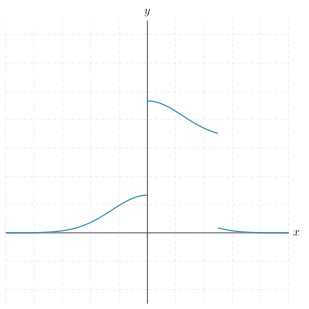
- \(\,\) \begin{align*} && \mathbb{P}(X \leq x) &= \int_{-\infty}^x f(x) \d x \\ &&&= \begin{cases} \frac13 \Phi(x) & \text{if } x < 0 \\ \frac13\Phi(x) + \frac13x & \text{if } 0 \leq x \leq 2 \\ \frac13 \Phi(x) + \frac23 & \text{if } 2 < x \end{cases} \end{align*} When \(\lambda = 2\), \(\mu = \frac{4}{6} = \frac23\), \(\sigma^2 = \frac{16+32+24+12}{12 \cdot 9} = \frac{7}{9}\), so \(\mu + 2 \sigma = \frac23 + \frac{2\sqrt7}{3}>2\). Therefore \begin{align*} && \P(0 < X < \mu + 2\sigma) &= \frac13 \Phi\left (\frac{2+2\sqrt{7}}{3} \right) + \frac23 - \Phi(0) \\ &&&= \tfrac13 \cdot 0.9921 +\tfrac23 - \tfrac12 \\ &&&= 0.4974 \end{align*}
2004 Paper 3 Q14
In this question, \(\Phi(z)\) is the cumulative distribution function of a standard normal random variable. A random variable is known to have a Normal distribution with mean \(\mu\) and standard deviation either \(\sigma_0\) or \(\sigma_1\), where \(\sigma_0 < \sigma_1\,\). The mean, \(\overline{X}\), of a random sample of \(n\) values of \(X\) is to be used to test the hypothesis \(\mathrm{H}_0: \sigma = \sigma_0\) against the alternative \(\mathrm{H}_1: \sigma = \sigma_1\,\). Explain carefully why it is appropriate to use a two sided test of the form: accept \(\mathrm{H}_0\) if \(\mu - c < \overline{X} < \mu+c\,\), otherwise accept \(\mathrm{H}_1\). Given that the probability of accepting \(\mathrm{H}_1\) when \(\mathrm{H}_0\) is true is \(\alpha\), determine \(c\) in terms of \(n\), \(\sigma_0\) and \(z_{\alpha}\), where \(z_\alpha \) is defined by \(\displaystyle\Phi(z_{\alpha}) = 1 - \tfrac{1}{2}\alpha\). The probability of accepting \(\mathrm{H}_0\) when \(\mathrm{H}_1\) is true is denoted by \(\beta\). Show that \(\beta\) is independent of \(n\). Given that \(\Phi(1.960)\approx 0.975\) and that \(\Phi(0.063) \approx 0.525\,\), determine, approximately, the minimum value of \(\displaystyle \frac{\sigma_1}{\sigma_0}\) if \(\alpha\) and \(\beta\) are both to be less than \(0.05\,\).
Solution: If \(\sigma\) is smaller we should expect our sample to have a mean closer to the true mean. Therefore we should use a two sided test which accepts \(\mathrm{H}_0\) if the mean is very close to the true mean. Suppose \(\textrm{H}_0\) is true, ie \(\sigma = \sigma_0\), then note that \(X \sim N(\mu, \frac{\sigma_0^2}{n})\) \begin{align*} && 1-\alpha &= \mathbb{P}(\mu - c < X < \mu + c) \\ &&&= \mathbb{P}(\mu - c < \frac{\sigma_0}{\sqrt{n}} Z + \mu < \mu + c) \\ &&&= \mathbb{P}(- \frac{c\sqrt{n}}{\sigma_0} < Z<\frac{\sqrt{n}c}{\sigma_0}) \\ &&&= \mathbb{P}(Z<\frac{\sqrt{n}c}{\sigma_0}) -\mathbb{P}( Z<-\frac{\sqrt{n}c}{\sigma_0}) \\ &&&= \mathbb{P}(Z<\frac{\sqrt{n}c}{\sigma_0}) -(1-\mathbb{P}( Z<\frac{\sqrt{n}c}{\sigma_0})) \\ &&&= 2\mathbb{P}(Z<\frac{\sqrt{n}c}{\sigma_0})-1 \\ \Rightarrow && \Phi(\frac{\sqrt{n}c}{\sigma_0})&=1 - \tfrac12 \alpha \\ \Rightarrow && \frac{\sqrt{n}c}{\sigma_0} &= z_{\alpha} \\ && c &= \frac{\sigma_0 z_{\alpha}}{\sqrt{n}} \end{align*} Under \(\mathrm{H}_1\), \(\sigma = \sigma_1\) so \begin{align*} && \beta &= \mathbb{P}(\mu - c < X < \mu + c) \\ &&&= \mathbb{P}(-\frac{c\sqrt{n}}{\sigma_1} < Z < \frac{\sqrt{n}c}{\sigma_1}) \\ &&&= \mathbb{P}(-\frac{\sigma_0}{\sigma_1} z_{\alpha}< Z < \frac{\sigma_0}{\sigma_1} z_{\alpha}) \\ &&&= 2\Phi(\frac{\sigma_0}{\sigma_1} z_{\alpha})-1 \end{align*} which does not depend on \(n\). Suppose both \(\alpha<0.05\) and \(\beta<0.05\), then \(z_{\alpha} > 1.96\) and \(\Phi(\frac{\sigma_0}{\sigma_1}1.96)<0.525 \Rightarrow \frac{\sigma_0}{\sigma_1}1.96 < 0.063 \Rightarrow \frac{\sigma_1}{\sigma_0} > \frac{1.96}{0.063} = 31.1 \) so the ratio of variances needs to be larger than \(31.1\).
2000 Paper 2 Q12
Tabulated values of \({\Phi}(\cdot)\), the cumulative distribution function of a standard normal variable, should not be used in this question. Henry the commuter lives in Cambridge and his working day starts at his office in London at 0900. He catches the 0715 train to King's Cross with probability \(p\), or the 0720 to Liverpool Street with probability \(1-p\). Measured in minutes, journey times for the first train are \(N(55,25)\) and for the second are \(N(65,16)\). Journey times from King's Cross and Liverpool Street to his office are \(N(30,144)\) and \(N(25,9)\), respectively. Show that Henry is more likely to be late for work if he catches the first train. Henry makes \(M\) journeys, where \(M\) is large. Writing \(A\) for \(1-{\Phi}(20/13)\) and \(B\) for \(1-{\Phi}(2)\), find, in terms of \(A\), \(B\), \(M\) and \(p\), the expected number, \(L\), of times that Henry will be late and show that for all possible values of \(p\), $$BM \le L \le AM.$$ Henry noted that in 3/5 of the occasions when he was late, he had caught the King's Cross train. Obtain an estimate of \(p\) in terms of \(A\) and \(B\). [A random variable is said to be \(N\left({{\mu}, {\sigma}^2}\right)\) if it has a normal distribution with mean \({\mu}\) and variance \({\sigma}^2\).]
Solution: If Henry catches the first train, his journey time is \(N(55+30,25+144) = N(85,13^2)\). He is on time if the journey takes less than \(105\) minutes, \(\frac{20}{13}\) std above the mean. If he catches the second train, his journey times is \(N(65+25, 16+9) = N(90, 5^2)\). He is on time if his journey takes less than \(80\) minutes, ie \(\frac{10}{5} = 2\) standard deviations above the mean. This is more likely than from the first train. \(A = 1 - \Phi(20/13)\) is the probability he is late from the first train. \(B = 1 - \Phi(2)\) is the probability he is late from the second train. The expected number of lates is \(L = M \cdot p \cdot A + M \cdot (1-p) \cdot B\), since \(B \leq A\) we must have \(BM \leq L \leq AM\) \begin{align*} && \frac35 &= \frac{pA}{pA + (1-p)B} \\ \Rightarrow && 3(1-p)B &= 2pA \\ \Rightarrow && p(2A+3B) &= 3B \\ \Rightarrow && p &= \frac{3B}{2A+3B} \end{align*}
1995 Paper 1 Q14
- Find the maximum value of \(\sqrt{p(1-p)}\) as \(p\) varies between \(0\) and \(1\).
- Suppose that a proportion \(p\) of the population is female. In order to estimate \(p\) we pick a sample of \(n\) people at random and find the proportion of them who are female. Find the value of \(n\) which ensures that the chance of our estimate of \(p\) being more than \(0.01\) in error is less than 1\%.
- Discuss how the required value of \(n\) would be affected if (a) \(p\) were the proportion of people in the population who are left-handed; (b) \(p\) were the proportion of people in the population who are millionaires.
Solution:
- \(\,\) \begin{align*} && \sqrt{p(1-p)} &= \sqrt{p-p^2} \\ &&&= \sqrt{\tfrac14-(\tfrac12-p)^2} \\ &&&\leq \sqrt{\tfrac14} = \tfrac12 \end{align*} Therefore the maximum is \(\tfrac12\) when \(p=\frac12\)
- Notice that our estimate \(\hat{p}\) will (for large \(n\)) be follow a normal distribution \(N(p, pq/n)\) by either the normal approximation to the binomial or central limit theorem. We would like \(0.01 > \mathbb{P}\left ( |\hat{p}-p| < 0.01 \right)\) or in other words \begin{align*} && 0.01 &> \mathbb{P}\left ( |\hat{p}-p| > 0.01 \right) \\ &&&=\mathbb{P}\left ( |\sqrt{\frac{pq}{n}}Z+p-p| > 0.01 \right) \\ &&&= \mathbb{P} \left (|Z|>\frac{0.01\sqrt{n}}{\sqrt{pq}}\right) \end{align*} therefore we need \(\frac{0.01\sqrt{n}}{\sqrt{pq}}> 2.58 \Rightarrow n > 258^2 pq \approx 2^{14} \approx 16\,000\), where we are using \(pq = \frac14\) as the worst case possibility and \(258 \approx 256 = 2^8\)
- If we were looking at when we are looking at left handed people (maybe ~\(10\%\), we would be looking at \(pq = \frac{9}{100}\) so we need a smaller sample). If we are looking at millionaires (an even smaller again percentage), we would need an even smaller sample. This is surprising since you would expect you would need a larger sample to accurately gauge smaller proportions. However, this surprise can be resolved by considering that this is an absolute error. For smaller values the relative error is larger, but the absolute error is smaller.
1995 Paper 2 Q14
Suppose \(X\) is a random variable with probability density \[ \mathrm{f}(x)=Ax^{2}\exp(-x^{2}/2) \] for \(-\infty < x < \infty.\) Find \(A\). You belong to a group of scientists who believe that the outcome of a certain experiment is a random variable with the probability density just given, while other scientists believe that the probability density is the same except with different mean (i.e. the probability density is \(\mathrm{f}(x-\mu)\) with \(\mu\neq0\)). In each of the following two cases decide whether the result given would shake your faith in your hypothesis, and justify your answer.
- A single trial produces the result 87.3.
- 1000 independent trials produce results having a mean value \(0.23.\)
Solution: Let \(Z \sim N(0,1)\), with a pdf of \(f(x) = \frac{1}{\sqrt{2\pi}} \exp(-x^2/2)\) \begin{align*} && 1 &= \int_{-\infty}^\infty Ax^2 \exp(-x^2/2) \d x \\ &&&= A\sqrt{2\pi} \int_{-\infty}^\infty x^2 \frac{1}{\sqrt{2\pi}} \exp(-x^2/2) \d x \\ &&&= A\sqrt{2\pi} \E[Z^2] = A\sqrt{2\pi} \\ \Rightarrow && A &= \frac{1}{\sqrt{2\pi}} \end{align*}
- The probability of seeing a result as extreme as \(87.3\) is \begin{align*} \mathbb{P}(X > 87.3) &= \frac{1}{\sqrt{2\pi}}\int_{87.3}^{\infty} x^2 \exp(-x^2/2) \d x \\ &= \left [ -\frac{1}{\sqrt{2\pi}}x \exp(-x^2/2)\right]_{87.3}^{\infty}+\int_{87.3}^{\infty}\frac{1}{\sqrt{2\pi}} \exp(-x^2/2) \d x \\ &\approx 0 +(1- \Phi(87.3)) \\ &\approx 0 \end{align*} It is very unlikely this data point has come from our distribution rather than one with a higher mean, therefore our faith is very shaken.
- If there are 1000 trials of this, we would expect the sample mean to be distributed according to the CLT. Each sample has mean \(0\) and variance \(\E[X^2] = \int_{-\infty}^\infty x^4 \frac{1}{\sqrt{2\pi}} \exp(-x^2/2) \d x = \E[Z^4] = 3\), therefore the sample mean is \(N(0, 3/1000)\). Therefore the probability of being \(0.23\) away is \begin{align*} && \mathbb{P}(S > 0.23) &= \mathbb{P}\left (Z > \frac{0.23}{\sqrt{3/1000}} \right) \\ &&&= \mathbb{P}\left (Z > \frac{0.23}{\sqrt{30}/100} \right) \\ &&&\approx \mathbb{P}\left (Z > \frac{0.23}{0.055} \right) \\ &&& \approx 0 \end{align*} again our faith should be shaken
1995 Paper 3 Q12
The random variables \(X\) and \(Y\) are independently normally distributed with means 0 and variances 1. Show that the joint probability density function for \((X,Y)\) is \[ \mathrm{f}(x,y)=\frac{1}{2\pi}\mathrm{e}^{-\frac{1}{2}(x^{2}+y^{2})}\qquad-\infty < x < \infty,-\infty < y < \infty. \] If \((x,y)\) are the coordinates, referred to rectangular axes, of a point in the plane, explain what is meant by saying that this density is radially symmetrical. The random variables \(U\) and \(V\) have a joint probability density function which is radially symmetrical (in the above sense). By considering the straight line with equation \(U=kV,\) or otherwise, show that \[ \mathrm{P}\left(\frac{U}{V} < k\right)=2\mathrm{P}(U < kV,V > 0). \] Hence, or otherwise, show that the probability density function of \(U/V\) is \[ \mathrm{g}(k)=\frac{1}{\pi(1+k^{2})}\qquad-\infty < k < \infty. \]
1993 Paper 3 Q16
The time taken for me to set an acceptable examination question it \(T\) hours. The distribution of \(T\) is a truncated normal distribution with probability density \(\f\) where \[ \mathrm{f}(t)=\begin{cases} \dfrac{1}{k\sigma\sqrt{2\pi}}\exp\left(-\dfrac{1}{2}\left(\dfrac{t-\sigma}{\sigma}\right)^{2}\right) & \mbox{ for }t\geqslant0\\ 0 & \mbox{ for }t<0. \end{cases} \] Sketch the graph of \(\f(t)\). Show that \(k\) is approximately \(0.841\) and obtain the mean of \(T\) as a multiple of \(\sigma\). Over a period of years, I find that the mean setting time is 3 hours.
- Find the approximate probability that none of the 16 questions on next year's paper will take more than 4 hours to set.
- Given that a particular question is unsatisfactory after 2 hours work, find the probability that it will still be unacceptable after a further 2 hours work.
1988 Paper 1 Q14
Let \(X\) be a standard normal random variable. If \(M\) is any real number, the random variable \(X_{M}\) is defined in terms of \(X\) by \[ X_{M}=\begin{cases} X & \mbox{if }X < M,\\ M & \mbox{if }X\geqslant M. \end{cases} \] Show that the expectation of \(X_{M}\) is given by \[ \mathrm{E}(X_{M})=-\phi(M)+M(1-\Phi(M)), \] where \(\phi\) is the probability density function, and \(\Phi\) is the cumulative distribution function of \(X\). Fifty times a year, 1024 tourists disembark from a cruise liner at the port of Slaka. From there they must travel to the capital either by taxi or by bus. Officials of HOGPo are equally likely to direct a tourist to the bus station or to the taxi rank. Each bus of the bus coorperative holds 31 passengers, and the coorperative currently runs 16 buses. The bus coorperative makes a profit of 1 vloska for each passenger carried. It carries all the passengers it can, with any excess being (eventually) transported by taxi. What is the largest annual bribe the bus coorperative should consider paying to HOGPo in order to be allowed to run an extra bus?
Solution: Let \(X \sim N(0,1)\), and $\displaystyle X_{M}=\begin{cases} X & \text{if }X < M,\\ M & \text{if }X\geqslant M. \end{cases} $. Then we can calculate: \begin{align*} \mathbb{E}[X_M] &= \int_{-\infty}^M xf_X(x)\,dx + M\mathbb{P}(X \geq M) \\ &= \int_{-\infty}^M x \frac1{\sqrt{2\pi}}e^{-\frac12x^2}\,dx + M\mathbb{P}(X \geq M) \\ &= \left [ -\frac{1}{\sqrt{2\pi}}e^{-\frac12x^2} \right ]_{-\infty}^M + M (1-\mathbb{P}(X < M)) \\ &= -\phi(M) + M(1-\Phi(M)) \end{align*} Let \(B \sim B\left (1024, \frac12 \right)\) be the number of potential bus passengers. Then \(B \approx N(512, 256) = N(512, 16^2)\) which is a good approximation since both \(np\) and \(nq\) are large. The question is asking us, how much additional profit would the bus company get if they ran an additional bus. Currently each week they is (on average) \(512\) passengers worth of demand, but they can only supply \(496\) seats, so we should expect that there is demand for another bus. The question is how much that demand is worth. Using the first part of the question, we can see that their profit is something like a `capped normal', \(X_M\), except we are scaled and with a different cap. So we are interested in $\displaystyle Y_{M}=\begin{cases} B & \mbox{if }B< M,\\ M & \mbox{if }B\geqslant M. \end{cases}\(, but since \)B \approx N\left (512,16^2\right)$ this is similar to \begin{align*} Y_{M}&=\begin{cases} 16X+512 & \mbox{if }16X+512< M,\\ M & \mbox{if }16X+512\geq M. \end{cases} \\ &= \begin{cases} 16X+512 & \mbox{if }X< \frac{M-512}{16},\\ M & \mbox{if }X \geq \frac{M-512}{16}. \end{cases} \\ &= 16X_{\frac{M-512}{16}} + 512\end{align*} We are interested in \(\mathbb{E}[Y_{16\times31}]\) and \(\mathbb{E}[Y_{17\times31}]\), which are \(16\mathbb{E}[X_{-1}]+512\) and \(16\mathbb{E}[Y_{\frac{15}{16}}]+512\) Since \(\frac{15}{16} \approx 1\), lets look at \(16(\mathbb{E}[X_1] - \mathbb{E}[X_{-1}])\) \begin{align*} \mathbb{E}[X_1] - \mathbb{E}[X_{-1}] &= \left ( -\phi(1) + 1-\Phi(1)\right) - \left ( - \phi(-1) -(1 - \Phi(-1)) \right ) \\ &= -\phi(1) + \phi(-1) + 1-\Phi(1) + 1 - \Phi(-1) \\ &= 1 - \Phi(1) + \Phi(1) \\ &= 1 \end{align*} Therefore the extra \(31\) will fill roughly \(16\) of them. (This is a slight overestimate, which is worth bearing in mind). A better approximation might be that \(\mathbb{E}[X_t] - \mathbb{E}[X_{-1}] = \frac{t +1}{2}\) for \(t \approx 1\), (since we want something increasing). This would give us an approximation of \(15.5\), which is very close to the `true' answer. Therefore, over \(50\) bus runs, we should earn roughly \(800\) vloska extra from an additional bus. (Again an overestimate, and with an uncertain pay-off, they should consider offering maybe \(600\)). Since this is the future, we can quite easily calculate the exact values using the binomial distribution on a computer. This gives the true value as \(15.833\), and so they should pay up to \(791\)