Problems
Filters
4 problems found
2005 Paper 1 Q9
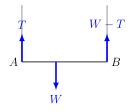
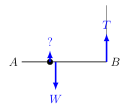
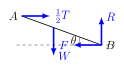
A non-uniform rod \(AB\) has weight \(W\) and length \(3l\). When the rod is suspended horizontally in equilibrium by vertical strings attached to the ends \(A\) and \(B\), the tension in the string attached to \(A\) is \(T\). When instead the rod is held in equilibrium in a horizontal position by means of a smooth pivot at a distance \(l\) from \(A\) and a vertical string attached to \(B\), the tension in the string is \(T\). Show that \(5T = 2W\). When instead the end \(B\) of the rod rests on rough horizontal ground and the rod is held in equilibrium at an angle \(\theta\) to the horizontal by means of a string that is perpendicular to the rod and attached to \(A\), the tension in the string is \(\frac12 T\). Calculate \(\theta\) and find the smallest value of the coefficient of friction between the rod and the ground that will prevent slipping.
Solution:
1991 Paper 2 Q13
A non-uniform rod \(AB\) of mass \(m\) is pivoted at one end \(A\) so that it can swing freely in a vertical plane. Its centre of mass is a distance \(d\) from \(A\) and its moment of inertia about any axis perpendicular to the rod through \(A\) is \(mk^{2}.\) A small ring of mass \(\alpha m\) is free to slide along the rod and the coefficient of friction between the ring and rod is \(\mu.\) The rod is initially held in a horizontal position with the ring a distance \(x\) from \(A\). If \(k^{2} > xd\), show that when the rod is released, the ring will start to slide when the rod makes an angle \(\theta\) with the downward vertical, where \[ \mu\tan\theta=\frac{3\alpha x^{2}+k^{2}+2xd}{k^{2}-xd}. \] Explain what will happen if (i) \(k^{2}=xd\) and (ii) \(k^{2} < xd\).
1990 Paper 2 Q13
A thin non-uniform rod \(PQ\) of length \(2a\) has its centre of gravity a distance \(a+d\) from \(P\). It hangs (not vertically) in equilibrium suspended from a small smooth peg \(O\) by means of a light inextensible string of length \(2b\) which passes over the peg and is attached at its ends to \(P\) and \(Q\). Express \(OP\) and \(OQ\) in terms of \(a,b\) and \(d\). By considering the angle \(POQ\), or otherwise, show that \(d < a^{2}/b\).
Solution:

1989 Paper 2 Q13
A body of mass \(m\) and centre of mass \(O\) is said to be dynamically equivalent to a system of particles of total mass \(m\) and centre of mass \(O\) if the moment of inertia of the system of particles is the same as the moment of inertia of the body, about any axis through \(O\). Show that this implies that the moment of inertia of the system of particles is the same as that of the body about any axis. Show that a uniform rod of length \(2a\) and mass \(m\) is dynamically equivalent to a suitable system of three particles, one at each end of the rod, and one at the midpoint. Use this result to deduce that a uniform rectangular lamina of mass \(M\) is dynamically equivalent to a system consisting of particles each of mass \(\frac{1}{36}M\) at the corners, particles each of mass \(\frac{1}{9}M\) at the midpoint of each side, and a particle of mass \(\frac{4}{9}M\) at the centre. Hence find the moment of inertia of a square lamina, of side \(2a\) and mass \(M,\) about one of its diagonals. The mass per unit length of a thin rod of mass \(m\) is proportional to the distance from one end of the rod, and a dynamically equivalent system consists of one particle at each end of the rod and one at the midpoint. Write down a set of equations which determines these masses, and show that, in fact, only two particles are required.
Solution: This follows from the parallel axis theorem. The moment of inertia of both the system and the body will be equal to the moment of inertia about the axis through the centre of mass plus the distance from the axis. Suppose we have an axis through the centre of the rod, then consider the coordinate frame with the axis and as the \(y\) axis and the intersection between rod and axis at the origin. Suppose the angle between the rod and the \(x\) axis is \(\theta\) Then the moment of inertia for the rod will be: \begin{align*} \int_{-a}^a\frac{M}{2a} x^2 \cos^2 \theta \d x &= \frac{M}{2a}\frac23 a^3 \cos^2 \theta \\ &= \frac13 M \cos^2 \theta a^2 \end{align*} Suppose we put a weights of mass \(\frac16\) at where the end of the rod would be, and a weight of mass \(\frac23\) at the centre, then the moment of inertial would be: \begin{align*} I &= \frac23M \cdot 0^2 + \frac16M (a \cos \theta)^2+\frac16 (a \cos \theta)^2 \\ &= \frac13 M \cos^2 \theta a^2 \end{align*} Therefore it has the same mass (\(M\)), centre of mass (\(O\)) and moment of inertia for any axis through the COM so the two systems are dynamically equivalent. A uniform lamina can be broken down into a system with a rod of mass \(\frac23 M\) through the middle parallel to one side and rods of mass \(\frac16 M\) on each of those parallel sides. Those rods are then equivalent to a particle at the centre mass \(\frac23 \cdot \frac23 M = \frac49 M\) a mass at the centre of those sides of mass \(\frac23 \cdot \frac 16 M = \frac19 M\), a mass at the centre of the parallel sides of mass \(\frac16 \cdot \frac23 M = \frac 19 M\) and masses at the corners of mass \(\frac16 \cdot \frac16 M = \frac1{36} M\) The moment of inertia of a square lamina side length \(2a\) mass \(M\) about a diagonal through the centre will be: \begin{align*} I &= \sum_{\text{points}} md^2 \\ &= 2 \cdot \frac1{36}M \cdot \frac12 (2a)^2 \\ &= \frac19 Ma^2 \end{align*} Suppose the rod is on \([0, 1]\), then we must have: \(\displaystyle \int_0^1 \rho x \d x = m \Rightarrow \rho = 2m\). The centre of mass will be at: \begin{align*} \overline{x} &= \frac1m \int_0^1 2m x^2 \d x \\ &= \frac23 \end{align*} The moment of inertial for a line through \((\frac23, 0)\) with angle \(\theta\) will be: \begin{align*} I &= \int_0^12mx \l\frac23 - x \r^2\cos^2 \theta \d x \\ &= 2m\cos^2 \theta \cdot \frac1{36} \\ &= \frac1{18}m \cos^2 \theta \end{align*} Therefore if the particles have mass \(m_0, m_{1/2}, m_1\) we must have: \begin{align*} &&m &= m_0 + m_{1/2} + m_1 \\ &&\frac23m &= \frac12 m_{1/2} + m_1 \\ &&\frac1{18}m \cos^2 \theta &= m_0\frac49 \cos^2 \theta + m_{1/2}\frac1{36} \cos^2 \theta + m_1 \frac1{9} \cos^2 \theta \\ \Rightarrow && m &= 8 m_0 +\frac12 m_{1/2}+2m_1 \\ \Rightarrow && m_0 &= 0 \\ && m_{1/2} &= \frac23 \\ && m_1 &= \frac13 \end{align*} Since \(m_0 = 0\) the particle at the "thin" end of the rod could be ignored.