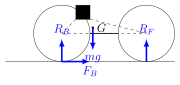
The axles of the wheels of a motorbike of mass \(m\) are a distance \(b\) apart. Its centre of mass is a horizontal distance of \(d\) from the front axle, where \(d < b\), and a vertical distance \(h\) above the road, which is horizontal and straight.
The engine is connected to the rear wheel.
The coefficient of friction between the ground and the rear wheel is \(\mu\), where \(\mu < b/h\), and the front wheel is smooth.
You may assume that the sum of the moments of the forces acting on the motorbike about the centre of mass is zero. By taking moments about the centre of mass show that, as the acceleration of the motorbike increases from zero, the rear wheel will slip before the front wheel loses contact with the road if
\[
\mu < \frac {b-d}h\,.
\tag{*}
\]
If the inequality \((*)\) holds and the rear wheel does not slip, show that the maximum acceleration is
\[
\frac{ \mu dg}{b-\mu h}
\,.
\]
If the inequality \((*)\) does not hold, find the maximum acceleration given that the front wheel remains in contact with the road.
Solution:
\begin{align*}
% \text{N2}(\uparrow): && R_B+ R_F &= mg \\
\overset{\curvearrowright}{G}: && -R_Fd - F_B h + R_B (b-d) &= 0 \\
\Rightarrow && -d R_F - \mu h R_B +R_B(b-d) &= 0 \\
\Rightarrow && R_B(b-d-\mu h) &= d R_F \\
\underbrace{\Rightarrow}_{R_F > 0 \text{ if not leaving ground}} && R_B(b-d-\mu h) & > 0 \\
\Rightarrow && \frac{b-d}{h} > \mu
\end{align*}
The acceleration is \(\frac{F_B}{m}\), so we wish to maximize \(F_B\) which is the same as maximising \(R_B\). Since the bike will slip before the front wheel lifts, we want the bike to be on the point of slipping, ie $$
\begin{align*}
&& R_B(b-d-\mu h) &= d R_F \\
\text{N2}(\uparrow): && R_B + R_F &= mg \\
\Rightarrow && R_B(b-d-\mu h) &= d(mg - R_B) \\
\Rightarrow && R_B(b-\mu h) &= dmg \\
\Rightarrow && R_B &= \frac{dmg}{b-\mu h} \\
\Rightarrow && a &= \frac{F_B}{m} \\
&&&= \frac{\mu R_B}{m} \\
&&&= \frac{\mu dg}{b-\mu h} \\
\end{align*}
If the inequality doesn't hold, we want to be at the point just before \(R_F = 0\), since that gives us maximum friction at \(F_B\), ie
\begin{align*}
&& R_B &= mg \\
\Rightarrow && a &= \frac{F_B}{m} \\
&&&= \frac{\mu mg}{m} \\
&&&= \mu g
\end{align*}