Problems
Filters
9 problems found
2025 Paper 3 Q2
Let \(f(x) = 7 - 2|x|\). A sequence \(u_0, u_1, u_2, \ldots\) is defined by \(u_0 = a\) and \(u_n = f(u_{n-1})\) for \(n > 0\).
- Sketch, on the same axes, the graphs with equations \(y = f(x)\) and \(y = f(f(x))\).
- Find all solutions of the equation \(f(f(x)) = x\).
- Find the values of \(a\) for which the sequence \(u_0, u_1, u_2, \ldots\) has period 2.
- Show that, if \(a = \frac{28}{5}\), then the sequence \(u_2, u_3, u_4, \ldots\) has period 2, but neither \(u_0\) or \(u_1\) is equal to either of \(u_2\) or \(u_3\).
- Sketch, on the same axes, the graphs with equations \(y = f(x)\) and \(y = f(f(f(x)))\).
- Consider the sequence \(u_0, u_1, u_2, \ldots\) in the cases \(a = 1\) and \(a = -\tfrac79\). Hence find all the solutions of the equation \(f(f(f(x))) = x\).
- Find a value of \(a\) such that the sequence \(u_3, u_4, u_5, \ldots\) has period 3, but where none of \(u_0, u_1\) or \(u_2\) is equal to any of \(u_3, u_4\) or \(u_5\).
Solution:

- If \(a = 1\) then \(u_1 = f(a) = 7-2 = 5\), \(u_2 = f(5) = -3\), \(u_3 = f(-3) = 7-6 = 1\). Therefore it must be the case that \(f(f(f(x))) = x\) for \(x = 1, 5, -3\). Similarly, if \(a = -\tfrac79\) then \(u_1 = f(-\tfrac79) = \tfrac{49}{9}\), \(u_2 = f(\tfrac{49}{9}) = -\tfrac{35}{9}\) and \(u_3 = f(-\tfrac{35}{9}) = -\tfrac79\). Therefore we must also have roots \(x = -\tfrac79, \tfrac{49}{9}, -\tfrac{35}9\). We also have the roots \(x = -7, \tfrac73\) from the first part so we have found all \(8\) roots.
- We need \(f(f(f(x))) = 1\) but \(f(f(x)) \neq -3, f(x) \neq 5, x \neq 1\). Suppose \(f(y) = 1 \Rightarrow 7-2|y| = 1 \Rightarrow y = \pm 3\). So \(y = 3\), ie \(f(f(x)) = 3\). Suppose \(f(z) = 3 \Rightarrow 7-2|z| = 3 \Rightarrow z = \pm 2\). Finally we need \(f(x) = \pm 2\), so say \(7-2|x| = 2 \Rightarrow x = \tfrac52\), so we have the sequence \(\tfrac52, 2, 3, 1, 5, -3, 1, \cdots\)as required.
2024 Paper 3 Q2
- Solve the inequalities
- \(\sqrt{4x^2 - 8x + 64} \leqslant |x+8|\,\),
- \(\sqrt{4x^2 - 8x + 64} \leqslant |3x-8|\,\).
- Let \(\mathrm{f}(x) = \sqrt{4x^2 - 8x + 64} - 2(x-1)\). Show, by considering \(\bigl(\sqrt{4x^2 - 8x + 64} + 2(x-1)\bigr)\mathrm{f}(x)\) or otherwise, that \(\mathrm{f}(x) \to 0\) as \(x \to \infty\).
- Sketch \(y = \sqrt{4x^2 - 8x + 64}\) and \(y = 2(x-1)\) on the same axes.
- Find a value of \(m\) and the corresponding value of \(c\) such that the solution set of the inequality \[\sqrt{4x^2 - 5x + 4} \leqslant |mx + c|\] is \(\{x : x \geqslant 3\}\).
- Find values of \(p\), \(q\), \(m\) and \(c\) such that the solution set of the inequality \[|x^2 + px + q| \leqslant mx + c\] is \(\{x : -5 \leqslant x \leqslant 1\} \cup \{x : 5 \leqslant x \leqslant 7\}\).
2023 Paper 3 Q8
If \[y = \begin{cases} \mathrm{k}_1(x) & x \leqslant b \\ \mathrm{k}_2(x) & x \geqslant b \end{cases}\] with \(\mathrm{k}_1(b) = \mathrm{k}_2(b)\), then \(y\) is said to be \emph{continuously differentiable} at \(x = b\) if \(\mathrm{k}_1'(b) = \mathrm{k}_2'(b)\).
- Let \(\mathrm{f}(x) = x\mathrm{e}^{-x}\). Verify that, for all real \(x\), \(y = \mathrm{f}(x)\) is a solution to the differential equation \[\frac{\mathrm{d}^2 y}{\mathrm{d}x^2} + 2\frac{\mathrm{d}y}{\mathrm{d}x} + y = 0\] and that \(y = 0\) and \(\dfrac{\mathrm{d}y}{\mathrm{d}x} = 1\) when \(x = 0\). Show that \(\mathrm{f}'(x) \geqslant 0\) for \(x \leqslant 1\).
- You are given the differential equation \[\frac{\mathrm{d}^2 y}{\mathrm{d}x^2} + 2\left|\frac{\mathrm{d}y}{\mathrm{d}x}\right| + y = 0\] where \(y = 0\) and \(\dfrac{\mathrm{d}y}{\mathrm{d}x} = 1\) when \(x = 0\). Let \[y = \begin{cases} \mathrm{g}_1(x) & x \leqslant 1 \\ \mathrm{g}_2(x) & x \geqslant 1 \end{cases}\] be a solution of the differential equation which is continuously differentiable at \(x = 1\). Write down an expression for \(\mathrm{g}_1(x)\) and find an expression for \(\mathrm{g}_2(x)\).
- State the geometrical relationship between the curves \(y = \mathrm{g}_1(x)\) and \(y = \mathrm{g}_2(x)\).
- Prove that if \(y = \mathrm{k}(x)\) is a solution of the differential equation \[\frac{\mathrm{d}^2 y}{\mathrm{d}x^2} + p\frac{\mathrm{d}y}{\mathrm{d}x} + qy = 0\] in the interval \(r \leqslant x \leqslant s\), where \(p\) and \(q\) are constants, then, in a suitable interval which you should state, \(y = \mathrm{k}(c - x)\) satisfies the differential equation \[\frac{\mathrm{d}^2 y}{\mathrm{d}x^2} - p\frac{\mathrm{d}y}{\mathrm{d}x} + qy = 0\,.\]
- You are given the differential equation
\[\frac{\mathrm{d}^2 y}{\mathrm{d}x^2} + 2\left|\frac{\mathrm{d}y}{\mathrm{d}x}\right| + 2y = 0\]
where \(y = 0\) and \(\dfrac{\mathrm{d}y}{\mathrm{d}x} = 1\) when \(x = 0\).
Let \(\mathrm{h}(x) = \mathrm{e}^{-x}\sin x\). Show that \(\mathrm{h}'\!\left(\frac{1}{4}\pi\right) = 0\).
It is given that \(y = \mathrm{h}(x)\) satisfies the differential equation in the interval \(-\frac{3}{4}\pi \leqslant x \leqslant \frac{1}{4}\pi\) and that \(\mathrm{h}'(x) \geqslant 0\) in this interval.
In a solution to the differential equation which is continuously differentiable at \((n + \frac{1}{4})\pi\) for all \(n \in \mathbb{Z}\), find \(y\) in terms of \(x\) in the intervals
- \(\frac{1}{4}\pi \leqslant x \leqslant \frac{5}{4}\pi\),
- \(\frac{5}{4}\pi \leqslant x \leqslant \frac{9}{4}\pi\).
2022 Paper 2 Q4
- Show that the function \(\mathrm{f}\), given by the single formula \(\mathrm{f}(x) = |x| - |x-5| + 1\), can be written without using modulus signs as \[\mathrm{f}(x) = \begin{cases} -4 & x \leqslant 0\,,\\ 2x - 4 & 0 \leqslant x \leqslant 5\,,\\ 6 & 5 \leqslant x\,.\end{cases}\] Sketch the graph with equation \(y = \mathrm{f}(x)\).
- The function \(\mathrm{g}\) is given by: \[\mathrm{g}(x) = \begin{cases} -x & x \leqslant 0\,,\\ 3x & 0 \leqslant x \leqslant 5\,,\\ x + 10 & 5 \leqslant x\,.\end{cases}\] Use modulus signs to write \(\mathrm{g}(x)\) as a single formula.
- Sketch the graph with equation \(y = \mathrm{h}(x)\), where \(\mathrm{h}(x) = x^2 - x - 4|x| + |x(x-5)|\).
- The function \(\mathrm{k}\) is given by: \[\mathrm{k}(x) = \begin{cases} 10x & x \leqslant 0\,,\\ 2x^2 & 0 \leqslant x \leqslant 5\,,\\ 50 & 5 \leqslant x\,.\end{cases}\] Use modulus signs to write \(\mathrm{k}(x)\) as a single formula, explicitly verifying that your formula is correct.
2014 Paper 2 Q7
- The function \(\f\) is defined by \(\f(x)= |x-a| + |x-b| \), where \(a < b\). Sketch the graph of \(\f(x)\), giving the gradient in each of the regions \(x < a\), \(a < x < b\) and \(x > b\). Sketch on the same diagram the graph of \(\g(x)\), where \(\g(x)= |2x-a-b|\). What shape is the quadrilateral with vertices \((a,0)\), \((b,0)\), \((b,\f(b))\) and \((a, \f(a))\)?
- Show graphically that the equation \[ |x-a| + |x-b| = |x-c|\,, \] where \(a < b\), has \(0\), \(1\) or \(2\) solutions, stating the relationship of \(c\) to \(a\) and \(b\) in each case.
- For the equation \[ |x-a| + |x-b| = |x-c|+|x-d|\,, \] where \(a < b\), \(c < d\) and \(d-c < b-a\), determine the number of solutions in the various cases that arise, stating the relationship between \(a\), \(b\), \(c\) and \(d\) in each case.
Solution:
- \(\,\)
\((a,0)\), \((b,0)\), \((b,\f(b))\) and \((a, \f(a))\) forms a rectangle.

- There are no solutions if \(a < c < b\):
There is one solution if \(a=c\) or \(a = b\)
 And there are two solution if \(c \not \in [a,b]\)
 There is exactly one solution unless....
 ... there are infinitely many solutions when the gradients line up perfectly, ie when \(a+b=c+d\)

2006 Paper 1 Q7
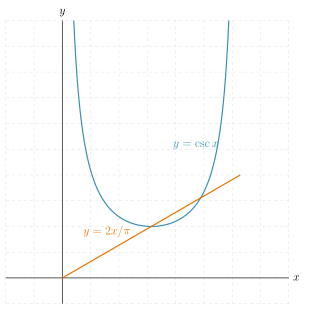
- Sketch on the same axes the functions \({\rm cosec}\, x\) and \(2x/ \pi\), for \(0 < x < \pi\,\). Deduce that the equation \(x\sin x = \pi/2 \) has exactly two roots in the interval \(0 < x < \pi\,\). Show that \[ \displaystyle \int_{\pi/2}^{\pi} \left \vert x\sin x - \frac{\pi} { 2} \right \vert \; \mathrm{d}x = 2\sin\alpha +\frac{3\pi^2} 4 - \alpha \pi -\pi -2\alpha \cos\alpha -1 \] where \(\alpha\) is the larger of the roots referred to above.
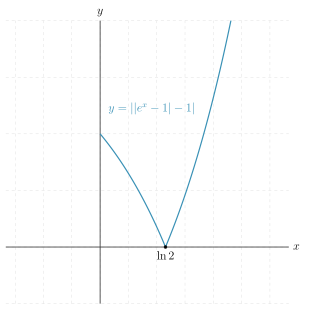
- Show that the region bounded by the positive \(x\)-axis, the \(y\)-axis and the curve \[y = \Bigl| \vert \e^x - 1 \vert - 1 \Bigr|\] has area \(\ln 4-1\).
Solution:
- \(\,\)
Notice that they are equal at \(1\) when \(x = \pi/2\), but this is a local minimum for \(\csc x\) whereas \(2x/\pi\) is increasing so there is a second intersection. Notice that \(\csc x = \frac{2x}{\pi} \Leftrightarrow x \sin x = \frac{\pi}{2}\) therefore our intersections are also the roots of \(x \sin x = \frac{\pi}{2}\) and the larger one is greater than \(\pi/2\) \begin{align*} && I &= \int_{\pi/2}^{\pi} \Bigl| x \sin x - \frac{\pi}{2} \Bigr| \d x \\ &&&= \int_{\pi/2}^{\alpha} \left ( x \sin x - \frac{\pi}{2} \right )\d x +\int_{\alpha}^{\pi} \left ( \frac{\pi}{2} -x \sin x \right) \d x \\ &&&= \left ( \pi - 2\alpha + \frac{\pi}{2}\right) \frac{\pi}{2} + \int_{\pi/2}^{\alpha} x \sin x\d x -\int_{\alpha}^{\pi} x \sin x \d x \\ &&&= \frac{3\pi^2}{4} - \alpha \pi + \left [-x \cos x \right]_{\pi/2}^{\alpha}+\left[x \cos x \right]_{\alpha}^{\pi} + \int_{\pi/2}^{\alpha} \cos x \d x - \int_{\alpha}^{\pi} \cos x \d x \\ &&&= \frac{3\pi^2}{4} - \alpha \pi -\alpha \cos \alpha -\pi -\alpha \cos \alpha+ \sin \alpha - 1+\sin \alpha \\ &&&= 2\sin \alpha + \frac{3\pi^2}{4} - \alpha \pi - 2\alpha \cos \alpha - 1 \end{align*}
- \(\,\)
\begin{align*} && A &= \int_0^{\ln 2} ||e^x-1|-1| \d x \\ &&&= \int_0^{\ln 2} |e^x-2| \d x \\ &&&=\int_0^{\ln 2} (2-e^x) \d x \\ &&&= 2 \ln 2 - \left [e^x \right]_0^{\ln 2} \\ &&&= \ln 4 - (2-1) = \ln 4 - 1 \end{align*}
1999 Paper 1 Q4
Sketch the following subsets of the \(x\)-\(y\) plane:
- \(|x|+|y|\le 1\) ;
- \(|x-1|+|y-1|\le 1 \) ;
- \(|x-1|-|y+1|\le 1 \) ;
- \(|x|\, |y-2|\le 1\) .
Solution:


1997 Paper 1 Q4
Find all the solutions of the equation \[|x+1|-|x|+3|x-1|-2|x-2|=x+2.\]
Solution: Case 1: \(x \leq -1\) \begin{align*} && -1-x+x-3(x-1)+2(x-2) &= x + 2 \\ \Leftrightarrow && -x-2 &= x + 2 \\ \Leftrightarrow && x = -2 \end{align*} Case \(-1 < x \leq 0\): \begin{align*} && x+1+x-3(x-1)+2(x-2) &= x + 2 \\ \Leftrightarrow && x&= x + 2 \\ \end{align*} No solutions Case \(0 < x \leq 1\): \begin{align*} && x+1-x-3(x-1)+2(x-2) &= x + 2 \\ \Leftrightarrow && -x&= x + 2 \\ \end{align*} No solutions Case \(1 < x \leq 2\): \begin{align*} && x+1-x+3(x-1)+2(x-2) &= x + 2 \\ \Leftrightarrow && 5x-6&= x + 2 \\ \Leftrightarrow && x = 2 \end{align*} Case \(2 < x\): \begin{align*} && x+1-x+3(x-1)-2(x-2) &= x + 2 \\ \Leftrightarrow && x+2&= x + 2 \\ \end{align*} Therefore the solutions are \(x \in \{-2\} \cup [2, \infty)\)
1991 Paper 3 Q3
The function \(\mathrm{f}\) is defined for \(x<2\) by \[ \mathrm{f}(x)=2| x^{2}-x|+|x^{2}-1|-2|x^{2}+x|. \] Find the maximum and minimum points and the points of inflection of the graph of \(\mathrm{f}\) and sketch this graph. Is \(\mathrm{f}\) continuous everywhere? Is \(\mathrm{f}\) differentiable everywhere? Find the inverse of the function \(\mathrm{f}\), i.e. expressions for \(\mathrm{f}^{-1}(x),\) defined in the various appropriate intervals.
Solution: \[ f(x) = 2|x(x-1)| + |(x-1)(x+1)|-2|x(x+1)| \] Therefore the absolute value terms will change behaviour at \(x = -1, 0, 1\). Then \begin{align*} f(x) &= \begin{cases} 2(x^2-x)+(x^2-1)-2(x^2+x) & x \leq -1 \\ 2(x^2-x)-(x^2-1)+2(x^2+x) & -1 < x \leq 0 \\ -2(x^2-x)-(x^2-1)-2(x^2+x) & 0 < x \leq 1 \\ 2(x^2-x)+(x^2-1)-2(x^2+x) & 1 < x\end{cases} \\ &= \begin{cases} x^2-4x-1 & x \leq -1 \\ 3x^2+1& -1 < x \leq 0 \\ -5x^2+1& 0 < x \leq 1 \\ x^2-4x-1 & 1 < x\end{cases} \\ \\ f'(x) &= \begin{cases} 2x-4 & x <-1 \\ 6x & -1 < x < 0 \\ -10x & 0 < x < 1 \\ 2x-4 & 1 < x\end{cases} \\ \end{align*} Therefore \(f'(x) = 0 \Rightarrow x = 0, 2\) and so we should check all the turning points. Therefore the minimum is \(x = 2, y = -5\), maximum is \(x = -2, y = 11\) (assuming the range is actually \(|x| < 2\). There is a point of inflection at \(x = 0, y = 1\).
