Problems
Filters
2 problems found
2025 Paper 2 Q12
D: 1500.0
B: 1500.0
Poisson distribution
probability
sequences
mode of distribution
inequality
curve sketching
difference sequence
optimisation
Let \(X\) be a Poisson random variable with mean \(\lambda\) and let \(p_r = P(X = r)\), for \(r = 0, 1, 2, \ldots\). Neither \(\lambda\) nor \(\lambda + \frac{1}{2} + \sqrt{\lambda + \frac{1}{4}}\) is an integer.
- Show, by considering the sequence \(d_r \equiv p_r - p_{r-1}\) for \(r = 1, 2, \ldots\), that there is a unique integer \(m\) such that \(P(X = r) \leq P(X = m)\) for all \(r = 0, 1, 2, \ldots\), and that \[\lambda - 1 < m < \lambda.\]
- Show that the minimum value of \(d_r\) occurs at \(r = k\), where \(k\) is such that \[k < \lambda + \frac{1}{2} + \sqrt{\lambda + \frac{1}{4}} < k + 1.\]
- Show that the condition for the maximum value of \(d_r\) to occur at \(r = 1\) is \[1 < \lambda < 2 + \sqrt{2}.\]
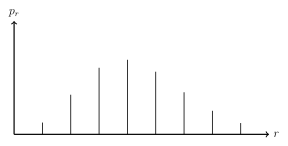
- In the case \(\lambda = 3.36\), sketch a graph of \(p_r\) against \(r\) for \(r = 0, 1, 2, \ldots, 6, 7\).
Solution:
- Suppose \(d_r = p_r - p_{r-1}\) then \begin{align*} d_r &= p_r - p_{r-1} \\ &= \mathbb{P}(X = r) - \mathbb{P}(X = r-1) \\ &= e^{-\lambda} \left ( \frac{\lambda^r}{r!} - \frac{\lambda^{r-1}}{(r-1)!} \right) \\ &= e^{-\lambda} \frac{\lambda^{r-1}}{(r-1)!} \left ( \frac{\lambda}{r} - 1\right) \end{align*} Therefore \(d_r > 0 \Leftrightarrow \lambda > r\)ie, \(p_r\) is increasing while \(r < \lambda\) and reaches a (unique) maximum when \(r = \lfloor \lambda \rfloor\).
- Let \(dd_r = d_r - d_{r-1}\), so: \begin{align*} dd_r &= d_r - d_{r-1} \\ &= p_r - 2p_{r-1} + p_{r-2} \\ &= e^{-\lambda} \frac{\lambda^{r-2}}{r!} \left ( \lambda^2 - 2 \lambda r + r(r-1)\right ) \end{align*} Therefore \(dd_r < 0 \Leftrightarrow \lambda^2 - 2\lambda r +r(r-1) < 0 \Leftrightarrow r^2 -(1+2\lambda)r + \lambda^2 < 0\), but this has roots \(r = \frac{(1+2\lambda) \pm \sqrt{(1+2\lambda)^2-4\lambda^2}}{2} = \lambda + \frac12 \pm \sqrt{\lambda + \frac14}\). Therefore \(d_r\) is decreasing when \(r \in \left (\lambda + \frac12 -\sqrt{\lambda + \frac14},\lambda + \frac12 + \sqrt{\lambda + \frac14} \right)\), therefore the possible minimums are \(d_1\) and \(d_k\) where \(k < \lambda + \frac{1}{2} + \sqrt{\lambda + \frac{1}{4}} < k + 1\). \(d_1 = e^{-\lambda}(\lambda - 1)\), \(d_k = e^{-\lambda} \frac{\lambda^{k-1}}{(k-1)!}(\frac{\lambda}{k}-1)\)
- If the maximum value of \(d_r\) is \(r = 1\) then \(d_r\) must be decreasing, ie considering \(dd_2\) we have \(\lambda^2 -4\lambda + 2< 0 \Leftrightarrow 2 - \sqrt{2} < \lambda < 2 + \sqrt{2}\). It must also be the case that it doesn't get beaten as \(\lambda \to \infty\). In this case \(d_r \to 0\), so we need \(d_1 > 0\), ie \(\lambda > 1\). Therefore \(1 < \lambda < 2 + \sqrt{2}\)
2011 Paper 3 Q13
D: 1700.0
B: 1500.0
probability
binomial distribution
hypergeometric distribution
mode of distribution
ratio of probabilities
floor function
sampling with replacement
sampling without replacement
In this question, the notation \(\lfloor x \rfloor\) denotes the greatest integer less than or equal to \(x\), so for example \(\lfloor \pi\rfloor = 3\) and \(\lfloor 3 \rfloor =3\).
- A bag contains \(n\) balls, of which \(b\) are black. A sample of \(k\) balls is drawn, one after another, at random with replacement. The random variable \(X\) denotes the number of black balls in the sample. By considering \[ \frac{\P(X=r+1)}{\P(X=r)}\,, \] show that, in the case that it is unique, the most probable number of black balls in the sample is \[ \left\lfloor \frac{(k+1)b}{n}\right\rfloor. \] Under what circumstances is the answer not unique?
- A bag contains \(n\) balls, of which \(b\) are black. A sample of \(k\) balls (where \(k\le b\)) is drawn, one after another, at random without replacement. Find, in the case that it is unique, the most probable number of black balls in the sample. Under what circumstances is the answer not unique?
Solution:
- \(\mathbb{P}(X = r) = \binom{k}{r}p^rq^{k-r}\) where \(p = \frac{b}{n}, q = 1-p\). Therefore \begin{align*} && \frac{\mathbb{P}(X=r+1)}{\mathbb{P}(X=r)} &= \frac{\binom{k}{r+1}p^{r+1}q^{k-r-1}}{\binom{k}{r}p^rq^{k-r}} \\ &&&= \frac{(k-r)p}{(r+1)q} \\ &&&= \frac{(k-r)b}{(r+1)(n-b)} \end{align*} Comparing this to \(1\) we find: \begin{align*} && 1 & < \frac{\mathbb{P}(X=r+1)}{\mathbb{P}(X=r)} \\ \Leftrightarrow && 1 &< \frac{(k-r)b}{(r+1)(n-b)} \\ \Leftrightarrow && (r+1)(n-b) &<(k-r)b \\ \Leftrightarrow && rn& < (k+1)b - n \\ \Leftrightarrow && r &< \frac{(k+1)b}{n} - 1\\ \end{align*} If this equation is true, then \(\mathbb{P}(X=r+1)\) is larger, so \(r_{max} = \left \lfloor \frac{(k+1)b}{n} \right \rfloor\)
- Let \(Y\) be the number of black balls in our sample, ie \(\mathbb{P}(Y = r) = \binom{b}{r}\binom{n-b}{k-r}/\binom{n}{k}\), so \begin{align*} && \frac{\mathbb{P}(Y = r+1)}{\mathbb{P}(Y=r)} &= \frac{\binom{b}{r+1}\binom{n-b}{k-(r+1)}/\binom{n}{k}}{\binom{b}{r}\binom{n-b}{k-r}/\binom{n}{k}} \\ &&&= \frac{b-r}{r+1} \frac{k-r}{n-b-k+r+1} \\ && 1 &< \frac{\mathbb{P}(Y = r+1)}{\mathbb{P}(Y=r)} \\ \Leftrightarrow && (r+1)(n-b-k+r+1) &< (b-r)(k-r) \\ \Leftrightarrow &&r(n-b-k+1)+(n-b-k+1) &< -r(b+k)+bk \\ \Leftrightarrow &&r(n+1) &< bk+b+k+1-n \\ \Leftrightarrow && r &< \frac{(b+1)(k+1)}{n+1} - \frac{n}{n+1} \end{align*} Therefore \(r = \left \lfloor \frac{ (b+1)(k+1)}{n+1}\right \rfloor\), it is not unique if \(n+1\) divides \((b+1)(k+1)\)