Problems
Filters
2 problems found
2023 Paper 2 Q11
- \(X_1\) and \(X_2\) are both random variables which take values \(x_1, x_2, \ldots, x_n\), with probabilities \(a_1, a_2, \ldots, a_n\) and \(b_1, b_2, \ldots, b_n\) respectively. The value of random variable \(Y\) is defined to be that of \(X_1\) with probability \(p\) and that of \(X_2\) with probability \(q = 1-p\). If \(X_1\) has mean \(\mu_1\) and variance \(\sigma_1^2\), and \(X_2\) has mean \(\mu_2\) and variance \(\sigma_2^2\), find the mean of \(Y\) and show that the variance of \(Y\) is \(p\sigma_1^2 + q\sigma_2^2 + pq(\mu_1 - \mu_2)^2\).
- To find the value of random variable \(B\), a fair coin is tossed and a fair six-sided die is rolled. If the coin shows heads, then \(B = 1\) if the die shows a six and \(B = 0\) otherwise; if the coin shows tails, then \(B = 1\) if the die does not show a six and \(B = 0\) if it does. The value of \(Z_1\) is the sum of \(n\) independent values of \(B\), where \(n\) is large. Show that \(Z_1\) is a Binomial random variable with probability of success \(\frac{1}{2}\). Using a Normal approximation, show that the probability that \(Z_1\) is within \(10\%\) of its mean tends to \(1\) as \(n \longrightarrow \infty\).
- To find the value of random variable \(Z_2\), a fair coin is tossed and \(n\) fair six-sided dice are rolled, where \(n\) is large. If the coin shows heads, then the value of \(Z_2\) is the number of dice showing a six; if the coin shows tails, then the value of \(Z_2\) is the number of dice not showing a six. Use part (i) to write down the mean and variance of \(Z_2\). Explain why a Normal distribution with this mean and variance will not be a good approximation to the distribution of \(Z_2\). Show that the probability that \(Z_2\) is within \(10\%\) of its mean tends to \(0\) as \(n \longrightarrow \infty\).
2005 Paper 2 Q14
The probability density function \(\f(x)\) of the random variable \(X\) is given by $$\f(x) = k\left[{\phi}(x) + {\lambda}\g(x)\right]$$ where \({\phi}(x)\) is the probability density function of a normal variate with mean 0 and variance 1, \(\lambda \) is a positive constant, and \(\g(x)\) is a probability density function defined by \[ \g(x)= \begin{cases} 1/\lambda & \mbox{for \(0 \le x \le {\lambda}\)}\,;\\ 0& \mbox{otherwise} . \end{cases} \] Find \(\mu\), the mean of \(X\), in terms of \(\lambda\), and prove that \(\sigma\), the standard deviation of \(X\), satisfies. $$\sigma^2 = \frac{\lambda^4 +4{\lambda}^3+12{\lambda}+12} {12(1 + \lambda )^2}\;.$$ In the case \(\lambda=2\):
- draw a sketch of the curve \(y=\f(x)\);
- express the cumulative distribution function of \(X\) in terms of \(\Phi(x)\), the cumulative distribution function corresponding to \(\phi(x)\);
- evaluate \(\P(0 < X < \mu+2\sigma)\), given that \(\Phi (\frac 23 + \frac23 \surd7)=0.9921\).
Solution: \begin{align*} && 1 &= \int_{-\infty}^{\infty} f(x) \d x \\ &&&= k[1 + \lambda] \\ \Rightarrow && k &= \frac{1}{1+\lambda} \\ \\ && \mu &= \int_{-\infty}^\infty x f(x) \d x \\ &&&= k \int_{-\infty}^\infty x \phi(x) \d x + k \lambda \int_{-\infty}^{\infty} x g(x) \d x \\ &&&= k \cdot 0 + k \lambda \cdot \frac{\lambda}{2} \\ &&&= \frac{\lambda^2}{2(1+\lambda)} \\ \\ && \E[X^2] &= \int_{-\infty}^\infty x^2 f(x) \d x \\ &&&= k \int_{-\infty}^\infty x^2 \phi(x) \d x + k \lambda \int_{-\infty}^{\infty} x^2 g(x) \d x \\ &&&= k \cdot 1 + k \lambda \int_0^{\lambda} \frac{x^2}{\lambda} \d \lambda \\ &&&= k + \frac{k \lambda^3}{3} \\ &&&= \frac{3+\lambda^3}{3(1+\lambda)} \\ && \var[X] &= \frac{3+\lambda^3}{3(1+\lambda)} - \frac{\lambda^4}{4(1+\lambda)^2} \\ &&& = \frac{(3+\lambda^3)4(1+\lambda) - 3\lambda^4}{12(1+\lambda)^2} \\ &&&= \frac{\lambda^4+4\lambda^3+12\lambda + 12}{12(1+\lambda)^2} \end{align*}
- \(\,\)
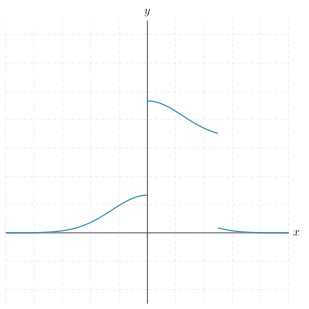
- \(\,\) \begin{align*} && \mathbb{P}(X \leq x) &= \int_{-\infty}^x f(x) \d x \\ &&&= \begin{cases} \frac13 \Phi(x) & \text{if } x < 0 \\ \frac13\Phi(x) + \frac13x & \text{if } 0 \leq x \leq 2 \\ \frac13 \Phi(x) + \frac23 & \text{if } 2 < x \end{cases} \end{align*} When \(\lambda = 2\), \(\mu = \frac{4}{6} = \frac23\), \(\sigma^2 = \frac{16+32+24+12}{12 \cdot 9} = \frac{7}{9}\), so \(\mu + 2 \sigma = \frac23 + \frac{2\sqrt7}{3}>2\). Therefore \begin{align*} && \P(0 < X < \mu + 2\sigma) &= \frac13 \Phi\left (\frac{2+2\sqrt{7}}{3} \right) + \frac23 - \Phi(0) \\ &&&= \tfrac13 \cdot 0.9921 +\tfrac23 - \tfrac12 \\ &&&= 0.4974 \end{align*}