Problems
Filters
4 problems found
2014 Paper 2 Q8
For positive integers \(n\), \(a\) and \(b\), the integer \(c_r\) (\(0\le r\le n\)) is defined to be the coefficient of \(x^r\) in the expansion in powers of \(x\) of \((a+bx)^n\). Write down an expression for \(c_r\) in terms of \(r\), \(n\), \(a\) and \(b\). For given \(n\), \(a\) and \(b\), let \(m\) denote a value of \(r\) for which \(c_r\) is greatest (that is, \(c_m \ge c_r\) for \(0\le r\le n\)). Show that \[ \frac{b(n+1)}{a+b} - 1 \le m \le \frac {b(n+1)}{a+b} \,. \] Deduce that \(m\) is either a unique integer or one of two consecutive integers. Let \(G(n,a,b)\) denote the unique value of \(m\) (if there is one) or the larger of the two possible values of \(m\).
- Evaluate \(G(9,1,3)\) and \(G(9,2,3)\).
- For any positive integer \(k\), find \(G(2k,a,a)\) and \(G(2k-1,a,a)\) in terms of \(k\).
- For fixed \(n\) and \(b\), determine a value of \(a\) for which \(G(n,a,b)\) is greatest.
- For fixed \(n\), find the greatest possible value of \(G(n,1,b)\). For which values of \(b\) is this greatest value achieved?
Solution: \(c_r = \binom{n}{r}a^{n-r}b^r\) \begin{align*} && c_m &\geq c_{m+1} \\ \Rightarrow && \binom{n}{m} a^{n-m}b^m &\geq \binom{n}{m+1} a^{n-m-1}b^{m+1} \\ \Rightarrow && \frac{1}{(n-m)}a &\geq \frac{1}{m+1}b \\ \Rightarrow && (m+1)a &\geq (n-m)b \\ \Rightarrow && m(a+b) &\geq nb -a \\ \Rightarrow && m &\geq \frac{n(b+1)-a-b}{a+b}=\frac{n(b+1)}{a+b} - 1 \\ \\ && c_m &\geq c_{m-1} \\ \Rightarrow && \binom{n}{m} a^{n-m}b^m &\geq \binom{n}{m-1} a^{n-m+1}b^{m-1} \\ \Rightarrow && \frac{1}m b &\geq \frac{a}{(n-m+1)} \\ \Rightarrow && (n-m+1)b &\geq ma \\ \Rightarrow && (n+1)b &\geq m(a+b) \\ \Rightarrow && m &\leq \frac{(n+1)b}{a+b} \end{align*} Since \(m\) lies between two values \(1\) apart is is either equal to one of those two values or is the unique integer between them. Let \(\displaystyle G(n,a,b) = \left \lfloor \frac{b(n+1)}{a+b} \right \rfloor\), so
- \(\,\) \begin{align*} && G(9,1,3) &= \left \lfloor \frac{3(9+1)}{1+3} \right \rfloor \\ &&&= \left \lfloor \frac{30}{4} \right \rfloor \\ &&&= 7 \\ \\ && G(9,2,3) &= \left \lfloor \frac{3(9+1)}{2+3} \right \rfloor \\ &&&= \left \lfloor \frac{30}{5} \right \rfloor \\ &&&= 6 \end{align*}
- \(\,\) \begin{align*} && G(2k, a, a) &= \left \lfloor \frac{a(2k+1)}{a+a} \right \rfloor \\ && &= \left \lfloor \frac{2k+1}{2} \right \rfloor \\ &&&= k \\ \\ && G(2k-1, a, a) &= \left \lfloor \frac{a(2k-1+1)}{a+a} \right \rfloor \\ && &= \left \lfloor k\right \rfloor \\ &&&= k \\ \end{align*}
- \(G(n,a,b)\) is decreasing in \(a\), therefore take \(a = 1\).
- For fixed \(n\), we are looking at \(\frac{a(n+1)}{a+b}\) and we want this to be as large as possible. By considering \((n+1) - \frac{b(n+1)}{a+b}\) we can see this is increasing in \(b\) and the largest value possible is \(n\). This is achieved when \begin{align*} && \frac{b(n+1)}{a+b} & \geq n \\ \Leftrightarrow && bn + b &\geq na + bn \\ \Leftrightarrow && b& \geq na \end{align*}
2006 Paper 2 Q11
A projectile of unit mass is fired in a northerly direction from a point on a horizontal plain at speed \(u\) and an angle \(\theta\) above the horizontal. It lands at a point \(A\) on the plain. In flight, the projectile experiences two forces: gravity, of magnitude \(g\); and a horizontal force of constant magnitude \(f\) due to a wind blowing from North to South. Derive an expression, in terms of \(u\), \(g\), \(f\) and \(\theta\) for the distance \(OA\).
- Determine the angle \(\alpha\) such that, for all \(\theta>\alpha\), the wind starts to blow the projectile back towards \(O\) before it lands at \(A\).
- An identical projectile, which experiences the same forces, is fired from \(O\) in a northerly direction at speed \(u\) and angle \(45^\circ\) above the horizontal and lands at a point \(B\) on the plain. Given that \(\theta\) is chosen to maximise \(OA\), show that \[ \frac{OB}{OA} = \frac{ g-f}{\; \sqrt{g^2+f^2\;}- f \;\;}\;. \] Describe carefully the motion of the second projectile when \(f=g\).
1998 Paper 1 Q4
Prove that the rectangle of greatest perimeter which can be inscribed in a given circle is a square. The result changes if, instead of maximising the sum of lengths of sides of the rectangle, we seek to maximise the sum of \(n\)th powers of the lengths of those sides for \(n\geqslant 2\). What happens if \(n=2\)? What happens if \(n=3\)? Justify your answers.
Solution: We can always rotate the circle so that sides are parallel to the \(x\) and \(y\) axes. Therefore if one corner is \((a,b)\) the other coordinates are \((-a,b), (a,-b), (-a,-b)\) and the perimeter will be \(4(a+b)\). Therefore we wish to maximise \(4(a+b)\) subject to \(a^2+b^2 = \text{some constant}\). Notice that \(\frac{a+b}{2} \leq \sqrt{\frac{a^2+b^2}{2}}\) with equality when \(a = b\), therefore the maximum is a square. If \(n = 2\) then we are looking at \(2((2a)^2+(2b)^2) = 8(a^2+b^2)\) which is constant for all rectangles. If \(n=3\) we are maximising \(16(a^3+b^3) = 16(a^3+(c^2-a^2)^{3/2})\) which is maximised when \(a = 0, c\)
1990 Paper 1 Q1
\(\,\)
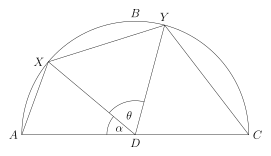
Solution: The area for \(\alpha\) fixed is \(\frac12 r^2 \sin \alpha + \frac12 r^2 \sin \theta + \frac12 r^2 \sin (\pi - \theta - \alpha)\) So we wish to maximise \(V = \sin \theta + \sin(\pi - \theta-\alpha)\) \begin{align*} && V &= \sin \theta + \sin(\pi - \theta-\alpha)\\ &&&= 2\sin \l \frac{\pi-\alpha}2\r\cos \l \frac{2\theta + \alpha - \pi}{2}\r \end{align*} The largest \(\cos\) can be is \(1\) when \(\displaystyle 2\theta + \alpha - \pi = 0 \Rightarrow \theta = \frac{\pi-\alpha}2\). (ie we split the remaining area exactly in half). We are now trying to maximise \(W = \sin \alpha + 2 \sin \frac{\pi - \alpha}2\) ie \begin{align*} && W &= \sin \alpha + 2 \cos \frac{\alpha}{2} \\ \Rightarrow && \frac{\d W}{\d \alpha} &= \cos \alpha-\sin \frac{\alpha}{2} \\ &&&= 1-2 \sin^2 \frac{\alpha}{2} - \sin \frac{\alpha}{2} \\ &&&= (1+\sin \frac{\alpha}{2})(1-2\sin \frac{\alpha}{2}) \end{align*} Therefore \(\frac{\alpha}{2} = -\frac{3\pi}{2}, \frac{\alpha}{2} = \frac{\pi}{6}, \frac{5\pi}{6} \Rightarrow \alpha = -3\pi, \frac{\pi}{3}, \frac{5\pi}{3}\). The only turning point in our range is \(\frac{\pi}{3}\). This is obvious a a maximum by symmetry or checking the end points, but we could also check the second derivative \(\frac{\d^2 W}{\d \alpha^2} = -\sin \frac{\pi}{3}-\cos \frac{\pi}{3} < 0\) so we have a maximum. Therefore the largest possible area is: \(\displaystyle \frac{3\sqrt{3}}{4}r^2\)