Problems

Filters
Clear Filters

4 problems found

2007 Paper 3 Q11
D: 1700.0 B: 1500.0

  1. A wheel consists of a thin light circular rim attached by light spokes of length \(a\) to a small hub of mass \(m\). The wheel rolls without slipping on a rough horizontal table directly towards a straight edge of the table. The plane of the wheel is vertical throughout the motion. The speed of the wheel is \(u\), where \(u^2
  2. Two particles, each of mass \(m/2\), are attached to a light circular hoop of radius \(a\), at the ends of a diameter. The hoop rolls without slipping on a rough horizontal table directly towards a straight edge of the table. The plane of the hoop is vertical throughout the motion. When the centre of the hoop is vertically above the edge of the table it has speed \(u\), where \(u^2

1999 Paper 3 Q11
D: 1700.0 B: 1500.0

Calculate the moment of inertia of a uniform thin circular hoop of mass \(m\) and radius \(a\) about an axis perpendicular to the plane of the hoop through a point on its circumference. The hoop, which is rough, rolls with speed \(v\) on a rough horizontal table straight towards the edge and rolls over the edge without initially losing contact with the edge. Show that the hoop will lose contact with the edge when it has rotated about the edge of the table through an angle \(\theta\), where \[ \cos\theta = \frac 12 +\frac {v^2}{2ag}. \] %Give the corresponding result for a smooth hoop and table.

1990 Paper 3 Q13
D: 1700.0 B: 1500.0

A particle \(P\) is projected, from the lowest point, along the smooth inside surface of a fixed sphere with centre \(O\). It leaves the surface when \(OP\) makes an angle \(\theta\) with the upward vertical. Find the smallest angle that must be exceeded by \(\theta\) to ensure that \(P\) will strike the surface below the level of \(O\). You may find it helpful to find the time at which the particle strikes the sphere.


Solution:

TikZ diagram
\begin{align*} %\text{COE}: && \frac12 m u^2 - mga &= \frac12mv^2 + mga\cos \theta \\ \text{N2}(\swarrow): && R+mg\cos\theta &= \frac{m v^2}{a} \\ R = 0: && v^2 &= ag\cos \theta \\ \end{align*} So the particle will become a projectile moving tangent to the circle with \(v^2 = ag \cos \theta\). Therefore the velocity will be \(\displaystyle \sqrt{ag \cos \theta}\binom{-\cos \theta}{\sin \theta}\). We have: \begin{align*} && \mathbf{s} &= a\binom{\sin \theta}{\cos \theta}+\sqrt{ag \cos \theta}\binom{-\cos \theta}{\sin \theta} t + \frac12 \binom{0}{-g} t^2 \\ \Rightarrow && a^2 &= \mathbf{s} \cdot \mathbf{s} \\ &&&= a^2 + ag\cos \theta t^2 + \frac1{4} g^2t^4 -ag \cos \theta t^2 - \sqrt{ag \cos \theta} \sin \theta g t^3 \\ \Rightarrow && 0 &= \frac14 g t - \sqrt{ag \cos \theta} \sin \theta \\ \Rightarrow && t &= \frac{4\sqrt{a g \cos \theta} \sin \theta}{g} \end{align*} At this time, the vertical position will be: \begin{align*} && s_y &= a \cos \theta + \sqrt{ag \cos \theta} \sin \theta \frac{4\sqrt{a g \cos \theta} \sin \theta}{g} - \frac12 g \left ( \frac{4\sqrt{a g \cos \theta} \sin \theta}{g} \right)^2 \\ &&&= a \cos \theta + 4a\cos \theta \sin^2 \theta - 8a\cos \theta \sin^2 \theta \\ &&&= a \cos \theta - 4 a \cos \theta \sin^2 \theta \\ &&&= a \cos \theta (1-4 \sin^2 \theta) \\ \underbrace{\Rightarrow}_{s_y < 0} && 0 &> 1 - 4 \sin^2 \theta \\ \Rightarrow && \sin\theta &> \frac12 \\ \Rightarrow && \theta & > \frac{\pi}{6} \end{align*}

1987 Paper 1 Q11
D: 1500.0 B: 1486.7

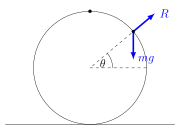
A smooth sphere of radius \(r\) stands fixed on a horizontal floor. A particle of mass \(m\) is displaced gently from equilibrium on top of the sphere. Find the angle its velocity makes with the horizontal when it loses contact with the sphere during the subsequent motion. By energy considerations, or otherwise, find the vertical component of the momentum of the particle as it strikes the floor.


Solution:
TikZ diagram
Whilst the particle is on the surface of the sphere consider the energy. Letting the height of centre of the sphere by our \(0\) GPE level, the initial energy is \(mgr\) (assuming that the initial speed is so close to \(0\) as to make no difference). When it makes an angle \(\theta\) with the horizontal it's energy will be \(mgr \sin \theta + \frac12 m v^2\). By conservation of energy: \(mgr \sin \theta + \frac12 m v^2 = mgr \Rightarrow v^2 = 2gr(1-\sin \theta)\) \begin{align*} \text{N2}(\text{radially}): && mg \sin \theta - R &= m \frac{v^2}{r} \\ \Rightarrow && R &= mg\sin \theta - \frac{m}{r} 2gr(1-\sin \theta) \\ &&&=mg \l 3\sin \theta - 2 \r \end{align*} Since \(R\) must be positive whilst the particle is in contact with the sphere, the angle \(\theta\) makes with the horizontal when it leaves the sphere is \(\sin^{-1} \frac{2}{3}\). At this point \(v^2 = 2gr(1-\sin \theta) = \frac{2}{3}gr\) Again, considering energy, the initial energy is \(mgr\). The final energy is \(-mgr + \frac12mu_x^2 + \frac12mu_y^2\) When the particle leaves the surface it has speed \(v= \frac23 gr\), so the component \(u_x = \sqrt{v}\sin \theta\). By conservation of energy therefore: \begin{align*} && mgr &= -mgr + \frac12mu_x^2 + \frac12mu_y^2 \\ \Rightarrow && \frac12 u_y^2 &= 2gr - \frac12 u_x^2 \\ &&&= 2gr - \frac12 (\sqrt{v} \sin \theta)^2 \\ &&&= 2gr - \frac12 \frac23gr \sin^2 \theta \\ &&&= 2gr - \frac13gr \frac{4}{9} \\ &&&= \frac{50}{27}gr \\ \Rightarrow && u_y &= \frac{10}{3\sqrt{3}}\sqrt{gr} \end{align*} Therefore vertical component of momentum is \(\displaystyle \frac{10}{3\sqrt{3}}\sqrt{gr}m\)