Problems
Filters
1 problem found
1995 Paper 2 Q8
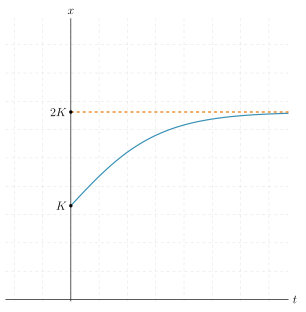
If there are \(x\) micrograms of bacteria in a nutrient medium, the population of bacteria will grow at the rate \((2K-x)x\) micrograms per hour. Show that, if \(x=K\) when \(t=0\), the population at time \(t\) is given by \[ x(t)=K+K\frac{1-\mathrm{e}^{-2Kt}}{1+\mathrm{e}^{-2Kt}}. \] Sketch, for \(t\geqslant0\), the graph of \(x\) against \(t\). What happens to \(x(t)\) as \(t\rightarrow\infty\)? Now suppose that the situation is as described in the first paragraph, except that we remove the bacteria from the nutrient medium at a rate \(L\) micrograms per hour where \(K^{2}>L\). We set \(\alpha=\sqrt{K^{2}-L}.\) Write down the new differential equation for \(x\). By considering a new variable \(y=x-K+\alpha,\) or otherwise, show that, if \(x(0)=K\) then \(x(t)\rightarrow K+\alpha\) as \(t\rightarrow\infty\).
Solution: \begin{align*} && \dot{x} &= (2K-x)x \\ \Rightarrow && \int \d t &= \int \frac{1}{(2K-x)x} \d x \\ &&&= \int \frac1{2K}\left ( \frac{1}{2K-x} + \frac{1}{x} \right) \d x \\ &&&= \frac{1}{2K} \left (\ln x - \ln (2K-x) \right) \\ \Rightarrow && 2Kt+C &= \ln \frac{x}{2K-x} \\ t = 0, x = K: && C &= \ln \frac{K}{2K-K} = 0 \\ \Rightarrow && e^{2Kt} &= \frac{x}{2K-x} \\ \Rightarrow && e^{-2Kt} &= \frac{2K}{x} -1 \\ \Rightarrow && x &= \frac{2K}{1+e^{-2Kt}} \\ &&&= K + K \frac{1-e^{-2Kt}}{1+e^{-2Kt}} \end{align*}