Problems
Filters
13 problems found
2025 Paper 2 Q3
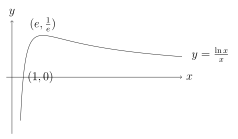
- Sketch a graph of \(y = \frac{\ln x}{x}\) for \(x > 0\).
- Use your graph to show the following.
- \(3^{\pi} > \pi^3\)
- \(\left(\frac{9}{4}\right)^{\sqrt{5}} > \sqrt{5}^{\frac{9}{4}}\)
- Given that \(1 < x < 2\), decide, with justification, which is the larger of \(x^{x+2}\) or \((x+2)^x\).
- Show that the inequalities \(9^{\sqrt{2}} > \sqrt{2}^9\) and \(3^{2\sqrt{2}} > (2\sqrt{2})^3\) are equivalent. Given that \(e^2 < 8\), decide, with justification, which is the larger of \(9^{\sqrt{2}}\) and \(\sqrt{2}^9\).
- Decide, with justification, which is the larger of \(8^{\sqrt[4]{3}}\) and \(\sqrt[3]{8}\).
Solution:

- \begin{enumerate}
- since \(\frac{\ln x}{x}\) is decreasing on \((e, \infty)\) we must have that \(\frac{\ln 3}{3} > \frac{\ln \pi}{\pi} \Rightarrow e^\pi > \pi^3\)
- similarly, since \(\frac{\ln x}{x}\) is increasing on \((0, e)\) we must have that \(\frac{\ln \sqrt{5}}{\sqrt{5}} < \frac{\ln 9/4}{9/4} \Rightarrow \left(\frac{9}{4}\right)^{\sqrt{5}} > \sqrt{5}^{\frac{9}{4}}\)
- Since \(2^4 = 4^2\) notice also that:
from the graph we must have the green area between \(1\) and \(2\) mapping to the (higher) green area between \(3\) and \(4\). Therefore \((x+2)^x > x^{x+2}\) for \(1 < x < 2\)

- \begin{align*} && 9^{\sqrt 2} & \stackrel{?}{>} \sqrt{2}^9 \\ \Leftrightarrow && (3^2)^{\sqrt2} &\stackrel{?}{>} (\sqrt{2}^3)^3 \\ \Leftrightarrow && 3^{2 \sqrt2} &\stackrel{?}{>} (2\sqrt2)^3 \end{align*} Since \(e^2 < 8 < 9\Rightarrow e < 2\sqrt2 < 3\) therefore: \begin{align*} && \frac{\ln 2 \sqrt2}{2 \sqrt 2} &> \frac{\ln 3}{3} \\ \Leftrightarrow && (2 \sqrt{2})^3 &> 3^{2 \sqrt{2}} \\ \Leftrightarrow && \sqrt{2}^9 &> 9^{\sqrt 2} \\ \end{align*}
- \begin{align*} && 8^{\sqrt[3]{3}} & \stackrel{?}{>} \sqrt[3]{3}^8 \\ \Leftrightarrow && 2^{3 \sqrt[3] 3} & \stackrel{?}{>} (\sqrt[3]{3}^4)^2 \\ \Leftrightarrow && 2^{3 \sqrt[3] 3} & \stackrel{?}{>} (3\sqrt[3]{3})^2 \\ \end{align*} Since \(3\sqrt[3]{3} > 4\) we have \begin{align*} && \frac{\ln (3 \sqrt[3]3)}{3 \sqrt[3]3} &< \frac{\ln 4}{4} \\ &&&= \frac{\ln 2}{2}\\ \Rightarrow && (3 \sqrt[3]{3})^2 &< 2^{3 \sqrt[3]{3}} \\ \Rightarrow && \sqrt[3]3^8 &< 8^{\sqrt[3]3} \end{align*}
2022 Paper 3 Q4
You may assume that all infinite sums and products in this question converge.
- Prove by induction that for all positive integers \(n\), \[ \sinh x = 2^n \cosh\!\left(\frac{x}{2}\right) \cosh\!\left(\frac{x}{4}\right) \cdots \cosh\!\left(\frac{x}{2^n}\right) \sinh\!\left(\frac{x}{2^n}\right) \] and deduce that, for \(x \neq 0\), \[ \frac{\sinh x}{x} \cdot \frac{\dfrac{x}{2^n}}{\sinh\!\left(\dfrac{x}{2^n}\right)} = \cosh\!\left(\frac{x}{2}\right) \cosh\!\left(\frac{x}{4}\right) \cdots \cosh\!\left(\frac{x}{2^n}\right)\,. \]
- You are given that the Maclaurin series for \(\sinh x\) is \[ \sinh x = \sum_{r=0}^{\infty} \frac{x^{2r+1}}{(2r+1)!}\,. \] Use this result to show that, as \(y\) tends to \(0\), \(\dfrac{y}{\sinh y}\) tends to \(1\). Deduce that, for \(x \neq 0\), \[ \frac{\sinh x}{x} = \cosh\!\left(\frac{x}{2}\right) \cosh\!\left(\frac{x}{4}\right) \cdots \cosh\!\left(\frac{x}{2^n}\right) \cdots\,. \]
- Let \(x = \ln 2\). Evaluate \(\cosh\!\left(\dfrac{x}{2}\right)\) and show that \[ \cosh\!\left(\frac{x}{4}\right) = \frac{1 + 2^{\frac{1}{2}}}{2 \times 2^{\frac{1}{4}}}\,. \] Use part (ii) to show that \[ \frac{1}{\ln 2} = \frac{1 + 2^{\frac{1}{2}}}{2} \times \frac{1 + 2^{\frac{1}{4}}}{2} \times \frac{1 + 2^{\frac{1}{8}}}{2} \cdots\,. \]
- Show that \[ \frac{2}{\pi} = \frac{\sqrt{2}}{2} \times \frac{\sqrt{2+\sqrt{2}}}{2} \times \frac{\sqrt{2+\sqrt{2+\sqrt{2}}}}{2} \cdots\,. \]
2020 Paper 2 Q2
The curves \(C_1\) and \(C_2\) both satisfy the differential equation \[\frac{\mathrm{d}y}{\mathrm{d}x} = \frac{kxy - y}{x - kxy},\] where \(k = \ln 2\). All points on \(C_1\) have positive \(x\) and \(y\) co-ordinates and \(C_1\) passes through \((1,\,1)\). All points on \(C_2\) have negative \(x\) and \(y\) co-ordinates and \(C_2\) passes through \((-1,\,-1)\).
- Show that the equation of \(C_1\) can be written as \((x-y)^2 = (x+y)^2 - 2^{x+y}\). Determine a similar result for curve \(C_2\). Hence show that \(y = x\) is a line of symmetry of each curve.
- Sketch on the same axes the curves \(y = x^2\) and \(y = 2^x\), for \(x \geqslant 0\). Hence show that \(C_1\) lies between the lines \(x + y = 2\) and \(x + y = 4\). Sketch curve \(C_1\).
- Sketch curve \(C_2\).
2017 Paper 3 Q4
For any function \(\f\) satisfying \(\f(x) > 0\), we define the geometric mean, F, by \[ F(y) = e^{\frac{1}{y} \int_{0}^{y} \ln f(x) \, dx} \quad (y > 0). \]
- The function f satisfies \(\f(x) > 0\) and \(a\) is a positive number with \(a\ne1\). Prove that \[ F(y) = a^{\frac{1}{y} \int_{0}^{y} \log_a f(x) \, dx}. \]
- The functions f and g satisfy \(\f(x) > 0\) and \(\g(x) > 0\), and the function \(\h\) is defined by \(\h(x) = \f(x)\g(x)\). Their geometric means are F, G and H, respectively. Show that \(H(y)= \F(y) \G(y)\,\).
- Prove that, for any positive number \(b\), the geometric mean of \(b^x\) is \(\sqrt{b^y}\,\).
- Prove that, if \(\f(x)>0\) and the geometric mean of \(\f(x)\) is \(\sqrt{\f(y)}\,\), then \(\f(x) = b^x\) for some positive number \(b\).
Solution:
- \begin{align*} && a^{\frac{1}{y} \int_{0}^{y} \log_a f(x) \, dx} &= e^{\ln a \cdot \frac{1}{y} \int_{0}^{y} \log_a f(x) \, dx} \\ &&&= e^{\ln a \cdot \frac{1}{y} \int_{0}^{y} \frac{\ln f(x)}{\ln a} \, dx} \\ &&&= e^{ \frac{1}{y} \int_{0}^{y} \ln f(x) \, dx} \\ &&&= F(y) \end{align*}
- \(\,\) \begin{align*} && H(y) &= e^{\frac1y \int_0^y \ln h(x) \d x} \\ &&&= e^{\frac1y \int_0^y \ln (f(x)g(x))\d x} \\ &&&= e^{\frac1y \int_0^y \left ( \ln f(x)+\ln g(x) \right)\d x} \\ &&&= e^{\frac1y \int_0^y \ln f(x) \d x +\frac1y \int_0^y \ln g(x) \d x} \\ &&&= e^{\frac1y \int_0^y \ln f(x) \d x }e^{\frac1y \int_0^y \ln g(x) \d x} \\ &&&= F(y)G(y) \end{align*}
- Suppose \(f(x) = b^x\), then \begin{align*} && F(y) &= b^{\frac1y \int_0^y \log_b f(x) \d x} \\ &&&= b^{\frac1y \int_0^y x \d x}\\ &&&= b^{\frac1y \frac{y^2}{2}} \\ &&&= b^{\frac{y}2} = \sqrt{b^y} \end{align*}
- Suppose the geometric mean of \(f(x)\) is \(\sqrt{f(y)}\) then the geometric mean of \(f(x)^2\) is \(f(y)\) by the the second part.
2010 Paper 2 Q10
- In an experiment, a particle \(A\) of mass \(m\) is at rest on a smooth horizontal table. A particle \(B\) of mass \(bm\), where \(b >1\), is projected along the table directly towards \(A\) with speed \(u\). The collision is perfectly elastic. Find an expression for the speed of \(A\) after the collision in terms of \(b\) and \(u\), and show that, irrespective of the relative masses of the particles, \(A\) cannot be made to move at twice the initial speed of \(B\).
- In a second experiment, a particle \(B_1\) is projected along the table directly towards \(A\) with speed \(u\). This time, particles \(B_2\), \(B_3\), \(\ldots\,\), \(B_n\) are at rest in order on the line between \(B_1\) and \(A\). The mass of \(B_i\) (\(i=1\), \(2\), \(\ldots\,\), \(n\)) is \(\lambda^{n+1-i}m\), where \(\lambda>1\). All collisions are perfectly elastic. Show that, by choosing \(n\) sufficiently large, there is no upper limit on the speed at which \(A\) can be made to move. In the case \(\lambda=4\), determine the least value of \(n\) for which \(A\) moves at more than \(20u\). You may use the approximation \(\log_{10}2 \approx 0.30103\).
Solution:
- Since the collision is perfectly elastic, the speed of approach and separation are equal, ie \(v_B = v_A - u\) \begin{align*} \text{COM}: && bmu &= bm(v_A - u) + mv_A \\ \Rightarrow && (b+1)v_A &= 2bu \\ \Rightarrow && v_A &= \frac{2b}{b+1} u \end{align*} Since \(0 < \frac{b}{b+1} < 1\), the largest \(0 < v_A < 2u\)

- After the first collision with each \(B_i\) we will have \(\displaystyle v_{i+1} = \frac{2\lambda}{\lambda + 1}v_i\), ie \(\displaystyle v_{i+1} = \left (\frac{2\lambda}{\lambda + 1} \right)^i u\) and so \(\displaystyle v_A = \left (\frac{2\lambda}{\lambda + 1} \right)^n u\) which can be arbitrarily large. Suppose \(\lambda = 4\), then \begin{align*} && 20u &< v_A \\ &&&= \left (\frac{8}{5} \right)^n u \\ \Rightarrow && \log_{10} 20 < n \log_{10}(16/10) \\ && \log_{10} 2 + 1 < n 4\log_{10} 2 - n \\ \Rightarrow && n &> \frac{ \log_{10} 2 + 1}{ 4\log_{10} 2 - 1} \\ &&&\approx \frac{0.30103+1}{4 \times 0.30103 -1}\\ &&&= \frac{1.30103}{0.20412} \\ &&&>6 \end{align*} So \(n =7\) is the smallest possible
2008 Paper 2 Q5
Evaluate the integrals \[\int_0^{\frac{1}{2}\pi} \frac{\sin 2x}{1+\sin^2x} \d x \text{ and } \int_0^{\frac{1}{2}\pi} \frac{\sin x}{1+\sin^2x} \d x\] Show, using the binomial expansion, that \((1+\sqrt2\,)^5<99\). Show also that \(\sqrt 2 > 1.4\). Deduce that \(2^{\sqrt2} > 1+ \sqrt2\,\). Use this result to determine which of the above integrals is greater.
Solution: \begin{align*} && I &= \int_0^{\frac{1}{2}\pi} \frac{\sin 2x}{1+\sin^2x} \d x \\ &&&= \int_0^{\frac{1}{2}\pi} \frac{2 \sin x \cos x}{1+\sin^2x} \d x \\ &&&= \left [\ln (1 + \sin^2 x) \right]_0^{\pi/2} \\ &&&= \ln 2 \\ \\ && J &= \int_0^{\frac{1}{2}\pi} \frac{\sin x}{1+\sin^2x} \d x \\ &&&= \int_0^{\frac{1}{2}\pi} \frac{\sin x}{2-\cos^2x} \d x \\ &&&= \frac{1}{2\sqrt{2}}\int_0^{\frac{1}{2}\pi} \left ( \frac{\sin x}{\sqrt{2}-\cos x}+ \frac{\sin x}{\sqrt{2}+\cos x} \right) \d x \\ &&&= \frac{1}{2\sqrt{2}} \left [\ln (\sqrt{2}-\cos x) - \ln (\sqrt{2}+\cos x) \right]_0^{\pi/2} \\ &&&= \frac{1}{2\sqrt{2}} \left (-\ln(\sqrt{2}-1)+\ln(\sqrt{2}+1) \right) \\ &&&= \frac1{2\sqrt{2}} \ln \left (\frac{\sqrt{2}+1}{\sqrt{2}-1} \right)\\ &&&= \frac1{\sqrt{2}} \ln (\sqrt{2}+1) \end{align*} \begin{align*} && (1+\sqrt{2})^5 + (1-\sqrt{2})^5 &= 2(1+10\cdot2+5\cdot2^2) \\ &&&= 82 \\ && |(1-\sqrt{2})^5| & < 1 \\ && (1+\sqrt{2})^5 &< 83 < 99 \\ \\ && 1.4^2 &= 1.96 \\ &&&< 2 \\ \Rightarrow && 1.4 &<\sqrt{2} \\ \\ \Rightarrow && 2^{\sqrt{2}} &> 2^{1.4} \\ &&&=2^{7/5} \\ &&&= {128}^{1/5} \\ &&&>99^{1/5} \\ &&&>1+\sqrt{2} \end{align*} \begin{align*} && \ln 2 & > \frac{1}{\sqrt{2}} \ln(\sqrt{2}+1) \\ \Leftrightarrow && \sqrt{2} \ln 2 &> \ln(\sqrt{2}+1) \\ \Leftrightarrow && 2^{\sqrt{2}} &> 1+\sqrt{2} \end{align*} which we have already shown, so the first integral is larger.
2007 Paper 2 Q7
A function \(\f(x)\) is said to be concave on some interval if \(\f''(x)<0\) in that interval. Show that \(\sin x\) is concave for \(0< x < \pi\) and that \(\ln x\) is concave for \(x > 0\). Let \(\f(x)\) be concave on a given interval and let \(x_1\), \(x_2\), \(\ldots\), \(x_n\) lie in the interval. Jensen's inequality states that \[ \frac1 n \sum_{k=1}^n\f(x_k) \le \f \bigg (\frac1 n \sum_{k=1}^n x_k\bigg) \] and that equality holds if and only if \(x_1=x_2= \cdots =x_n\). You may use this result without proving it.
- Given that \(A\), \(B\) and \(C\) are angles of a triangle, show that \[ \sin A + \sin B + \sin C \le \frac{3\sqrt3}2 \,. \]
- By choosing a suitable function \(\f\), prove that
\[
\sqrt[n]{t_1t_2\cdots t_n}\; \le \; \frac{t_1+t_2+\cdots+t_n}n
\]
for any positive integer \(n\) and for any positive numbers \(t_1\), \(t_2\), \(\ldots\), \(t_n\).
Hence:
- show that \(x^4+y^4+z^4 +16 \ge 8xyz\), where \(x\), \(y\) and \(z\) are any positive numbers;
- find the minimum value of \(x^5+y^5+z^5 -5xyz\), where \(x\), \(y\) and \(z\) are any positive numbers.
Solution: \begin{align*} && f(x) &= \sin x \\ \Rightarrow && f''(x) &= -\sin x \end{align*} which is clearly negative on \((0,\pi)\) since \(\sin\) is positive on this interval. \begin{align*} && f(x) &= \ln x \\ \Rightarrow && f''(x) &= -1/x^2 \end{align*} which is clearly negative for \(x > 0\)
- Since \(A,B,C\) are angles in a triangle, we must have \(0 < A,B,C< \pi\) and so we can apply Jensen with \(f = \sin\) to obtain: \begin{align*} &&\frac13( \sin A + \sin B + \sin C) &\leq \sin \left ( \frac{A+B+C}{3}\right) \\ &&&= \sin \frac{\pi}{3} = \frac{\sqrt{3}}2 \\ \Rightarrow && \sin A + \sin B + \sin C &\leq\frac{3\sqrt{3}}2 \end{align*}
- Suppose \(f(x) = \ln x\), then applying Jensen on the positive numbers \(t_1, \ldots, t_n\) we obtain
\begin{align*}
&& \frac1n \left ( \sum_{i=1}^n \ln t_n \right) &\leq \ln \left ( \frac1n\sum_{i=1}^n t_n \right) \\
\Rightarrow && \frac1n \ln\left (\prod_{i=1} t_n\right)&\leq \ln \left ( \frac1n\sum_{i=1}^n t_n \right) \\
\Rightarrow && \ln\left (\left (\prod_{i=1} t_n\right)^{1/n}\right)&\leq \ln \left ( \frac1n\sum_{i=1}^n t_n \right) \\
\Rightarrow && \left (\prod_{i=1} t_n\right)^{1/n}&\leq\frac1n\sum_{i=1}^n t_n \\
\Rightarrow && \sqrt[n]{t_1t_2 \cdots t_n}&\leq\frac1n(t_1 + t_2 + \cdots + t_n) \tag{AM-GM}\\
\end{align*}
- Applying AM-GM with \(t_1 = x^4, t_2 = y^4, t_3 = z^4, t_4 = 2^4\) we have \begin{align*} && \frac{x^4+y^4+z^4+16}{4} & \geq \sqrt[4]{x^4y^4z^42^4} \\ \Rightarrow && x^4+y^4+z^4+16 &\geq 8xyz \end{align*}
- Applying AM-GM with \(t_1 = x^5, t_2 = y^5, t_3 = z^5, t_4 = 1^5, t_5 = 1^5\) we have \begin{align*} && \frac{x^5+y^5+z^5+1+1}{5} & \geq \sqrt[5]{x^5y^5z^5} \\ \Rightarrow && x^5+y^5+z^5+2 &\geq 5xyz \\ \Rightarrow && x^5+y^5+z^5 - 5xyz &\geq -2 \end{align*} Therefore the minimum is \(-2\)
2000 Paper 1 Q1
To nine decimal places, \(\log_{10}2=0.301029996\) and \(\log_{10}3=0.477121255\).
- Calculate \(\log_{10}5\) and \(\log_{10}6\) to three decimal places. By taking logs, or otherwise, show that \[ 5\times 10^{47} < 3^{100} < 6\times 10^{47}. \] Hence write down the first digit of \(3^{100}\).
- Find the first digit of each of the following numbers: \(2^{1000}\); \ \(2^{10\,000}\); \ and \(2^{100\, 000}\).
Solution:
- \begin{align*} \log_{10}5 &= \log_{10} 10 - \log_{10}2 \\ &= 1- \log_{10} 2 \\ &= 0.699\\ \\ \log_{10} 6 &= \log_{10} 2 + \log_{10} 3 \\ &= 0.301029996+0.477121255 \\ &= 0.778 \end{align*} \begin{align*} && 5 \times 10^{47} < 3^{100} < 6 \times 10^{47} \\ \Leftrightarrow && 47 + \log_{10} 5 < 100 \log_{10} 3 < \log_{10} 6 + 47 \\ \Leftrightarrow &&47.699< 47.71 < 47.778 \\ \end{align*} Which is true. Therefore the first digit of \(3^{100}\) is 5.
- \(\log_{10} 2^{1000} = 1000 \log_{10} 2 = 301.02\cdots\). Therefore it starts with a \(1\). \(\log_{10}2^{10\, 000} = 10\,000 \log_{10} 2 = 3010.2\) therefore this also starts with a \(1\). \(\log_{10} 2^{100\, 000} = 100\,000 \log_{10} 2 = 30102.9996\) therefore it starts with a \(9\)
1999 Paper 2 Q1
Let \(x=10^{100}\), \(y=10^{x}\), \(z=10^{y}\), and let $$ a_1=x!, \quad a_2=x^y,\quad a_3=y^x,\quad a_4=z^x,\quad a_5=\e^{xyz},\quad a_6=z^{1/y},\quad a_7 = y^{z/x}. $$
- Use Stirling's approximation \(n! \approx \sqrt{2 \pi}\, {n^{n+{1\over2}}\e^{-n}}\), which is valid for large \(n\), to show that \(\log_{10}\left(\log_{10} a_1 \right) \approx 102\).
- Arrange the seven numbers \(a_1\), \(\ldots\) , \(a_7\) in ascending order of magnitude, justifying your result.
Solution:
- \begin{align*} \log_{10}(\log_{10} a_1) &= \log_{10} (\log_{10} (x!) \\ &\approx \log_{10} (\log_{10} \sqrt{2 \pi} x^{x+\frac12} e^{-x}) \\ &= \log_{10} \l \log_{10} \sqrt{2 \pi} + (x+\frac12) \log_{10} x-x \r \\ &= \log_{10} \l \log_{10} \sqrt{2 \pi} + (100x+50)-x \r \\ &= \log_{10} \l 99x + \epsilon \r \\ &\approx \log_{10} 99 + \log_{10} x \\ &\approx 2 + 100 = 102 \end{align*}
- \begin{align*} \log_{10}(\log_{10} a_2) &= \log_{10}(\log_{10} x^y) \\ &= \log_{10} y + \log_{10} \log_{10} x \\ &= x + 2 \end{align*} \begin{align*} \log_{10}(\log_{10} a_3) &= \log_{10}(\log_{10} y^x) \\ &= \log_{10} x + \log_{10} \log_{10} y \\ &= 100 + \log_{10} x \\ &= 200 \end{align*} \begin{align*} \log_{10}(\log_{10} a_4) &= \log_{10}(\log_{10} z^x) \\ &= \log_{10} x + \log_{10} \log_{10} z \\ &= 100 + \log_{10} y \\ &= 100+x \end{align*} \begin{align*} \log_{10}(\log_{10} a_5) &= \log_{10}(\log_{10} e^{xyz}) \\ &= \log_{10} x + \log_{10}y+\log_{10} z+ \log_{10} \log_{10} e \\ &\approx 100 + x + y \end{align*} \begin{align*} \log_{10}(\log_{10} a_6) &= \log_{10}(\log_{10} z^{1/y}) \\ &= \log_{10}(\log_{10} 10) \\ &= 0 \end{align*} \begin{align*} \log_{10}(\log_{10} a_7) &= \log_{10}(\log_{10} y^{z/x}) \\ &= \log_{10}z-\log_{10} x + \log_{10} \log_{10} y \\ &= y \end{align*} Since \(0 < 102 < 200 < x+2 < x+100 < y < y+x+100\) we must have \(a_6 < a_1 < a_3 < a_2 < a_4 < a_7 < a_5\)
1998 Paper 1 Q3
Which of the following statements are true and which are false? Justify your answers.
- \(a^{\ln b}=b^{\ln a}\) for all \(a,b>0\).
- \(\cos(\sin\theta)=\sin(\cos\theta)\) for all real \(\theta\).
- There exists a polynomial \(\mathrm{P}\) such that \(|\mathrm{P}(\theta)-\cos\theta|\leqslant 10^{-6}\) for all real \(\theta\).
- \(x^{4}+3+x^{-4}\geqslant 5\) for all \(x>0\).
Solution:
- True. \begin{align*} && \ln a \cdot \ln b &= \ln b \cdot \ln a \\ \Leftrightarrow && \exp ( \ln a \cdot \ln b) &= \exp ( \ln b \cdot \ln a) \\ \Leftrightarrow && \exp ( \ln a )^{\ln b} &= \exp ( \ln b )^{\ln a} \\ \Leftrightarrow && a^{\ln b} &= b^{\ln a} \\ \end{align*}
- False. Consider \(\theta = 0\). We'd need \(\cos 0 = 1 = \sin 1\), but \(0 < 1 < \frac{\pi}{2}\) so \(\sin 1 \neq 1\)
- False. If the polynomial has positive degree, then as \(n \to \infty\), \(\P(x) \to \pm \infty\), in particular it must be well outside the interval \([-1,1]\). Therefore it can't be within \(10^{-6}\) of \(\cos \theta\) which is confined to that interval. The only polynomial which is restricted to that range are constants, but then \(|\cos 0 - c| \leq 10^{-6}\) and \(|\cos \pi - c| \leq 10^{-6}\) \(2 = |1-(-1)| \leq |1-c| + |-1-c| \leq 2\cdot 10^{-6}\) contradiction.
- True. \begin{align*} && (x^2-x^{-2})^2 &\geq 0 \\ \Leftrightarrow && x^4-2+x^{-4} &\geq0 \\ \Leftrightarrow && x^4+3+x^{-4} &\geq 5 \\ \end{align*}
1997 Paper 1 Q8
By considering the maximum of \(\ln x-x\ln a\), or otherwise, show that the equation \(x=a^{x}\) has no real roots if \(a > e^{1/e}\). How many real roots does the equation have if \(0 < a < 1\)? Justify your answer.
Solution: \begin{align*} && y &= \ln x - x \ln a \\ \Rightarrow && y' &= \frac1x - \ln a \\ && y'' &= -\frac{1}{x^2} \end{align*} Therefore the maximum is when \(x = \frac{1}{\ln a}\) and \(y_{max} = -\ln \ln a - 1\). If \(y_{max} < 0\) then \(y \neq 0\). But that's equivalent to \(a > e^{1/e}\). \begin{align*} && 0 &> -\ln \ln a - 1 \\ \Leftrightarrow && 1 &> - \ln \ln a \\ \Leftrightarrow && \ln \ln a &>-1 \\ \Leftrightarrow && \ln a &> e^{-1} \\ \Leftrightarrow && a & > e^{1/e} \end{align*} If \(0 < a < 1\) then, when \(x\) is small, \(\ln x - x \ln a\) is large and negative. When \(x\) is large and positive \(\ln x\) is positive and \(-x \ln a\) is positive. We also notice there is no turning point. Hence exactly one solution
1988 Paper 1 Q1
Sketch the graph of the function \(\mathrm{h}\), where \[ \mathrm{h}(x)=\frac{\ln x}{x},\qquad(x>0). \] Hence, or otherwise, find all pairs of distinct positive integers \(m\) and \(n\) which satisfy the equation \[ n^{m}=m^{n}. \]
Solution:
1987 Paper 1 Q4
Show that the sum of the infinite series \[ \log_{2}\mathrm{e}-\log_{4}\mathrm{e}+\log_{16}\mathrm{e}-\ldots+(-1)^{n}\log_{2^{2^{n}}}\mathrm{e}+\ldots \] is \[ \frac{1}{\ln(2\sqrt{2})}. \] {[}\(\log_{a}b=c\) is equivalent to \(a^{c}=b\).{]}
Solution: Let \(S = \log_{2}\mathrm{e}-\log_{4}\mathrm{e}+\log_{16}\mathrm{e}-\ldots+(-1)^{n}\log_{2^{2^{n}}}\mathrm{e}+\ldots\) then \begin{align*} S &= \sum_{n=0}^{\infty} (-1)^n \log_{2^{2^n}} e \\ &= \sum_{n=0}^{\infty} (-1)^n \frac{\log e}{\log {2^{2^n}}} \\ &= \sum_{n=0}^{\infty} (-1)^n \frac{\log e}{2^n\log {2}} \\ &= \frac{\log e}{\log 2} \sum_{n=0}^{\infty} \frac{(-1)^n}{2^n} \\ &= \frac{1}{\log_e 2} \frac{1}{1+\frac12} \\ &= \frac{1}{\ln (2^{3/2})} \\ &= \frac{1}{\ln (2 \sqrt{2})} \end{align*}