Problems
Filters
6 problems found
2014 Paper 3 Q2
- Show, by means of the substitution \(u=\cosh x\,\), that \[ \int \frac{\sinh x}{\cosh 2x} \d x = \frac 1{2\sqrt2} \ln \left\vert \frac{\sqrt2 \cosh x - 1}{\sqrt2 \cosh x + 1 } \right\vert + C \,.\]
- Use a similar substitution to find an expression for \[ \int \frac{\cosh x}{\cosh 2x} \d x \,.\]
- Using parts (i) and (ii) above, show that \[ \int_0^1 \frac 1{1+u^4} \d u = \frac{\pi + 2\ln(\sqrt2 +1)}{4\sqrt2}\,. \]
Solution:
- \begin{align*} && \int \frac{\sinh x}{\cosh 2x} \d x &= \int \frac{\sinh x}{2\cosh^2 x -1} \d x \\ u = \cosh x, \d u = \sinh x \d x &&&= \int \frac{1}{2u^2 -1} \d u \\ &&&= \int\frac12 \left ( \frac{1}{\sqrt{2}u-1}-\frac{1}{\sqrt{2}u+1} \right) \d u \\ &&&= \frac1{2\sqrt{2}} \left (\ln (\sqrt{2}u-1) - \ln(\sqrt{2}u+1) \right) + C \\ &&&= \frac{1}{2\sqrt{2}} \ln \left ( \frac{\sqrt{2}\cosh x -1}{\sqrt{2}\cosh x +1} \right) + C \end{align*}
- \begin{align*} && \int \frac{\cosh x}{\cosh 2x} \d x &= \int \frac{\cosh x}{1+2\sinh^2 x} \d x \\ u = \sinh x && &= \int \frac{1}{1+2u^2} \d u \\ &&&=\frac{1}{\sqrt{2}} \tan^{-1} (\sqrt{2}u) + C \\ &&&= \frac{1}{\sqrt{2}} \tan^{-1}(\sqrt{2}\sinh x) + C \end{align*}
- \begin{align*} u = e^x : && \int_0^1 \frac{1}{1+u^4} \d u &= \int_{x=-\infty}^{x=0} \frac{1}{1+e^{4x}}e^{x} \d x \\ &&&= \int_{-\infty}^{0} \frac{e^{-x}}{e^{2x}+e^{-2x}} \d x \\ &&&= \int_{-\infty}^{0} \frac{\cosh x - \sinh x}{2\cosh 2x } \d x \\ &&&= \frac12 \int_{-\infty}^{0} \frac{\cosh x}{\cosh 2x} \d x - \frac12 \int_{-\infty}^{0} \frac{\sinh x}{\cosh 2x} \\ &&&= \frac12 \left [\frac{1}{\sqrt{2}} \tan^{-1}(\sqrt{2}\sinh x) \right]_{-\infty}^{0}-\frac12 \left [ \frac{1}{2\sqrt{2}}\ln \left ( \frac{\sqrt{2}\cosh x -1}{\sqrt{2}\cosh x +1} \right) \right]_{-\infty}^{0} \\ &&&= 0 - \frac1{2\sqrt{2}} \frac{-\pi}{2}-\left (\frac1{4\sqrt{2}} \ln \left (\frac{\sqrt{2}-1}{\sqrt{2}+1} \right) - 0 \right) \\ &&&= \frac{\pi - \ln((\sqrt{2}-1)^2)}{4\sqrt{2}} \\ &&&= \frac{\pi + 2 \ln(1+\sqrt{2})}{4\sqrt{2}} \end{align*}
2006 Paper 1 Q5
- Use the substitution \(u^2=2x+1\) to show that, for \(x>4\), \[ \int \frac{3} { ( x-4 ) \sqrt {2x+1}} \; \d x = \ln \l \frac{\sqrt{2x+1}-3} {\sqrt{2x+1}+3} \r + K\,, \] where \(K\) is a constant.
- Show that $ \displaystyle \int_{\ln 3}^{\ln 8} \frac{2} { \e^x \sqrt{ \e^x + 1}}\; \mathrm{d}x\, = \frac 7{12} + \ln \frac23 $ .
Solution:
- \begin{align*} && I &= \int \frac{3}{(x-4)\sqrt{2x+1}}\, \d x \\ u^2 =2x+1, 2u \frac{\d u}{\d x}=2: && &= \int \frac{3}{\left(\frac{u^2-1}{2}-4\right)u} u \d u \\ &&&= \int \frac{6}{u^2-9} \d u \\ &&&= \int \frac{6}{(u-3)(u+3)} \d u\\ &&&= \int \left ( \frac{1}{u-3} - \frac{1}{u+3} \right )\d u \\ &&&= \ln (u-3) - \ln (u+3) + C \\ &&&= \ln \frac{u-3}{u+3} + C \\ &&&= \ln \left (\frac{\sqrt{2x+1}-3}{\sqrt{2x+1}+3} \right) + C \end{align*}
- \begin{align*} && I &= \int_{\ln 3}^{\ln 8} \frac{2}{e^x\sqrt{e^x+1}} \d x \\ u = e^x, \frac{\d u}{\d x} = e^x: &&&= \int_{u=3}^{u=8} \frac{2}{u\sqrt{u+1}} \frac{1}{u} \d u \\ v^2=u+1, 2v \frac{\d v}{\d u} = 1: &&&= \int_{v=2}^{v=3} \frac{2}{v(v^2-1)^2} \d v \\ &&&= \int_2^3 \left ( \frac{2}{v} - \frac{}{v-1} - \frac{1}{2(v-1)^2} - \frac{1}{v+1} - \frac{1}{2(v+1)^2}\right) \d v \\ &&&= \left [2\ln v - \ln(v^2-1)+\frac12(v-1)^{-1}+\frac12(v+1)^{-1} \right]_2^3 \\ &&&= \left ( 2\ln3-\ln 8+\frac14+\frac18\right)-\left ( 2\ln2-\ln 3+\frac12+\frac16\right) \\ &&&= \end{align*}
2004 Paper 3 Q1
Show that \[ \int_0^a \frac{\sinh x}{2\cosh^2 x -1} \, \mathrm{d} x = \frac{1}{2 \sqrt{2}} \ln \l \frac{\sqrt{2}\cosh a -1}{\sqrt{2}\cosh a +1}\r + \frac{1}{2 \sqrt{2}} \ln \l \frac{\sqrt{2}+1}{\sqrt{2}-1}\r \] and find \[ \int_0^a \frac{\cosh x}{1+2\sinh^2 x} \, \mathrm{d} x \, . \] Hence show that \[ \int_0^\infty \frac{\cosh x - \sinh x}{1+2\sinh^2 x} \, \mathrm{d} x = \frac{\pi}{2\sqrt{2}} - \frac{1}{2 \sqrt{2}} \ln \l \frac{\sqrt{2}+1}{\sqrt{2}-1}\r \, . \] By substituting \(u = \e^x\) in this result, or otherwise, find \[ \int_1^\infty \frac{1}{1+u^4} \, \mathrm{d} u \, . \]
2002 Paper 1 Q7
Let \[ I= \int_0^a \frac {\cos x}{\sin x + \cos x} \; \d x \, \quad \mbox{ and } \quad J= \int_0^a \frac {\sin x}{\sin x + \cos x} \; \d x \;, \] where \(0\le a < \frac{3}{4}\pi\,\). By considering \(I+J\) and \(I-J\), show that $ 2I= a + \ln (\sin a +\cos a)\;. $ Find also:
- \(\displaystyle \int_0^{\frac{1}{2}\pi} \frac {\cos x}{p\sin x + q\cos x} \; \d x \,\), where \(p\) and \(q\) are positive numbers; %
- [(ii)] %\(\displaystyle \int_0^{\frac{1}{2}\pi/2} \frac {\cos x}{\sin (x+k)} \; \d x \,\), where \(0 < k < \pi/2\,\);
- \(\displaystyle \int_0^{\frac{1}{2}\pi} \frac {\cos x+4}{3\sin x + 4\cos x+ 25} \; \d x \,\).
Solution: \begin{align*} && I + J &= \int_0^a \frac{\sin x + \cos x}{\sin x + \cos x } \d x = a \\ && I - J &= \int_0^a \frac{\cos x - \sin x}{\sin x + \cos x} \d x \\ &&&= \left [\ln ( \sin x + \cos x) \right]_0^a = \ln (\sin a + \cos a) - \ln 1 = \ln(\sin a + \cos a) \\ \\ \Rightarrow && 2I &= a + \ln(\sin a + \cos a) \end{align*}
- Let \(\displaystyle I = \int_0^{\frac12 \pi} \frac{\cos x}{p \sin x + q \cos x} \d x, J = \int_0^{\frac12 \pi} \frac{\sin x}{p \sin x + q \cos x} \d x\) so \begin{align*} && qI + pJ &= \frac{\pi}{2} \\ && pI - qJ &= \int_0^{\frac12 \pi} \frac{p \cos x - q \sin x}{p \sin x + q \cos x } \d x \\ &&&= \left [\ln (p \sin x + q \cos x) \right]_0^{\pi/2} \\ &&&= \ln(p) - \ln(q) = \ln \frac{p}{q} \end{align*}
- \(\,\) \begin{align*} && \int_0^{\frac{\pi}{2}} \frac{\cos x}{\sin(x + k)} \d x &= \int_0^{\frac{\pi}{2}} \frac{\cos x}{\sin(x) \cos(k) + \cos(x) \sin (k)} \d x \\ &&&= \ln \tan k \end{align*}
- Let \(\displaystyle I = \int_0^{\pi/2} \frac{\cos x + 4}{3 \sin x + 4 \cos x + 25} \d x, J = \int_0^{\pi/2} \frac{\sin x + 3}{3 \sin x + 4 \cos x + 25} \d x\), so \begin{align*} && 4I + 3J &= \int_0^{\pi/2} \frac{3 \sin x + 4 \cos x + 25}{3 \sin x + 4 \cos x + 25} \d x \\ &&&= \frac{\pi}{2} \\ && 3I - 4J &= \int_0^{\pi/2} \frac{3\cos x - 4 \sin x}{3 \sin x + 4 \cos x + 25} \d x \\ &&&= \left [\ln(3 \sin x + 4 \cos x + 25) \right]_0^{\pi/2} \\ &&&= \ln (28) - \ln (29) = \ln \frac{28}{29} \\ \Rightarrow && 25I &= 2\pi + 3 \ln \frac{28}{29} \\ \Rightarrow && I &= \frac{2}{25} \pi + \frac{3}{25} \ln \frac{28}{29} \end{align*}
2000 Paper 2 Q9
In an aerobatics display, Jane and Karen jump from a great height and go through a period of free fall before opening their parachutes. While in free fall at speed \(v\), Jane experiences air resistance \(kv\) per unit mass but Karen, who spread-eagles, experiences air resistance \mbox{\(kv + (2k^2/g)v^2\)} per unit mass. Show that Jane's speed can never reach \(g/k\). Obtain the corresponding result for Karen. Jane opens her parachute when her speed is \(g/(3{k})\). Show that she has then been in free fall for time \(k^{-1}\ln (3/2)\). Karen also opens her parachute when her speed is \(g/(3{k})\). Find the time she has then been in free fall.
Solution: Looking at the forces on Jane, \(kv < g \Rightarrow v < \frac{g}{k}\). For Karen we have \begin{align*} kv + (2k^2/g)v^2 &< g\\ -g^2 + gkv + (2k^2)v^2 &< 0 \\ (2kv-g)(kv+g) &< 0\\ \Rightarrow v &< \frac{g}{2k} \end{align*} \begin{align*} && \dot{v} &= g - kv \\ \Rightarrow && \frac{\dot{v}}{g - kv} &= 1 \\ \Rightarrow && T &= \int_0^{g/(3k)} \frac{1}{g - kv} dv \\ && &= \int_0^{g/(3k)} \frac{1}{g - kv} dv\\ && &= \int_0^{g/(3k)} \frac{1}{g - kv} dv \\ && &= \left [-\frac{1}{k} \ln \l g - kv \r \right ]_0^{g/(3k)} \\ && &= \frac{1}{k} \ln \l g \r - \frac{1}{k} \ln \l \frac{2}{3}g \r\\ &&&= \frac{1}{k} \ln \l \frac{3}{2} \r \end{align*} \begin{align*} && \dot{v} &= g - kv - (2k^2/g)v^2 \\ \Rightarrow && \frac{\dot{v}}{g - kv - (2k^2/g)v^2} &= 1 \\ \Rightarrow && T &= \int_0^{g/(3k)} \frac{1}{g - kv - (2k^2/g)v^2} dv \\ && &= \int_0^{g/(3k)} \frac{g}{(g-2kv)(kv+g)} dv\\ && &= \int_0^{g/(3k)} \l \frac{2}{3(g-2kv)} + \frac{1}{3(kv+g)} \r dv\\ && &= \left [ \l -\frac{1}{3k} \ln (g-2kv) + \frac{1}{3k}\ln(kv+g) \r \right ]_0^{g/(3k)} \\ && &= \left [ \l -\frac{1}{3k}\ln \l \frac{g}{3} \r + \frac{1}{3k}\ln \l \frac{4g}{3} \r \r \right ] - \left [- \frac1{3k} \ln(g) + \frac{1}{3k} \ln (g) \right ] \\ && &= \frac{1}{3k} \ln \l 4 \r \end{align*} NB: \(\sqrt[3]{4} \approx 1.58 > \frac{3}{2}\) so Karen has been in free-fall for longer, but not \emph{much} longer than Jane.
1990 Paper 2 Q9
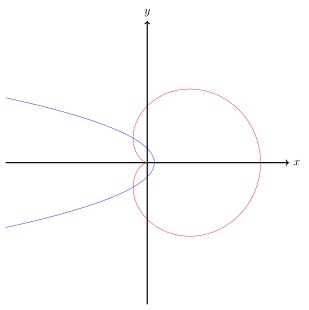
Show by means of a sketch that the parabola \(r(1+\cos\theta)=1\) cuts the interior of the cardioid \(r=4(1+\cos\theta)\) into two parts. Show that the total length of the boundary of the part that includes the point \(r=1,\theta=0\) is \(18\sqrt{3}+\ln(2+\sqrt{3}).\)
Solution: