Problems
Filters
6 problems found
2017 Paper 2 Q7
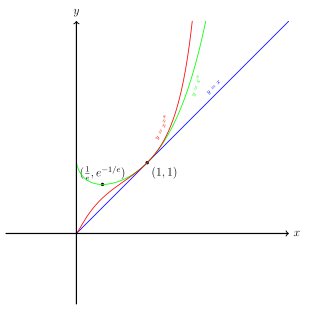
The functions \(\f\) and \(\g\) are defined, for \(x>0\), by \[ \f(x) = x^x\,, \ \ \ \ \ \g(x) = x^{\f(x)}\,. \]
- By taking logarithms, or otherwise, show that \(\f(x) > x\) for \(0 < x < 1\,\). Show further that \(x < \g(x) < \f(x)\) for \(0 < x < 1\,\). Write down the corresponding results for \(x > 1 \,\).
- Find the value of \(x\) for which \(\f'(x)=0\,\).
- Use the result \(x\ln x \to 0\) as \(x\to 0\) to find \(\lim\limits_{x\to0}\f(x)\), and write down \(\lim\limits_{x\to0}\g(x)\,\).
- Show that \( x^{-1}+\, \ln x \ge 1\,\) for \(x>0\). Using this result, or otherwise, show that \(\g'(x) > 0\,\).
Solution:
- \(\,\) \begin{align*} && \ln f(x) &= x \ln x \\ &&&> \ln x \quad (\text{if } 0 < x < 1)\\ \Rightarrow && f(x) &> x\quad\quad (\text{if } 0 < x < 1)\\ \Rightarrow && x^{f(x)} &< x^x \\ && g(x) &< f(x) \\ && 1&>f(x) \\ \Rightarrow && x &< x^{f(x)} = g(x) \end{align*}
- \(\,\) \begin{align*} && f(x) &= e^{x \ln x} \\ \Rightarrow && f'(x) &= (\ln x + 1)e^{x \ln x} \\ \Rightarrow && f'(x) = 0 &\Leftrightarrow x = \frac1e \end{align*}
- \(\,\) \begin{align*} && \lim_{x \to 0} f(x) &= \lim_{x \to 0} \exp \left ( x \ln x \right ) \\ &&&= \exp \left ( \lim_{x \to 0} \left ( x \ln x \right )\right) \\ &&&= \exp \left ( 0 \right) = 1\\ \\ && \lim_{x \to 0} g(x) &= \lim_{x \to 0} \exp \left ( f(x) \ln x\right) \\ &&&= \exp \left (\lim_{x \to 0} \ln x f(x)\right) \\ &&&= \exp \left (\lim_{x \to 0} \ln x \lim_{x \to 0}f(x)\right) \\ &&&= \exp \left (\lim_{x \to 0} \ln x\right) \\ &&&= 0 \end{align*}
- \(y = x^{-1} + \ln x \Rightarrow y' = -x^{-2} + x^{-1}\) which has roots at \(x =1\), therefore the minimum value is \(1\). (We can see it's a minimum by considering \(x \to 0, x \to \infty\). So \begin{align*} && g'(x) &= x^{f(x)} \cdot (f'(x) \ln x + f(x) x^{-1})\\ &&&= x^{f(x)} \cdot f(x) \cdot ((1+\ln x) \ln x + x^{-1}) \\ &&&= x^{f(x)} \cdot f(x) \cdot (\ln x + x^{-1} + (\ln x)^2) \\ &&&\geq x^{f(x)} \cdot f(x) > 0 \end{align*}
2007 Paper 2 Q6
- Differentiate \(\ln\big (x+\sqrt{3+x^2}\,\big)\) and \(x\sqrt{3+x^2}\) and simplify your answers. Hence find \(\int \! \sqrt{3+x^2}\, \d x\).
- Find the two solutions of the differential equation \[ 3\left(\frac{\d y}{\d x}\right)^{\!2} + 2 x \frac {\d y}{\d x} =1 \] that satisfy \(y=0\) when \(x=1\).
Solution:
- \(\,\) \begin{align*} && y &= \ln (x + \sqrt{3+x^2}) \\ \Rightarrow && y' &= \frac{1}{x + \sqrt{3+x^2}} \cdot \left (1 + \frac{x}{\sqrt{3+x^2}} \right) \\ &&&= \frac{1}{\sqrt{3+x^2}} \\ \\ && y &= x\sqrt{3+x^2} \\ && y' &= \sqrt{3+x^2} + \frac{x^2}{\sqrt{3+x^2}} \\ &&&= 2\sqrt{3+x^2} - \frac{3}{\sqrt{3+x^2}} \\ \\ \Rightarrow && \sqrt{3+x^2} &= \frac12(x \sqrt{3+x^2})' + \frac32(\ln(x+\sqrt{3+x^2})' \\ \Rightarrow && \int \sqrt{3+x^2}\, \d x &= \frac12x\sqrt{3+x^2} + \frac32 \ln (x+\sqrt{3+x^2}) + C \end{align*}
- \(\,\) \begin{align*} && 3 \left ( \frac{\d y}{\d x} \right)^2 + 2x \frac{\d y}{\d x} &= 1 \\ && \frac{\d y}{\d x} &= \frac{-x \pm \sqrt{x^2+3} }3 \\ \Rightarrow && y &= -\frac{x^2}{6} \pm \frac16x\sqrt{3+x^2} \pm \frac12 \ln (x+\sqrt{3+x^2}) + C \\ y = 0, x = 1: && 0 &= -\frac16 \pm \frac13 \pm \frac12 \ln 3 \\ \Rightarrow && y &= -\frac{x^2}{6} \pm \frac12x\sqrt{3+x^2} \pm \frac32 \ln (x+\sqrt{3+x^2}) + \frac16 \mp \frac13 \mp \frac12 \ln 3 \end{align*}
2007 Paper 3 Q5
Let \(y = \ln (x^2-1)\,\), where \(x >1\), and let \(r\) and \(\theta\) be functions of \(x\) determined by \(r= \sqrt{x^2-1}\) and \(\coth\theta= x\). Show that \[ \frac {\d y}{\d x} = \frac {2\cosh \theta}{r} \text{ and } \frac {\d^2 y}{\d x^2} = -\frac {2 \cosh 2\theta}{r^2}\,, \] and find an expression in terms of \(r\) and \(\theta\) for \(\dfrac {\d^3 y}{\d x^3}\,\). Find, with proof, a similar formula for \(\dfrac{\d^n y}{\d x^n}\) in terms of \(r\) and \(\theta\).
Solution: \begin{align*} && y &= \ln(x^2 -1) \\ && r &= \sqrt{x^2-1} \\ && \coth \theta &= x \\ && r &= \sqrt{\coth^2 \theta - 1} = \sqrt{\textrm{cosech}^2 \theta} = \textrm{cosech} \theta \\ && \frac{\d y}{\d x} &= \frac{2x}{x^2-1} \\ &&&= \frac{2 \coth \theta}{r^2} \\ &&&= \frac{2 \cosh \theta}{\sinh \theta \cdot r \cdot \textrm{cosech} \theta } \\ &&&= \frac{2 \cosh \theta}{r } \\ \\ && \frac{\d^2 y}{\d x^2} &= \frac{2(x^2-1)-4x^2}{(x^2-1)^2} \\ &&&= \frac{-2(1+x^2)}{r^2 \textrm{cosech}^2 r} \\ &&&= -\frac{2(1 + \coth^2 \theta) \sinh^2 \theta}{r^2} \\ &&&= -\frac{2(\sinh^2 \theta + \cosh^2 \theta)}{r^2} \\ &&&= -\frac{2 \cosh 2 \theta}{r^2} \\ \\ && \frac{\d^3 y}{\d x^3} &= \frac{-4x(x^2-1)^2-(-2x^2-2)\cdot2(x^2-1)\cdot 2x}{(x^2-1)^4} \\ &&&= \frac{-4x(x^2-1)+8x(x^2+1)}{(x^2-1)^3}\\ &&&= \frac{4x^3+12x}{(x^2-1)^3} \\ &&&=\frac{\sinh^3 \theta (4\coth^3 \theta + 12\coth \theta )}{r^3} \\ &&&=\frac{4\cosh^3 \theta + 12\cosh \theta \sinh^2 \theta}{r^3} \\ &&&= \frac{4 \cosh 3 \theta}{r^3} \\ \end{align*} Claim: \(\frac{\d^n y}{\d x^n} = (-1)^{n+1}\frac{2(n-1)!\cosh n \theta}{r^n}\) Proof: By induction. Base cases already proven \begin{align*} \frac{\d r}{\d x} &= \frac{x}{\sqrt{x^2-1}} = \frac{\coth \theta}{\textrm{cosech} \theta} = \cosh \theta \\ \frac{\d \theta}{\d x} &= - \sinh^2 \theta \\ \\ \frac{\d^{n+1} y}{\d x^{n+1}} &= (-1)^{n+1}(n-1)!\frac{\d}{\d x} \left ( \frac{2\cosh n \theta}{r^n}\right) \\ &= (-1)^{n+1}\frac{2 n \sinh n \theta \cdot r^n \cdot \frac{\d \theta}{\d x}- 2\cosh n \theta \cdot nr^{n-1} \frac{\d r}{\d x} }{r^{2n}} \\ &= (-1)^{n+2}\frac{2n( \cosh n \theta\cosh \theta + r\sinh n \theta \sinh^2 \theta) }{r^{n+1}} \\ &= (-1)^{n+2}n!\frac{2\cosh(n+1) \theta }{r^{n+1}} \\ \end{align*} We can think of this as \(\ln(x^2-1) = \ln(x+1)+\ln(x-1)\) and also note \(x \pm 1 = \coth \theta \pm 1 = \frac{\cosh \theta \pm \sinh \theta}{\sinh \theta} = \frac{e^{\pm \theta}}{\sinh \theta}\) \begin{align*} && \frac{\d^n}{\d x^n} \ln(x^2-1) &= (n-1)!(-1)^{n-1} \left ( \frac{1}{(x+1)^n} + \frac{1}{(x-1)^n} \right) \\ &&&= (-1)^{n-1}(n-1)! \left ( \frac{\sinh^n \theta}{e^{n\theta}} + \frac{\sinh^n \theta}{e^{-n\theta}} \right) \\ &&&= (-1)^{n-1} (n-1)!2\cosh n \theta \cdot \sinh^n \theta \\ &&&= (-1)^{n-1}(n-1)! \frac{2 \cosh n \theta }{r^n} \end{align*}
1998 Paper 2 Q7
\begin{eqnarray*} {\rm f}(x)&=& \tan x-x,\\ {\rm g}(x)&=& 2-2\cos x-x\sin x,\\ {\rm h}(x)&=& 2x+x\cos 2x-\tfrac{3}{2}\sin 2x,\\ {\rm F}(x)&=& {x(\cos x)^{1/3}\over\sin x}. \end{eqnarray*} \vspace{1mm}
- By considering \(\f(0)\) and \(\f'(x)\), show that \(\f(x)>0\)
for \(0
- Show similarly that \(\g(x)>0\) for \(0
- Show that \(\h(x)>0\) for \(0
- By considering \(\displaystyle {{\rm F}'(x)\over {\rm F}(x)}\), show that \({\rm F}'(x)<0\) for \(0
- Show similarly that \(\g(x)>0\) for \(0
1994 Paper 1 Q2
Given that \(a\) is constant, differentiate the following expressions with respect to \(x\):
- \(x^{a}\);
- \(a^{x}\);
- \(x^{x}\);
- \(x^{(x^{x})}\);
- \((x^{x})^{x}.\)
Solution: \begin{align*} && y &= x^a \\ && \frac{\d y}{\d x} &= \begin{cases} ax^{a-1} & a \neq 0 \\ 0 & a = 0 \end{cases} \\ \\ && y &= a^x \\ &&&= e^{(\ln a) \cdot x} \\ && \frac{\d y}{\d x} &= \ln a e^{(\ln a) x} \\ &&&= \ln a \cdot a^ x \\ \\ && y &= x^x \\ &&&= e^{x \ln x}\\ && \frac{\d y}{\d x} &= e^{x \ln x} \cdot \left ( \ln x + x \cdot \frac1x \right) \\ &&&= x^x \left (1 + \ln x \right) \\ \\ && y&= x^{(x^x)} \\ &&&= e^{x^ x \cdot \ln x} \\ && \frac{\d y}{\d x} &= e^{x^x \cdot \ln x} \left ( x^x \left (1 + \ln x \right) \cdot \ln x + x^x \cdot \frac1x\right) \\ &&&= x^{x^x} \left (x^x (1+ \ln x) \ln x +x^{x-1} \right) \\ &&&= x^{x^x+x-1} \left (1 + x \ln x + x (\ln x)^2 \right) \\ \\ && y &= (x^x)^x \\ &&&= x^{2x} \\ &&&= e^{2x \ln x} \\ && \frac{\d y}{\d x} &= e^{2 x \ln x} \left (2 \ln x + 2 \right) \\ &&&= 2(x^x)^x(1 + \ln x) \end{align*}
1989 Paper 2 Q4
The function \(\mathrm{f}\) is defined by \[ \mathrm{f}(x)=\frac{\left(x-a\right)\left(x-b\right)}{\left(x-c\right)\left(x-d\right)}\qquad\left(x\neq c,\ x\neq d\right), \] where \(a,b,c\) and \(d\) are real and distinct, and \(a+b\neq c+d\). Show that \[ \frac{x\mathrm{f}'(x)}{\mathrm{f}(x)}=\left(1-\frac{a}{x}\right)^{-1}+\left(1-\frac{b}{x}\right)^{-1}-\left(1-\frac{c}{x}\right)^{-1}-\left(1-\frac{d}{x}\right)^{-1}, \] \((x\neq0,x\neq a,x\neq b)\) and deduce that when \(\left|x\right|\) is much larger than each of \(\left|a\right|,\left|b\right|,\left|c\right|\) and \(\left|d\right|,\) the gradient of \(\mathrm{f}(x)\) has the same sign as \((a+b-c-d).\) It is given that there is a real value of real value of \(x\) for which \(\mathrm{f}(x)\) takes the real value \(z\) if and only if \[ [\left(c-d\right)^{2}z+\left(a-c\right)\left(b-d\right)+\left(a-d\right)\left(b-c\right)]^{2}\geqslant4\left(a-c\right)\left(b-d\right)\left(a-d\right)\left(b-c\right). \] Describe briefly a method by which this result could be proved, but do not attempt to prove it. Given that \(a < b\) and \(a < c < d\), make sketches of the graph of \(\mathrm{f}\) in the four distinct cases which arise, indicating the cases for which the range of \(\mathrm{f}\) is not the whole of \(\mathbb{R}.\)
Solution: Notice that \(\ln f(x) = \ln (x - a) + \ln (x-b) - \ln (x-c) - \ln (x-d)\) therefore: \begin{align*} \frac{\d}{\d x}: && \frac{f'(x)}{f(x)} &= (x-a)^{-1}+(x-b)^{-1}-(x-c)^{-1} - (x-d)^{-1} \\ &&&= \frac{1}{x} \left ( (1-\frac{a}{x})^{-1}+(1-\frac{b}{x})^{-1}-(1-\frac{c}{x})^{-1} - (1-\frac{d}{x})^{-1}\right) \end{align*} Multiplying by \(x\) gives the desired result. When \(|x|\) is very large then: \begin{align*} \frac{x f'(x)}{f(x)} &\approx 1 + \frac{a}{x} + o(\frac{1}{x^2})+ 1 + \frac{b}{x} + o(\frac{1}{x^2})-(1 + \frac{c}{x} + o(\frac{1}{x^2}))-(1 + \frac{d}{x} + o(\frac{1}{x^2})) \\ &= \frac{a+b-c-d}{x} + o(x^{-2}) \end{align*} Dividing by \(x\) we obtain \(\frac{f'(x)}{f(x)} \approx \frac{a+b-c-d}{x^2} + o(x^{-3})\) if \(|x|\) is sufficiently large this will be dominated by the \(\frac{a+b-c-d}{x^2}\) term which will have the same sign as \((a+b-c-d)\). When \(|x|\) is very large all of the brackets will have the same sign, and therefore \(f(x)\) will be positive, and so \(f'(x)\) must have the same sign as \(a+b-c-d\). To prove this result, we could set \(f(x) = k\) and rearrange to form a quadratic in \(x\). We could then check the discriminant is non-zero. Case 1: \(a < c < d < b\) and \(a+b > c+d \Rightarrow\) not all values reached and approx asymtope from below on the right and above on the left.


