Problems
Filters
3 problems found
2015 Paper 1 Q3
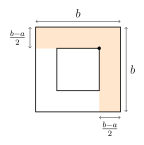
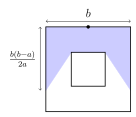
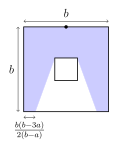
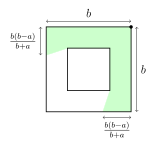
A prison consists of a square courtyard of side \(b\) bounded by a perimeter wall and a square building of side \(a\) placed centrally within the courtyard. The sides of the building are parallel to the perimeter walls. Guards can stand either at the middle of a perimeter wall or in a corner of the courtyard. If the guards wish to see as great a length of the perimeter wall as possible, determine which of these positions is preferable. You should consider separately the cases \(b<3a\) and \(b>3a\,\).
Solution:
1998 Paper 2 Q11
A fielder, who is perfectly placed to catch a ball struck by the batsman in a game of cricket, watches the ball in flight. Assuming that the ball is struck at the fielder's eye level and is caught just in front of her eye, show that \(\frac{ {\rm d}}{{\rm d t}} (\tan\theta ) \) is constant, where \(\theta\) is the angle between the horizontal and the fielder's line of sight. In order to catch the next ball, which is also struck towards her but at a different velocity, the fielder runs at constant speed \(v\) towards the batsman. Assuming that the ground is horizontal, show that the fielder should choose \(v\) so that \(\frac{ {\rm d}}{{\rm d t}} (\tan\theta ) \) remains constant.
Solution: Set up a coordinate frame such that the position of the catch is the origin and the time of the catch is \(t = 0\) . We must have then that the trajectory of the ball is \(\mathbf{s} =\mathbf{u} t + \frac12 \mathbf{g} t^2 = \binom{u_x t}{u_y t - \frac12 gt^2}\). We must then have: \begin{align*} && \tan \theta &= \frac{u_y t - \frac12 gt^2}{u_x t} \\ &&&= \frac{u_y}{u_x} - \frac{g}{2u_x} t \\ \Rightarrow && \frac{\d}{\d \theta} \left ( \tan \theta \right) &= 0 - \frac{g}{2 u_x} \end{align*} which is clearly constant. Set coordinates so \(y\)-axis starts from eye-level and \(t = 0\) the first time the ball reaches that level. (Or move the trajectory backwards if that's not the case). Then the ball has trajectory \(\binom{u_xt}{u_yt - \frac12 gt^2}\). The ball reaches eye level a second time when \(t = \frac{2u_y}{g}\), ie at a point \(\frac{2u_xu_y}{g}\). The fielder therefore needs to have position \(f + (u_x-\frac{g}{2u_y}f)t\) at all times. Therefore \begin{align*} && \tan \theta &= \frac{u_y t - \frac12 gt^2}{f + (u_x-\frac{g}{2u_y}f)t - u_x t} \\ &&&= \frac{u_y t - \frac12 gt^2}{f(1-\frac{g}{2u_y}t)} \\ &&&= \frac{u_yt ( 1- \frac{g}{2u_y}t)}{f( 1- \frac{g}{2u_y}t)} \\ &&&= u_y t \\ \Rightarrow && \frac{\d}{\d \theta} \left ( \tan \theta \right) &= u_y \end{align*} Ie \( \frac{\d}{\d \theta} \left ( \tan \theta \right) \) is constant as required.
1991 Paper 1 Q4
\(\ \)
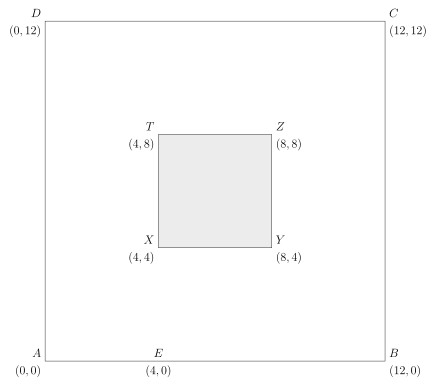
- as small as possible,
- as large as possible.
Solution:
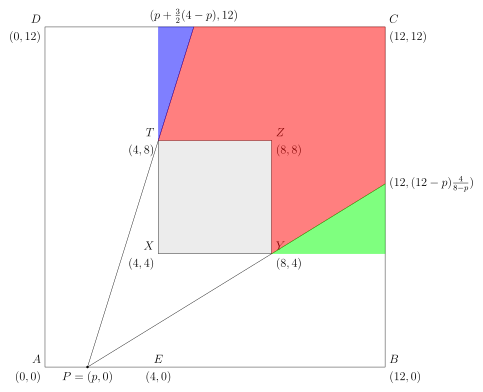
- Since the area not visible is increasing as \(p\) increases, we would like \(p\) to be as large as possible, ie \(p = 4\).
- Similarly, he can see the most when \(p =0\)