Problems
Filters
2 problems found
2015 Paper 2 Q9
An equilateral triangle \(ABC\) is made of three light rods each of length \(a\). It is free to rotate in a vertical plane about a horizontal axis through \(A\). Particles of mass \(3m\) and \(5m\) are attached to \(B\) and \(C\) respectively. Initially, the system hangs in equilibrium with \(BC\) below \(A\).
- Show that, initially, the angle \(\theta\) that \(BC\) makes with the horizontal is given by \(\sin\theta = \frac17\).
- The triangle receives an impulse that imparts a speed \(v\) to the particle \(B\). Find the minimum speed \(v_0\) such that the system will perform complete rotations if \(v>v_0\).
Solution:
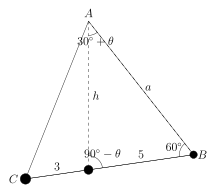
- The sine rule tells us: \begin{align*} && \frac{\frac58 a}{\sin(30^\circ + \theta)} &= \frac{a}{\sin(90^{\circ}-\theta)} \\ \Rightarrow &&\frac58 \cos \theta &= \frac12 \cos \theta+ \frac{\sqrt{3}}2 \sin \theta \\ \Rightarrow && \frac{1}{4\sqrt{3}} &= \tan \theta \\ \Rightarrow && \sin \theta &= \sqrt{\frac{1}{48+1}} = \frac17 \end{align*}
- \(\,\) \begin{align*} && \text{initial energy} &= \frac12(5m)v^2 + \frac12 (3m)v^2 - 3m \cdot g \cdot a \cos(30^{\circ}+\theta) -5m \cdot g \cdot a\cos(30^\circ - \theta) \\ &&&= 4m v^2 - amg(4\sqrt{3} \cos \theta + \sin \theta) \\ &&&= 4mv^2 - 7amg \\ && \text{energy at top} &= \frac12 m v_{top}^2 + 7amg \end{align*} We need this equation to be positive for all values of \(v_{top} \geq 0\), so \(4mv^2 \geq 14amg \Rightarrow v_0 = \sqrt{\frac{7ag}2}\)
1998 Paper 2 Q9
A light smoothly jointed planar framework in the form of a regular hexagon \(ABCDEF\) is suspended smoothly from \(A\) and a weight 1kg is suspended from \(C\). The framework is kept rigid by three light rods \(BD\), \(BE\) and \(BF\). What is the direction and magnitude of the supporting force which must be exerted on the framework at \(A\)? Indicate on a labelled diagram which rods are in thrust (compression) and which are in tension. Find the magnitude of the force in \(BE\).