Problems
Filters
2 problems found
1994 Paper 1 Q11
D: 1500.0
B: 1469.5
mechanics
motion on a slope
inclined plane
pulley
Newton's second law
energy conservation
kinematics
light inextensible string
inequality
\(\,\)
\psset{xunit=1.0cm,yunit=1.0cm,algebraic=true,dotstyle=o,dotsize=3pt 0,linewidth=0.3pt,arrowsize=3pt 2,arrowinset=0.25}
\begin{pspicture*}(-2.2,-0.26)(7.1,4.4)
\pscircle[fillcolor=black,fillstyle=solid,opacity=0.4](5,4){0.19}
\psline(-2,0)(7,0)
\psline(0,0)(5,4)
\psline(5,4)(5,0)
\psline(-0.08,0.26)(4.88,4.15)
\rput[tl](-0.4,0.98){\(A\)}
\rput[tl](5.59,3){\(B\)}
\psline(5.18,4.02)(5.18,3)
\begin{scriptsize}
\psdots[dotsize=13pt 0,dotstyle=*](-0.08,0.23)
\psdots[dotsize=11pt 0,dotstyle=*](5.18,3)
\end{scriptsize}
\end{pspicture*}
\par
The diagram shows a small railway wagon \(A\) of mass \(m\) standing
at the bottom of a smooth railway track of length \(d\) inclined at
an angle \(\theta\) to the horizontal. A light inextensible string,
also of length \(d\), is connected to the wagon and passes over a light
frictionless pulley at the top of the incline. On the other end of
the string is a ball \(B\) of mass \(M\) which hangs freely. The system
is initially at rest and is then released.
- Find the condition which \(m,M\) and \(\theta\) must satisfy to ensure that the ball will fall to the ground. Assuming that this condition is satisfied, show that the velocity \(v\) of the ball when it hits the ground satisfies \[ v^{2}=\frac{2g(M-m\sin\theta)d\sin\theta}{M+m}. \]
- Find the condition which \(m,M\) and \(\theta\) must satisfy if the wagon is not to collide with the pulley at the top of the incline.
1989 Paper 2 Q14
D: 1600.0
B: 1473.5
circular motion
horizontal table
string tension
energy conservation
constraint force
optimisation
light inextensible string
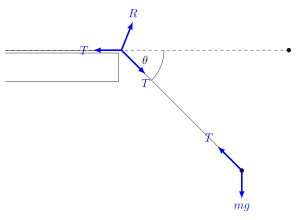
One end of a light inextrnsible string of length \(l\) is fixed to a point on the upper surface of a thin, smooth, horizontal table-top, at a distance \((l-a)\) from one edge of the table-top. A particle of mass \(m\) is fixed to the other end of the string, and held a distance \(a\) away from this edge of the table-top, so that the string is horizontal and taut. The particle is then released. Find the tension in the string after the string has rotated through an angle \(\theta,\) and show that the largest magnitude of the force on the edge of the table top is \(8mg/\sqrt{3}.\)
Solution: