Problems
Filters
6 problems found
2019 Paper 1 Q9
A box has the shape of a uniform solid cuboid of height \(h\) and with a square base of side \(b\), where \(h > b\). It rests on rough horizontal ground. A light ladder has its foot on the ground and rests against one of the upper horizontal edges of the box, making an acute angle of \(\alpha\) with the ground, where \(h = b \tan \alpha\). The weight of the box is \(W\). There is no friction at the contact between ladder and box. A painter of weight \(kW\) climbs the ladder slowly. Neither the base of the ladder nor the box slips, but the box starts to topple when the painter reaches height \(\lambda h\) above the ground, where \(\lambda < 1\). Show that:
- \(R = k\lambda W \cos \alpha\), where \(R\) is the magnitude of the force exerted by the box on the ladder;
- \(2k\lambda \cos 2\alpha + 1 = 0\);
- \(\mu \geq \frac{\sin 2\alpha}{1 - 3 \cos 2\alpha}\), where \(\mu\) is the coefficient of friction between the box and the ground.
Solution:

- \(\,\) \begin{align*} \overset{\curvearrowright}{X}:&& kW \cdot \lambda h\cos \alpha - R h &= 0 \\ \Rightarrow && R &= k\lambda W \cos \alpha \\ \end{align*}
- \(\,\) \begin{align*} \overset{\curvearrowright}{C}:&& R \sin \alpha \cdot h-R\cos \alpha \cdot b-W\frac{b}{2} &= 0 \\ && k\lambda W \cos \alpha \sin \alpha \cdot b \tan \alpha- k\lambda W \cos \alpha\cos \alpha \cdot h-W\frac{b}{2} &= 0 \\ && k \lambda (\cos^2 \alpha - \sin^2 \alpha) +\frac12 &= 0 \\ \Rightarrow && 2k \lambda \cos 2\alpha + 1 &= 0 \end{align*}
- \(\,\) \begin{align*} \text{N2}(\uparrow): && R_b -W-R\cos \alpha &= 0 \\ \Rightarrow && R_b &= W + k\lambda W \cos^2 \alpha\\ \text{N2}(\rightarrow): && R\sin \alpha - F_b &= 0 \\ \Rightarrow && F_b &= R \sin \alpha \\ \\ && F_b &\leq \mu R \\ \Rightarrow && k\lambda W \cos \alpha \sin \alpha &= \mu (W + k\lambda W \cos^2 \alpha) \\ \Rightarrow && \mu &\geq \frac{k\lambda \cos \alpha \sin \alpha}{1 + k\lambda \cos^2 \alpha} \\ &&&= \frac{k\lambda \sin 2\alpha}{2 + 2k\lambda cos^2 \alpha} \\ &&&= \frac{k\lambda \sin 2\alpha}{2 + k\lambda (\cos 2 \alpha+1)} \\ &&&= \frac{k\lambda \sin 2\alpha}{-4k\lambda \cos 2 \alpha + k\lambda (\cos 2 \alpha+1)} \\ &&&= \frac{\sin 2 \alpha}{1 -3 \cos 2\alpha} \end{align*}
2006 Paper 2 Q9
A painter of weight \(kW\) uses a ladder to reach the guttering on the outside wall of a house. The wall is vertical and the ground is horizontal. The ladder is modelled as a uniform rod of weight \(W\) and length \(6a\). The ladder is not long enough, so the painter stands the ladder on a uniform table. The table has weight \(2W\) and a square top of side \(\frac12 a\) with a leg of length \(a\) at each corner. The foot of the ladder is at the centre of the table top and the ladder is inclined at an angle \(\arctan 2\) to the horizontal. The edge of the table nearest the wall is parallel to the wall. The coefficient of friction between the foot of the ladder and the table top is \(\frac12\). The contact between the ladder and the wall is sufficiently smooth for the effects of friction to be ignored.
- Show that, if the legs of the table are fixed to the ground, the ladder does not slip on the table however high the painter stands on the ladder.
- It is given that \(k=9\) and that the coefficient of friction between each table leg and the ground is \(\frac13\). If the legs of the table are not fixed to the ground, so that the table can tilt or slip, determine which occurs first when the painter slowly climbs the ladder.
2004 Paper 1 Q11
Two uniform ladders \(AB\) and \(BC\) of equal length are hinged smoothly at \(B\). The weight of \(AB\) is \(W\) and the weight of \(BC\) is \(4W \). The ladders stand on rough horizontal ground with \(\angle ABC=60^\circ\,\). The coefficient of friction between each ladder and the ground is \(\mu\). A decorator of weight \(7W\) begins to climb the ladder \(AB\) slowly. When she has climbed up \(\frac13\) of the ladder, one of the ladders slips. Which ladder slips, and what is the value of \(\mu\)?
Solution:

2002 Paper 2 Q11
A rigid straight beam \(AB\) has length \(l\) and weight \(W\). Its weight per unit length at a distance \(x\) from \(B\) is \(\alpha Wl^{-1} (x/l)^{\alpha-1}\,\), where \(\alpha\) is a positive constant. Show that the centre of mass of the beam is at a distance \(\alpha l/(\alpha+1)\) from \(B\). The beam is placed with the end \(A\) on a rough horizontal floor and the end \(B\) resting against a rough vertical wall. The beam is in a vertical plane at right angles to the plane of the wall and makes an angle of \(\theta\) with the floor. The coefficient of friction between the floor and the beam is \(\mu\) and the coefficient of friction between the wall and the beam is also \(\mu\,\). Show that, if the equilibrium is limiting at both \(A\) and \(B\), then \[ \tan\theta = \frac{1-\alpha \mu^2}{(1+\alpha)\mu}\;. \] Given that \(\alpha =3/2\,\) and given also that the beam slides for any \(\theta<\pi/4\,\) find the greatest possible value of \(\mu\,\).
1989 Paper 1 Q13
A uniform ladder of mass \(M\) rests with its upper end against a smooth vertical wall, and with its lower end on a rough slope which rises upwards towards the wall and makes an angle of \(\phi\) with the horizontal. The acute angle between the ladder and the wall is \(\theta\). If the ladder is in equilibrium, show that \(N\) and \(F\), the normal reaction and frictional force at the foot of the ladder are given by \[ N=Mg\left(\cos\phi-\frac{\tan\theta\sin\phi}{2}\right), \] \[ F=Mg\left(\sin\phi+\frac{\tan\theta\cos\phi}{2}\right). \] If the coefficient of friction between the ladder and the slope is \(2\), and \(\phi=45^{\circ}\), what is the largest value of \(\theta\) for which the ladder can rest in equilibrium?
Solution: \begin{align*} \overset{\curvearrowleft}{X}: && 0&= \frac{l}{2} Mg\sin \theta - l R_1 \cos \theta \\ \Rightarrow && R_1 &= \frac12 \tan \theta Mg \\ \text{N2}(\uparrow): && 0 &= R\cos \phi +F \sin \phi - Mg \\ \text{N2}(\rightarrow):&& 0&=R_1-F \cos \phi + R \sin \phi \\ \Rightarrow && \frac12 \tan \theta Mg &= F \cos \phi- R \sin \phi \\ && Mg &= F \sin \phi +R \cos \phi \\ \Rightarrow && F &= Mg \left ( \sin \phi + \frac12 \tan \theta \cos \phi \right) \\ && N &= Mg \left (\cos \phi - \frac12 \tan \theta \sin \phi \right ) \end{align*} If \(\mu = 2\) and \(\phi = 45^{\circ}\), we must have \(F \leq 2 N\), so: \begin{align*} && Mg \left ( \sin \phi + \frac12 \tan \theta \cos \phi \right) &\leq 2 Mg \left (\cos \phi - \frac12 \tan \theta \sin \phi \right ) \\ \Rightarrow && 1 + \frac12 \tan \theta \leq 2-\tan \theta \\ \Rightarrow && \frac 32 \tan \theta \leq 1 \\ \Rightarrow && \tan \theta \leq \frac23 \\ \Rightarrow && \theta \leq \tan^{-1} \frac23 \end{align*}
1988 Paper 3 Q11
A uniform ladder of length \(l\) and mass \(m\) rests with one end in contact with a smooth ramp inclined at an angle of \(\pi/6\) to the vertical. The foot of the ladder rests, on horizontal ground, at a distance \(l/\sqrt{3}\) from the foot of the ramp, and the coefficient of friction between the ladder and the ground is \(\mu.\) The ladder is inclined at an angle \(\pi/6\) to the horizontal, in the vertical plane containing a line of greatest slope of the ramp. A labourer of mass \(m\) intends to climb slowly to the top of the ladder.
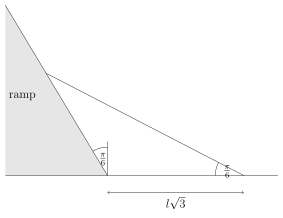
- Find the value of \(\mu\) if the ladder slips as soon as the labourer reaches the midpoint.
- Find the minimum value of \(\mu\) which will ensure that the labourer can reach the top of the ladder.
Solution:
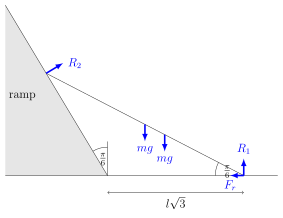
- \begin{align*} \text{N2}(\uparrow): && R_1 + R_2\sin(\frac{\pi}{6})-2mg &= 0 \\ \text{N2}(\rightarrow): && R_2 \cos (\frac{\pi}{6})-F_r &= 0 \\ \overset{\curvearrowleft}{X}: && lmg \cos \tfrac{\pi}{6} - l R_2 \cos \tfrac{\pi}{6} &= 0 \\ \\ \Rightarrow && R_2 &= mg \\ \Rightarrow && R_1 &= 2mg - \frac12mg \\ &&&=\frac32mg \\ \Rightarrow && \frac{\sqrt{3}}2mg - \mu\frac32mg &= 0 \\ \Rightarrow && \mu &= \frac{1}{\sqrt{3}} \end{align*}
- \begin{align*} \text{N2}(\uparrow): && R_1 + R_2\sin(\frac{\pi}{6})-2mg &= 0 \\ \overset{\curvearrowleft}{X}: && \frac12 lmg \cos \tfrac{\pi}{6}+xmg \cos \tfrac{\pi}{6} - l R_2 \cos \tfrac{\pi}{6} &= 0 \\ \\ \Rightarrow && R_2 &= mg(\frac{1}2+\frac{x}{l}) \\ \Rightarrow && R_1 &= 2mg - \frac12mg(\frac{1}2+\frac{x}{l}) \\ &&&=(\frac74 - \frac{x}{2l})mg \\ &&&\geq \frac{5}{4}mg\\ \text{N2}(\rightarrow): && R_2 \cos (\frac{\pi}{6})-\mu R_1& \leq 0 \\ \Rightarrow && \frac{\sqrt{3}}2mg - \mu\frac54mg &\leq 0 \\ \Rightarrow && \mu &\geq \frac{2\sqrt{3}}{5} \end{align*}