Problems
Filters
5 problems found
2012 Paper 2 Q11
A small block of mass \(km\) is initially at rest on a smooth horizontal surface. Particles \(P_1\), \(P_2\), \(P_3\), \(\ldots\) are fired, in order, along the surface from a fixed point towards the block. The mass of the \(i\)th particle is \(im\) (\(i = 1, 2, \ldots\))and the speed at which it is fired is \(u/i\,\). Each particle that collides with the block is embedded in it. Show that, if the \(n\)th particle collides with the block, the speed of the block after the collision is \[ \frac{2nu}{2k +n(n+1)}\,. \] In the case \(2k = N(N+1)\), where \(N\) is a positive integer, determine the number of collisions that occur. Show that the total kinetic energy lost in all the collisions is \[ \tfrac12 mu^2\bigg( \sum_{n=2}^{N+1} \frac 1 n \bigg)\,. \]
Solution: \begin{align*} \text{COM}: && \sum_{i=1}^n im \cdot \frac{u}{i} &= \left ( km + \sum_{i=1}^n im \right) v \\ \Rightarrow && nu &= \left ( k + \frac{n(n+1)}{2} \right) v \\ \Rightarrow && v &= \frac{2nu}{2k + n(n+1)} \end{align*} If \(2k = N(N+1)\), there will be no more collisions when \(v_n > \frac{u}{n+1}\), ie \begin{align*} && \frac{u}{n+1} &<\frac{2nu}{2k + n(n+1)} \\ \Leftrightarrow && N(N+1) + n(n+1) &< 2n(n+1) \\ \Leftrightarrow && N(N+1) &< n(n+1) \\ \end{align*} Therefore \(n = N+1\) and there will be \(N+1\) collisions. The loss of kinetic energy is: \begin{align*} && \text{initial k.e.} &= \sum_{k=1}^{N+1} \frac12 im \cdot \frac{u^2}{i^2} \\ &&&= \frac12 m u^2 \left ( \sum_{k=1}^{N+1} \frac{1}{i}\right) \\ && \text{final k.e.} &= \frac12 \left ( k + \frac{(N+1)(N+2)}{2}\right)m \left ( \frac{2(N+1)u}{N(N+1)+(N+1)(N+2)} \right)^2 \\ &&&= \frac12 m u^2 \frac{2(N+1)^2}{(N+1)(2N+2)} \\ &&&= \frac12 mu^2 \\ \Rightarrow && \Delta \text{ k.e.} &= \frac12 m u^2 \left ( \sum_{k=2}^{N+1} \frac{1}{i}\right) \end{align*}
2009 Paper 1 Q11
Two particles move on a smooth horizontal table and collide. The masses of the particles are \(m\) and \(M\). Their velocities before the collision are \(u{\bf i}\) and \(v{\bf i}\,\), respectively, where \(\bf i\) is a unit vector and \(u>v\). Their velocities after the collision are \(p{\bf i}\) and \(q{\bf i}\,\), respectively. The coefficient of restitution between the two particles is \(e\), where \(e<1\).
- Show that the loss of kinetic energy due to the collision is \[ \tfrac12 m (u-p)(u-v)(1-e)\,, \] and deduce that \(u\ge p\).
- Given that each particle loses the same (non-zero) amount of kinetic energy in the collision, show that \[ u+v+p+q=0\,, \] and that, if \(m\ne M\), \[ e= \frac{(M+3m)u + (3M+m)v}{(M-m)(u-v)}\,. \]
Solution:
- \begin{align*} \text{COM}: && mu + Mv &= mp + Mq \\ \Rightarrow && m(u-p) &= M(q-v) \\ \text{NEL}: && q-p &= e(u-v) \\ && q +ev &= p+eu \\ && \Delta \text{ k.e.} &= \frac12 m u^2 + \frac12 M v^2 -\frac12 m p^2 - \frac12 M q^2 \\ &&&= \frac12m (u^2 - p^2)+\frac12M(v^2-q^2) \\ &&&= \frac12m (u^2 - p^2)+\frac12M(v-q)(v+q) \\ &&&= \frac12m(u^2-p^2) - \frac12 m(u-p)(v+q) \\ &&&= \frac12 m(u-p) \left ( u+p-v-q\right) \\ &&&= \frac12 m(u-p) \left (u-v+(p-q)\right) \\ &&&= \frac12 m(u-p) \left (u-v-e(u-v)\right) \\ &&&= \frac12m(u-p)(u-v)(1-e) \end{align*} Since the loss in energy is positive, and \(m\), \(u-v\) and \(1-e\) are all positive, so is \(u-p\), ie \(u \geq p\)
- \begin{align*} && \frac12 m u^2 - \frac12mp^2 &= \frac12Mv^2 - \frac12Mq^2 \\ && \frac12 m(u-p)(u+p) &= \frac12 M (v-q)(v+q) \\ && \frac12 m (u-p)(u+p) &= -\frac12 m(u-p)(v+q) \\ \Rightarrow && u+p+v+q &= 0 \end{align*} \begin{align*} && p+q &= -(u+v)\\ &&mp+Mq &= mu+Mv \\ \Rightarrow && (M-m)q &= mu+Mv+mu+mv\\ \Rightarrow && q &= \frac{(M+m)v+2mu}{M-m} \\ \Rightarrow && (m-M)p &= mu+Mv+Mu+Mv \\ \Rightarrow && p &= -\frac{(M+m)u+2Mv}{M-m} \\ \\ && e &= \frac{q-p}{u-v} \\ &&&= \frac{(M+m)v+2mu+(M+m)u+2Mv}{(u-v)(M-m)} \\ &&&= \frac{(3M+m)v+(3m+M)u}{(u-v)(M-m)} \end{align*}
2008 Paper 2 Q10
The lengths of the sides of a rectangular billiards table \(ABCD\) are given by \(AB = DC = a\) and \(AD=BC = 2b\). There are small pockets at the midpoints \(M\) and \(N\) of the sides \(AD\) and \(BC\), respectively. The sides of the table may be taken as smooth vertical walls. A small ball is projected along the table from the corner \(A\). It strikes the side \(BC\) at \(X\), then the side \(DC\) at \(Y\) and then goes directly into the pocket at \(M\). The angles \(BAX\), \(CXY\) and \(DY\!M\) are \(\alpha\), \(\beta\) and \(\gamma\) respectively. On each stage of its path, the ball moves with constant speed in a straight line, the speeds being \(u\), \(v\) and \(w\) respectively. The coefficient of restitution between the ball and the sides is \(e\), where \(e>0\).
- Show that \(\tan\alpha \tan \beta = e\) and find \(\gamma\) in terms of \(\alpha\).
- Show that \(\displaystyle \tan\alpha = \frac {(1+2e)b} {(1+e)a}\) and deduce that the shot is possible whatever the value of \(e\).
- Find an expression in terms of \(e\) for the fraction of the kinetic energy of the ball that is lost during the motion.
Solution:
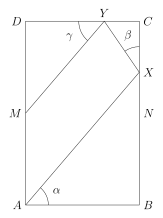
- The initial velocity is \(u = \binom{u \cos\alpha}{u \sin \alpha}\), therefore \(v = \binom{v_x}{u \sin \alpha}\). Newton's experimental law tells us \(v_x = -e u_x = -eu \cos\alpha\), therefore \(v = \binom{-eu \cos \alpha}{u \sin \alpha} = \binom{-v \sin \beta}{v\cos \beta} \Rightarrow -\tan \beta = -e \cot \alpha \Rightarrow \tan \alpha \tan \beta = e\). There is nothing special about the result here, and so it must also be the case that \(\tan \beta \tan \gamma = e \Rightarrow \tan \gamma = \tan \alpha\)
- \(\tan \alpha = \frac{XB}{BA}\) so the point \(X\) is at \((a, \tan \alpha a)\). The point \(Y\) satisfies \(\tan \beta = \frac{CY}{CX} = \frac{CY}{2b - \tan \alpha a}\) so the point \(Y\) is \((a-(2b - a \tan \alpha)\tan \beta,2b) = (a - 2b\tan \beta + ea, 2b) = ((1+e)a-2b\tan \beta, 2b)\). Finally, the point \(M\) is the midpoint, so \(\tan \gamma = \frac{DM}{DY}\) so \(M\) is the point \((0, 2b - ((1+e)a-2b\tan \beta)\tan \gamma) = (0, 2b - (1+e)a \tan \gamma - 2b e) = (0, (2b(1-e) - (1+e)a \tan \gamma)\), but \(M\) is the point \((0, b)\), ie \begin{align*} && b &= 2b(1-e) - (1+e)a \tan \gamma \\ \Rightarrow && b+2eb &= (1+e)a \tan \gamma \\ \Rightarrow && \tan \gamma &= \frac{(1+2e)b}{(1+e)a} \\ \Rightarrow && \tan \alpha &= \frac{(1+2e)b}{(1+e)a} \end{align*} Since \( \frac{(1+2e)b}{(1+e)a} = \frac{b}{a} + \frac{e}{1+e}b\) which is clearly an increasing function of \(e\) on \([0,1]\), so \(\tan \alpha \in \left [\frac{b}{a}, \frac{3b}{2a} \right]\) which are all all angles which place \(X\) in sensible places, therefore we can always hit the middle pocket. (Except \(e = 0\), where we would put the ball in \(N\), but we are given \(e > 0\)).
- After the first collision the velocity is \(\binom{-eu \cos \alpha}{u \sin \alpha}\) after the second collision the velocity is \(\binom{-eu \cos \alpha}{-eu \sin \alpha}\). Initial kinetic energy is therefore \(\frac12 m u^2\) and final kinetic energy is \(\frac12 m e^2u^2\) therefore the fraction lost is \(\frac{\frac12 m u^2 - \frac12 m e^2u^2}{\frac12 m u^2} = 1-e^2\)
2005 Paper 3 Q10
Two thin discs, each of radius \(r\) and mass \(m\), are held on a rough horizontal surface with their centres a distance \(6r\) apart. A thin light elastic band, of natural length \(2\pi r\) and modulus \(\dfrac{\pi mg}{12}\), is wrapped once round the discs, its straight sections being parallel. The contact between the elastic band and the discs is smooth. The coefficient of static friction between each disc and the horizontal surface is \(\mu\), and each disc experiences a force due to friction equal to \(\mu mg\) when it is sliding. The discs are released simultaneously. If the discs collide, they rebound and a half of their total kinetic energy is lost in the collision.
- Show that the discs start sliding, but come to rest before colliding, if and only if \mbox{\(\frac23 <\mu <1\)}.
- Show that, if the discs collide at least once, their total kinetic energy just before the first collision is \(\frac43 mgr(2-3\mu)\).
- Show that if \(\frac 4 9 > \mu^2 >\frac{5}{27}\) the discs come to rest exactly once after the first collision.
2003 Paper 1 Q11
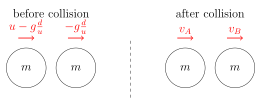
A smooth plane is inclined at an angle \(\alpha\) to the horizontal. \(A\) and \(B\) are two points a distance \(d\) apart on a line of greatest slope of the plane, with \(B\) higher than \(A\). A particle is projected up the plane from \(A\) towards \(B\) with initial speed \(u\), and simultaneously another particle is released from rest at \(B\,\). Show that they collide after a time \(\displaystyle {d /u}\,\). The coefficient of restitution between the two particles is \(e\) and both particles have mass \(m\,\). Show that the loss of kinetic energy in the collision is \(\frac14 {m u^2 \big( 1 - e^2 \big) }\,\).
Solution: We can `ignore' the fact that they are both accelerating, because the acceleration is the same for both object so it will "cancel" out. Therefore the time taken is the same as if the object has to travel distance \(d\) at speed \(u\), ie \(d/u\). \begin{align*} && u_A &= u - g \frac{d}{u} \\ && u_B &= -g\frac{d}{u} \end{align*}