Problems
Filters
3 problems found
2021 Paper 3 Q10
The origin \(O\) of coordinates lies on a smooth horizontal table and the \(x\)- and \(y\)-axes lie in the plane of the table. A cylinder of radius \(a\) is fixed to the table with its axis perpendicular to the \(x\)--\(y\) plane and passing through \(O\), and with its lower circular end lying on the table. One end, \(P\), of a light inextensible string \(PQ\) of length \(b\) is attached to the bottom edge of the cylinder at \((a, 0)\). The other end, \(Q\), is attached to a particle of mass \(m\), which rests on the table. Initially \(PQ\) is straight and perpendicular to the radius of the cylinder at \(P\), so that \(Q\) is at \((a, b)\). The particle is then given a horizontal impulse parallel to the \(x\)-axis so that the string immediately begins to wrap around the cylinder. At time \(t\), the part of the string that is still straight has rotated through an angle \(\theta\), where \(a\theta < b\).
- Obtain the Cartesian coordinates of the particle at this time. Find also an expression for the speed of the particle in terms of \(\theta\), \(\dot{\theta}\), \(a\) and \(b\).
- Show that \[ \dot{\theta}(b - a\theta) = u, \] where \(u\) is the initial speed of the particle.
- Show further that the tension in the string at time \(t\) is \[ \frac{mu^2}{\sqrt{b^2 - 2aut}}. \]
Solution:
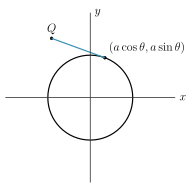
- The line to the circle is tangent, and the point it meets the circle is \((a \cos \theta, a \sin \theta)\) and it will be a distance \(b - a \theta\) away, therefore it is at \((a \cos \theta - (b-a \theta) \sin \theta, a \sin \theta + (b-a \theta) \cos \theta)\)
- The velocity will be \(\displaystyle \binom{-a \dot{\theta}\sin \theta-b \dot{\theta}\cos \theta + a \dot{\theta} \sin \theta + a \theta \dot{\theta} \cos \theta}{ a \dot{\theta} \cos \theta - b \dot{\theta} \sin \theta -a \dot{\theta} \cos \theta + a \theta \dot{\theta} \sin \theta}= \binom{-b \dot{\theta}\cos \theta + a \theta \dot{\theta} \cos \theta}{ - b \dot{\theta} \sin \theta + a \theta \dot{\theta} \sin \theta}\) Therefore the speed will be \(\dot{\theta}(b-a\theta)\)
- Conservation of energy and the fact that the tension is perpendicular to the velocity means no work is being done on the particle and hence it's speed is unchanged. So \(u = \dot{\theta}(b-a\theta)\).
- Note that the acceleration is \begin{align*} && \mathbf{a} &= \frac{\d}{\d t} \left (-\dot{\theta}(b-a\theta) \binom{\cos \theta}{\sin \theta} \right) \\ &&&=-u \dot{\theta}\binom{-\sin \theta}{\cos \theta} \\ \Rightarrow && T &= ma \\ &&&= \frac{mu^2}{b - a \theta} \end{align*} It would be valuable to have \(\theta\) in terms of \(t\), so we want to solve \begin{align*} &&\frac{\d \theta}{\d t} (b-a\theta) &= u \\ \Rightarrow && b \theta - a\frac{\theta^2}{2} + C &= ut \\ t = 0, \theta = 0: && C &= 0 \\ \Rightarrow && b\theta - \frac{a}{2} \theta^2 &= ut \\ \Rightarrow && \theta &= \frac{b \pm \sqrt{b^2-2aut}}{a} \end{align*} At \(t\) increases, \(\theta\) increases so \(a\theta = b -\sqrt{b^2-2aut}\) or \(b-a \theta = \sqrt{b^2-2aut}\) and the result follows
2011 Paper 2 Q8
The end \(A\) of an inextensible string \(AB\) of length \(\pi\) is attached to a point on the circumference of a fixed circle of unit radius and centre \(O\). Initially the string is straight and tangent to the circle. The string is then wrapped round the circle until the end \(B\) comes into contact with the circle. The string remains taut during the motion, so that a section of the string is in contact with the circumference and the remaining section is straight. Taking \(O\) to be the origin of cartesian coordinates with \(A\) at \((-1,0)\) and \(B\) initially at \((-1, \pi)\), show that the curve described by \(B\) is given parametrically by \[ x= \cos t + t\sin t\,, \ \ \ \ \ \ y= \sin t - t\cos t\,, \] where \(t\) is the angle shown in the diagram.
1992 Paper 3 Q14
\(\,\)