Problems
Filters
4 problems found
2018 Paper 3 Q6
- The distinct points \(A\), \(Q\) and \(C\) lie on a straight line in the Argand diagram, and represent the distinct complex numbers \(a\), \(q\) and \(c\), respectively. Show that \(\dfrac {q-a}{c-a}\) is real and hence that \((c-a)(q^*-a^*) = (c^*-a^*)(q-a)\,\). Given that \(aa^* = cc^* = 1\), show further that \[ q+ ac q^* = a+c \,. \]
- The distinct points \(A\), \(B\), \(C\) and \(D\) lie, in anticlockwise order, on the circle of unit radius with centre at the origin (so that, for example, \(aa^* =1\)). The lines \(AC\) and \(BD\) meet at \(Q\). Show that \[ (ac-bd)q^* = (a+c)-(b+d) \,, \] where \(b\) and \(d\) are complex numbers represented by the points \(B\) and \(D\) respectively, and show further that \[ (ac-bd) (q+q^*) = (a-b)(1+cd) +(c-d)(1+ab) \,. \]
- The lines \(AB\) and \(CD\) meet at \(P\), which represents the complex number \(p\). Given that \(p\) is real, show that \(p(1+ab)=a+b\,\). Given further that \(ac-bd \ne 0\,\), show that \[ p(q+q^*) = 2 \,. \]
Solution:
- \(A\), \(Q\), \(C\) lie on a straight line if \(q = \lambda a + (1-\lambda)c\) for some \(\lambda \in \mathbb{R}\), \begin{align*} && q &= \lambda a + (1-\lambda)c \\ \Leftrightarrow && q - a &= (\lambda - 1)a + (1-\lambda)c \\ \Leftrightarrow && q - a &= (\lambda - 1)(a-c) \\ \Leftrightarrow && \frac{q - a}{c-a} &= 1-\lambda \\ \end{align*} therefore \(\frac{q-a}{c-a} \in \mathbb{R}\) \begin{align*} && \frac{q-a}{c-a} & \in \mathbb{R} \\ \Leftrightarrow && \left (\frac{q-a}{c-a} \right)^* &= \frac{q-a}{c-a} \\ \Leftrightarrow && (q^*-a^*)(c-a) &= (q-a)(c^*-a^*) \\ \end{align*} Given \(aa^* = cc^* = 1\), \begin{align*} && (q^*-a^*)(c-a) &= (q-a)(c^*-a^*) \\ \Leftrightarrow && q^*(c-a) - \frac{c}{a}+1 &= q \frac{a-c}{ca} - \frac{a}{c}+1 \\ \Leftrightarrow && (c-a)\l q^* +\frac{q}{ca}\r &= \frac{c}{a} - \frac{a}{c} \\ &&&= \frac{c^2-a^2}{ac} \\ \Leftrightarrow && q^* +\frac{q}{ca} &= \frac{c+a}{ac} \\ \Leftrightarrow && q^*ac +q &= a+c \end{align*}
- Since \(Q\) lies on \(AC\) and \(BD\) we must have \begin{align*} &&& \begin{cases} q^*ac +q &= a+c \\ q^*bd +q &= b+d \\ \end{cases} \\ \Rightarrow && q^*(ac-bd) &= (a+c)-(b+d) \\ \Rightarrow && q(ac-bd) &= (b+d)ac-(a+c)bd \\ \Rightarrow && (q+q^*)(ac-bd) &= (a+c)(1-bd)+(b+d)(ac-1) \\ &&&=a-abd+c-bcd+abc-b+acd-d \\ &&&= a(1+cd)-b(1+cd)+c(1+ab)-d(1+ab) \\ &&&= (a-b)(1+cd)+(c-d)(1+ab) \end{align*}
- If \(AB\) and \(CD\) meet at \(p\) we must have \(p^*ab + p = a+b\), ie \(p(1+ab) = a+b\) amd \(p(1+cd) = c+d\), so \begin{align*} && (q+q^*)(ac-bd) &= (a-b) \frac{c+d}{p} + (c-d) \frac{a+b}{p} \\ \Leftrightarrow && p(q+q^*)(ac-bd) &= (a-b)(c+d)+(c-d)(a+b) \\ &&&= ac+ad-bc-bd+ac+bc-ad-bd \\ &&&= 2(ac-bd) \\ \Leftrightarrow && p(q+q^*) &= 2 \end{align*}
2014 Paper 1 Q7
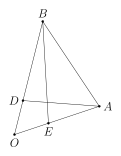
In the triangle \(OAB\), the point \(D\) divides the side \(BO\) in the ratio \(r:1\) (so that \(BD = rDO\)), and the point \(E\) divides the side \(OA\) in the ratio \(s:1\) (so that \(OE =s EA\)), where \(r\) and \(s\) are both positive.
- The lines \(AD\) and \(BE\) intersect at \(G\). Show that \[ \mathbf{g}= \frac{rs}{1+r+rs} \, \mathbf{a} + \frac 1 {1+r+rs} \, \mathbf{b} \,, \] where \(\mathbf{a}, \mathbf{b}\) and \(\mathbf{g}\) are the position vectors with respect to \(O\) of \(A\), \(B\) and \(G\), respectively.
- The line through \(G\) and \(O\) meets \(AB\) at \(F\). Given that \(F\) divides \(AB\) in the ratio \(t:1\), find an expression for \(t\) in terms of \(r\) and \(s\).
Solution:
2008 Paper 3 Q3
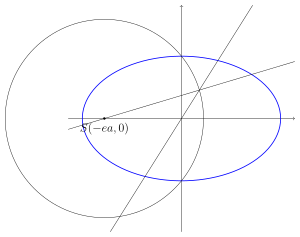
The point \(P(a\cos\theta\,,\, b\sin\theta)\), where \(a>b>0\), lies on the ellipse \[\dfrac {x^2}{a^2} + \dfrac {y^2}{b^2}=1\,.\] The point \(S(-ea\,,\,0)\), where \(b^2=a^2(1-e^2)\,\), is a focus of the ellipse. The point \(N\) is the foot of the perpendicular from the origin, \(O\), to the tangent to the ellipse at \(P\). The lines \(SP\) and \(ON\) intersect at \(T\). Show that the \(y\)-coordinate of \(T\) is \[\dfrac{b\sin\theta}{1+e\cos\theta}\,.\] Show that \(T\) lies on the circle with centre \(S\) and radius \(a\).
Solution: Find the gradient of the tangent of the ellipse at \(P\): \begin{align*} && \frac{2x}{a^2} + \frac{2y}{b^2} \frac{\d y}{\d x} &= 0 \\ \Rightarrow && \frac{\d y}{\d x} &= - \frac{2xb^2}{2ya^2} \\ &&&=- \frac{a \cos \theta b^2}{b \sin \theta a^2} \\ &&&=-\frac{b}{a} \cot \theta \end{align*} Therefore the gradient of \(ON\) is \(\frac{a}{b} \tan \theta\). \begin{align*} && y &= \frac{a}{b} \tan \theta x \\ && \frac{y-0}{x-(-ea)} &= \frac{b\sin \theta-0}{a\cos \theta -(-ea)} \\ && y &= \frac{b \sin \theta}{a(e+\cos \theta)}(x+ea) \\ \Rightarrow && y &= \frac{b \sin \theta}{a(\cos \theta+e)}\frac{b}{a} \cot \theta y+ \frac{eb \sin \theta}{\cos \theta + e} \\ &&&= \frac{b^2 \cos \theta}{a^2(\cos \theta +e)}y + \frac{eb \sin \theta}{\cos \theta + e} \\ \Rightarrow && (\cos \theta+e)y &= (1-e^2)\cos \theta y +eb \sin \theta\\ && e(1+e\cos \theta)y &= eb \sin \theta \\ \Rightarrow && y &= \frac{b \sin \theta}{1+e\cos \theta} \\ && x &= \frac{b \sin \theta}{1+e\cos \theta} \frac{b}{a} \cot \theta \\ &&&= \frac{b^2 \cos \theta}{a(1+e\cos \theta)} \end{align*} Therefore \(\displaystyle T\left (\frac{b^2 \cos \theta}{a(1+e\cos \theta)}, \frac{b \sin \theta}{1+e\cos \theta} \right)\). Finally, we can look at the distance of \(T\) from \(S\) \begin{align*} && d^2 &= \left (\frac{b^2 \cos \theta}{a(1+e\cos \theta)}-(-ea) \right)^2 + \left (\frac{b \sin \theta}{1+e\cos \theta} -0\right)^2 \\ &&&= \frac{\left (b^2 \cos \theta+ea^2(1+e\cos\theta)\right)^2 + \left ( ab \sin \theta\right)^2}{a^2(1+e\cos \theta)^2} \\ &&&= \frac{b^4\cos^2\theta+e^2a^4(1+e\cos\theta)^2+2ea^2b^2(1+e\cos\theta)+a^2b^2\sin^2\theta}{a^2(1+e\cos\theta)^2} \\ &&&= \frac{a^4(1-e^2)^2\cos^2\theta+e^2a^4(1+e\cos\theta)^2+2ea^2a^2(1-e^2)(1+e\cos\theta)+a^4(1-e^2)\sin^2\theta}{a^2(1+e\cos\theta)^2} \\ &&&= a^2 \left ( \frac{(1-e^2)^2\cos^2\theta+e^2(1+e\cos\theta)^2+2e(1-e^2)(1+e\cos\theta)+(1-e^2)(1-\cos^2\theta)}{(1+e\cos\theta)^2} \right) \\ &&&= a^2 \left ( \frac{e^2(1+e\cos\theta)^2+(1-e^2)((1-e^2)\cos^2\theta+2e(1+e\cos\theta)+(1-\cos^2\theta))}{(1+e\cos\theta)^2} \right) \\ &&&= a^2 \left ( \frac{e^2(1+e\cos\theta)^2+(1-e^2)(1+e\cos\theta)^2}{(1+e\cos\theta)^2} \right) \\ &&&= a^2 \end{align*} Therefore a circle radius \(a\) centre \(S\).
2006 Paper 2 Q8
Show that the line through the points with position vectors \(\bf x\) and \(\bf y\) has equation \[{\bf r} = (1-\alpha){\bf x} +\alpha {\bf y}\,, \] where \(\alpha\) is a scalar parameter. The sides \(OA\) and \(CB\) of a trapezium \(OABC\) are parallel, and \(OA>CB\). The point \(E\) on \(OA\) is such that \(OE : EA = 1:2\), and \(F\) is the midpoint of \(CB\). The point \(D\) is the intersection of \(OC\) produced and \(AB\) produced; the point \(G\) is the intersection of \(OB\) and \(EF\); and the point \(H\) is the intersection of \(DG\) produced and \(OA\). Let \(\bf a\) and \(\bf c\) be the position vectors of the points \(A\) and \(C\), respectively, with respect to the origin \(O\).
- Show that \(B\) has position vector \(\lambda {\bf a} + {\bf c}\) for some scalar parameter \(\lambda\).
- Find, in terms of \(\bf a\), \(\bf c\) and \(\lambda\) only, the position vectors of \(D\), \(E\), \(F\), \(G\) and \(H\). Determine the ratio \(OH:HA\).