Problems
Filters
49 problems found
2025 Paper 3 Q1
You need not consider the convergence of the improper integrals in this question. For \(p, q > 0\), define $$b(p,q) = \int_0^1 x^{p-1}(1-x)^{q-1} \, dx$$
- Show that \(b(p,q) = b(q,p)\).
- Show that \(b(p+1,q) = b(p,q) - b(p,q+1)\) and hence that \(b(p+1,p) = \frac{1}{2}b(p,p)\).
- Show that $$b(p,q) = 2\int_0^{\pi/2} (\sin\theta)^{2p-1}(\cos\theta)^{2q-1} \, d\theta$$ Hence show that \(b(p,p) = \frac{1}{2^{2p-1}}b(p,\frac{1}{2})\).
- Show that $$b(p,q) = \int_0^\infty \frac{t^{p-1}}{(1+t)^{p+q}} \, dt$$
- Evaluate $$\int_0^\infty \frac{t^{3/2}}{(1+t)^6} \, dt$$
Solution:
- \begin{align*} && b(p,q) &= \int_0^1 x^{p-1}(1-x)^{q-1}\, \d x \\ u = 1-x, \d u = -\d x && &= \int_{u=1}^{u = 0} (1-u)^{p-1}u^{q-1} (-1) \, \d u \\ &&&= \int_0^1 (1-u)^{p-1}u^{q-1} \d u \\ &&&= \int_0^1 u^{q-1}(1-u)^{p-1} \d u \\ &&&= b(q,p) \end{align*}
- \begin{align*} b(p+1,q) + b(p,q+1) &= \int_0^1 x^p(1-x)^{q-1} \d x + \int_0^1 x^{p-1}(1-x)^{q} \d x \\ &= \int_0^1 \left (x^p(1-x)^{q-1} + x^{p-1}(1-x)^{q}\right) \d x \\ &= \int_0^1 x^{p-1}(1-x)^{q-1} \left (x + (1-x) \right) \d x \\ &= \int_0^1 x^{p-1}(1-x)^{q-1} \d x \\ &= b(p,q) \end{align*} Therefore \(b(p+1,q) = b(p,q) - b(p,q+1)\), in particular \(2b(p+1,p) = b(p+1,p)+b(p,p+1) = b(p,p) \Rightarrow b(p+1,p) = \frac12 b(p,p)\) as required.
- \begin{align*} && b(p,q) &= \int_0^1 x^{p-1} (1-x)^{q-1} \d x \\ x = \sin^2 \theta, \d x = 2 \sin \theta \cos \theta \d \theta && &= \int_{u=0}^{u = \pi/2} \sin^{2p-2} \theta (1-\sin^2 \theta)^{q-1} \cdot 2 \sin \theta \cos \theta \d \theta \\ &&&= 2 \int_0^{\pi/2} \sin^{2p-1} \theta \cos^{2q-2} \cos \theta \d \theta \\ &&&= 2 \int_0^{\pi/2} \sin^{2p-1} \theta \cos^{2q-1} \theta \d \theta \end{align*} \begin{align*} b(p,p) &= 2\int_0^{\pi/2} (\sin \theta)^{2p-1}(\cos \theta)^{2p-1} \d \theta \\ &= 2 \int_0^{\pi/2} \left (\frac12 \sin 2\theta \right)^{2p-1} \d \theta \\ &= \frac1{2^{2p-1}} 2 \int_0^{\pi/2} (\sin 2 \theta)^{2p-1} \d \theta \\ &= \frac1{2^{2p-1}} 2 \int_{x=0}^{x=\pi} (\sin x)^{2p-1} 2 \d x\\ &= \frac1{2^{2p-1}} 2 \int_{x=0}^{x=\pi/2} (\sin x)^{2p-1} \d x\\ &= \frac1{2^{2p-1}} 2 \int_{0}^{\pi/2} (\sin x)^{2p-1} (\cos x)^{0} \d x\\ &= \frac1{2^{2p-1}} b(p,\tfrac12) \end{align*}
- \begin{align*} &&b(p,q) &= \int_0^1 x^{p-1}(1-x)^{q-1} \d x \\ t = \frac{x}{1-x}, \d t = (1-x)^{-2} \d x &&&= \int_{t=0}^{t = \infty} \left ( \frac{t}{1+t} \right)^{p-1} \left ( 1-\frac{t}{1+t} \right)^{q+1} \d t\\ x = \frac{t}{1+t} && &=\int_0^\infty t^{p-1} (1+t)^{-(p-1)-(q+1)} \d t \\ &&&= \int_0^{\infty} \frac{t^{p-1}}{(1+t)^{p+q}} \d t \end{align*}
- \begin{align*} I &= \int_0^\infty \frac{t^{3/2}}{(1+t)^6} \, dt \\ &= b( \tfrac52, \tfrac72) \\ &= b( \tfrac52, \tfrac52+1) \\ &= \tfrac12 b( \tfrac52, \tfrac52) \\ &= \frac12 \cdot \frac1{2^{4}} b(\tfrac52, \tfrac12) \\ &= \frac{1}{2^5} \cdot 2 \int_0^{\pi/2} (\sin \theta)^{4} \d \theta \\ &= \frac1{2^4} \int_0^{\pi/2}\left (\frac{1-\cos 2 \theta}{2} \right)^2 \d \theta \\ &= \frac1{2^6} \int_0^{\pi/2}\left (1 - 2 \cos 2 \theta + \cos^{2} 2 \theta \right) \d \theta \\ &= \frac1{2^6} \int_0^{\pi/2}\left (1 - 2 \cos 2 \theta + \frac{\cos 4 \theta + 1}{2} \right) \d \theta \\ &= \frac1{2^6} \left [\frac32 \theta - \sin 2 \theta + \frac18 \sin 4 \theta \right]_0^{\pi/2} \\ &= \frac1{2^6} \frac{3 \pi}{4} \\ &= \frac{3 \pi}{2^8} \end{align*}
2023 Paper 2 Q3
Let \(\mathrm{p}(x)\) be a polynomial of degree \(n\) with \(\mathrm{p}(x) > 0\) for all \(x\) and let \[\mathrm{q}(x) = \sum_{k=0}^{n} \mathrm{p}^{(k)}(x)\,,\] where \(\mathrm{p}^{(k)}(x) \equiv \dfrac{\mathrm{d}^k \mathrm{p}(x)}{\mathrm{d}x^k}\) for \(k \geqslant 1\) and \(\mathrm{p}^{(0)}(x) \equiv \mathrm{p}(x)\).
- Explain why \(n\) must be even and show that \(\mathrm{q}(x)\) takes positive values for some values of \(x\).
- Show that \(\mathrm{q}'(x) = \mathrm{q}(x) - \mathrm{p}(x)\).
- In this part you will be asked to show the same result in three different ways.
- Show that the curves \(y = \mathrm{p}(x)\) and \(y = \mathrm{q}(x)\) meet at every stationary point of \(y = \mathrm{q}(x)\). Hence show that \(\mathrm{q}(x) > 0\) for all \(x\).
- Show that \(\mathrm{e}^{-x}\mathrm{q}(x)\) is a decreasing function. Hence show that \(\mathrm{q}(x) > 0\) for all \(x\).
- Show that \[\int_0^{\infty} \mathrm{p}(x+t)\mathrm{e}^{-t}\,\mathrm{d}t = \mathrm{p}(x) + \int_0^{\infty} \mathrm{p}^{(1)}(x+t)\mathrm{e}^{-t}\,\mathrm{d}t\,.\] Show further that \[\int_0^{\infty} \mathrm{p}(x+t)\mathrm{e}^{-t}\,\mathrm{d}t = \mathrm{q}(x)\,.\] Hence show that \(\mathrm{q}(x) > 0\) for all \(x\).
2023 Paper 3 Q7
- Let \(\mathrm{f}\) be a continuous function defined for \(0 \leqslant x \leqslant 1\). Show that \[\int_0^1 \mathrm{f}(\sqrt{x})\,\mathrm{d}x = 2\int_0^1 x\,\mathrm{f}(x)\,\mathrm{d}x\,.\]
- Let \(\mathrm{g}\) be a continuous function defined for \(0 \leqslant x \leqslant 1\) such that \[\int_0^1 \big(\mathrm{g}(x)\big)^2\,\mathrm{d}x = \int_0^1 \mathrm{g}(\sqrt{x})\,\mathrm{d}x - \frac{1}{3}\,.\] Show that \(\displaystyle\int_0^1 \big(\mathrm{g}(x) - x\big)^2\,\mathrm{d}x = 0\) and explain why \(\mathrm{g}(x) = x\) for \(0 \leqslant x \leqslant 1\).
- Let \(\mathrm{h}\) be a continuous function defined for \(0 \leqslant x \leqslant 1\) with derivative \(\mathrm{h}'\) such that \[\int_0^1 \big(\mathrm{h}'(x)\big)^2\,\mathrm{d}x = 2\mathrm{h}(1) - 2\int_0^1 \mathrm{h}(x)\,\mathrm{d}x - \frac{1}{3}\,.\] Given that \(\mathrm{h}(0) = 0\), find \(\mathrm{h}\).
- Let \(\mathrm{k}\) be a continuous function defined for \(0 \leqslant x \leqslant 1\) and \(a\) be a real number, such that \[\int_0^1 \mathrm{e}^{ax}\big(\mathrm{k}(x)\big)^2\,\mathrm{d}x = 2\int_0^1 \mathrm{k}(x)\,\mathrm{d}x + \frac{\mathrm{e}^{-a}}{a} - \frac{1}{a^2} - \frac{1}{4}\,.\] Show that \(a\) must be equal to \(2\) and find \(\mathrm{k}\).
2022 Paper 2 Q1
- By integrating one of the two terms in the integrand by parts, or otherwise, find \[\int \left(2\sqrt{1+x^3} + \frac{3x^3}{\sqrt{1+x^3}}\right)\,\mathrm{d}x\,.\]
- Find \[\int (x^2+2)\frac{\sin x}{x^3}\,\mathrm{d}x\,.\]
- Sketch the graph with equation \(y = \dfrac{\mathrm{e}^x}{x}\), giving the coordinates of any stationary points.
- Find \(a\) if \[\int_a^{2a} \frac{\mathrm{e}^x}{x}\,\mathrm{d}x = \int_a^{2a} \frac{\mathrm{e}^x}{x^2}\,\mathrm{d}x\,.\]
- Show that it is not possible to find distinct integers \(m\) and \(n\) such that \[\int_m^n \frac{\mathrm{e}^x}{x}\,\mathrm{d}x = \int_m^n \frac{\mathrm{e}^x}{x^2}\,\mathrm{d}x\,.\]
2021 Paper 2 Q8
- Show that, for \(n = 2, 3, 4, \ldots\), \[ \frac{d^2}{dt^2}\bigl[t^n(1-t)^n\bigr] = n\,t^{n-2}(1-t)^{n-2}\bigl[(n-1) - 2(2n-1)t(1-t)\bigr]. \]
- The sequence \(T_0, T_1, \ldots\) is defined by \[ T_n = \int_0^1 \frac{t^n(1-t)^n}{n!}\,e^t\,dt. \] Show that, for \(n \geqslant 2\), \[ T_n = T_{n-2} - 2(2n-1)T_{n-1}. \]
- Evaluate \(T_0\) and \(T_1\) and deduce that, for \(n \geqslant 0\), \(T_n\) can be written in the form \[ T_n = a_n + b_n e, \] where \(a_n\) and \(b_n\) are integers (which you should not attempt to evaluate).
- Show that \(0 < T_n < \dfrac{e}{n!}\) for \(n \geqslant 0\). Given that \(b_n\) is non-zero for all~\(n\), deduce that \(\dfrac{-a_n}{b_n}\) tends to \(e\) as \(n\) tends to infinity.
2020 Paper 3 Q1
For non-negative integers \(a\) and \(b\), let \[ \mathrm{I}(a,b) = \int_0^{\frac{\pi}{2}} \cos^a x \cos bx \; \mathrm{d}x. \]
- Show that for positive integers \(a\) and \(b\), \[ \mathrm{I}(a,b) = \frac{a}{a+b} \, \mathrm{I}(a-1, b-1). \]
- Prove by induction on \(n\) that for non-negative integers \(n\) and \(m\), \[ \int_0^{\frac{\pi}{2}} \cos^n x \cos(n+2m+1)x \; \mathrm{d}x = (-1)^m \frac{2^n \, n! \, (2m)! \, (n+m)!}{m! \, (2n+2m+1)!}. \]
2019 Paper 1 Q8
The function \(f\) is defined, for \(x > 1\), by $$f(x) = \int_1^x \sqrt{\frac{t-1}{t+1}} dt.$$ Do not attempt to evaluate this integral.
- Show that, for \(x > 2\), $$\int_2^x \sqrt{\frac{u-2}{u+2}} du = 2f\left(\frac{1}{2}x\right).$$
- Evaluate in terms of \(f\), for \(x > 0\), $$\int_0^x \sqrt{\frac{u}{u+4}} du.$$
- Evaluate in terms of \(f\), for \(x > 5\), $$\int_5^x \sqrt{\frac{u-5}{u+1}} du.$$
- Evaluate in terms of \(f\) $$\int_1^2 \frac{u^2}{\sqrt{u^2+4}} du.$$
Solution:
- Let \(2t = u\), \begin{align*} \int_2^x \sqrt{\frac{u-2}{u+2}} du &= \int_{t=1}^{t=x/2} \sqrt{\frac{2t-2}{2t+2}}2 \d t \\ &= 2\int_{t=1}^{x/2} \sqrt{\frac{t-1}{t+1}} \d t \\ &= 2f\l\frac{x}{2}\r \end{align*}
- Let \(v = u-2\), \begin{align*} \int_0^x \sqrt{\frac{u}{u+4}} du &= \int_{v = 2}^{x+2} \sqrt{\frac{v-2}{v+2}} \d v \\ &= 2 f \l \frac{x+2}{2} \r \end{align*}
- Let \(v = u-2, \d v = \d u\) \begin{align*} \int_5^x \frac{u-5}{u+1} du &= \int_3^{x-2} \frac{v-3}{v+3} \d v \\ &= \int_1^{\frac{x-2}{3}} \frac{3t - 3}{3t+3} 3 \d t \\ &= 3 f \l \frac{x-2}{3} \r \end{align*}
- Let \(v = u^2, \d v = 2u \d u\)\begin{align*}\int_1^2 \frac{u^2}{\sqrt{u^2+4}} du &= \int_1^2 \sqrt{\frac{u^2}{u^2+4}} u \d u \\ &= \int_1^4 \sqrt{\frac{v}{v+4}} \frac12 \d v \\ &= f \l \frac{4+2}{2} \r - f \l \frac{3}{2} \r \\ &= f(3) - f(\frac32) \end{align*}
2017 Paper 1 Q6
In this question, you may assume that, if a continuous function takes both positive and negative values in an interval, then it takes the value \(0\) at some point in that interval.
- The function \(\f\) is continuous and \(\f(x)\) is non-zero for some value of \(x\) in the interval \(0\le x \le 1\). Prove by contradiction, or otherwise, that if \[ \int_0^1 \f(x) \d x = 0\,, \] then \(\f(x)\) takes both positive and negative values in the interval \(0\le x\le 1\).
- The function \(\g\) is continuous and \[ \int_0^1 \g(x) \, \d x = 1\,, \quad \int_0^1 x\g(x) \, \d x = \alpha\, , \quad \int_0^1 x^2\g(x) \, \d x = \alpha^2\,. \tag{\(*\)} \] Show, by considering \[ \int_0^1 (x - \alpha)^2 \g(x) \, \d x \,, \] that \(\g(x)=0\) for some value of \(x\) in the interval \(0\le x\le 1\). Find a function of the form \(\g(x) = a+bx\) that satisfies the conditions \((*)\) and verify that \(\g(x)=0\) for some value of \(x\) in the interval \(0\le x \le 1\).
- The function \(\h\) has a continuous derivative \(\h'\) and \[ \h(0) = 0\,, \quad \h(1) = 1\,, \quad \int_0^1 \h(x) \, \d x = \beta\,, \quad \int_0^1 x \h(x) \, \d x = \tfrac{1}{2}\beta (2 - \beta) \,. \] Use the result in part (ii) to show that \(\h^\prime(x)=0\) for some value of \(x\) in the interval \(0\le x\le 1\).
Solution:
- Claim: If \(f(x)\) non-zero for some \(x \in [0,1]\) and \(\int_0^1 f(x) \d x =0\) then \(f\) takes both positive and negative values in the interval \([0,1]\). Proof: Suppose not, then WLOG suppose \(f(x) > 0\) for some \(x \in [0,1]\). Then notice (since \(f\) is continuous) that there is some interval where \(f(x) > 0\) around the \(x\) we have already shown exists. But then \(\int_{\text{interval}} f(x) \d x > 0\) and since \(f(x) \geq 0\) everywhere \(\int_0^1 f(x) \d x > 0\), which is a contradiction.
- \(\,\) \begin{align*} && \int_0^1 (x - \alpha)^2 g(x) \d x &= \int_0^1 x^2g(x) \d x - 2 \alpha \int_0^1 x g(x) \d x + \alpha^2 \int_0^1 g(x) \d x \\ &&&= \alpha^2 - 2\alpha \cdot \alpha + \alpha^2 \cdot 1 \\ &&&= 0 \end{align*} Therefore \(g(x)(x-\alpha)^2\) is a continuous function which is either exactly \(0\) (in which case we've already found our \(0\)) or it is a continuous function which is both positive somewhere and has \(0\) integral, and therefore by part (i) must take both positive and negative values (and therefore takes \(0\) in between those points by continuity). \begin{align*} &&1 &= \int_0^1 a+bx \d x \\ &&&= a + \frac12 b \\ && \alpha &= \int_0^1 ax + bx^2 \d x \\ &&&= \frac12 a + \frac13 b \\ && \alpha^2 &= \int_0^1 ax^2 + bx^3 \d x\\ &&&= \frac13 a + \frac14 b \\ \Rightarrow && \frac1{36}(3a+2b)^2 &= \frac1{12}(4a+3b) \\ \Rightarrow && \frac1{36}(3a+2(2-2a))^2 &= \frac1{12}(4a+3(2-2a)) \\ \Rightarrow && (4-a)^2 &= 3(6-2a) \\ \Rightarrow && 16-8a+a^2 &= 18-6a \\ \Rightarrow && a^2-2a-2 &= 0 \\ \Rightarrow && (a-1)^2 - 3 &= 0 \\ \Rightarrow && a &= \pm \sqrt{3}+1 \\ && b &= \mp 2\sqrt{3} \end{align*} So say \(a = \sqrt{3}+1, b = -2\sqrt{3}\) This has a root at \(-\frac{a}{b} = \frac{1+\sqrt{3}}{2\sqrt{3}} = \frac{\sqrt{3}+3}{6} < 1\) so we have met our condition.
- Consider \(h'\), we must have \begin{align*} && \int_0^1 h'(x)\d x &= h(1)-h(0) =1\\ && \int_0^1 xh'(x) \d x &= \left [x h(x) \right]_0^1 - \int_0^1 h(x) \d x \\ &&&= 1 - \beta \\ && \int_0^1 x^2 h'(x) \d x &= \left [ x^2h(x) \right]_0^1 - \int_0^1 2xh(x) \d x \\ &&&= 1 - 2\tfrac12 \beta(2-\beta) \\ &&&= (1-\beta)^2 \end{align*} Therefore \(h'\) satisfies the conditions with \(\alpha = 1-\beta\), so \(h'\) must have a root in our interval.
2017 Paper 2 Q1
Note: In this question you may use without proof the result \( \dfrac{\d \ }{\d x}\big(\!\arctan x \big) = \dfrac 1 {1+x^2}\,\). Let \[ I_n = \int_0^1 x^n \arctan x \, \d x \;, \] where \(n=0\), 1, 2, 3, \(\ldots\) .
- Show that, for \(n\ge0\,\), \[ (n+1) I_n = \frac \pi 4 - \int _0^1 \frac {x^{n+1}}{1+x^2} \, \d x \, \] and evaluate \(I_0\).
- Find an expression, in terms of \(n\), for \((n+3)I_{n+2}+(n+1)I_{n}\,\). Use this result to evaluate \(I_4\).
- Prove by induction that, for \(n\ge1\), \[ (4n+1) I_{4n} =A - \frac12 \sum_{r=1}^{2n} (-1)^r \frac 1 {r} \,, \] where \(A\) is a constant to be determined.
Solution:
- \(\,\) \begin{align*} && I_n &= \int_0^1 x^n \arctan x \d x \\ &&&= \left [ \frac{x^{n+1}}{n+1} \arctan x\right]_0^1 - \int_0^1 \frac{x^{n+1}}{n+1} \frac{1}{1+x^2} \d x \\ &&&= \frac{1}{n+1} \frac{\pi}{4} - \frac{1}{n+1} \int_0^1 \frac{x^{n+1}}{1+x^2}\d x \\ \Rightarrow && (n+1)I_n &= \frac{\pi}{4} - \int_0^1 \frac{x^{n+1}}{1+x^2}\d x \\ && I_0 &= \frac{\pi}{4} - \int_0^1 \frac{x}{1+x^2} \d x \\ &&&= \frac{\pi}{4} - \left [\frac12 \ln(1+x^2) \right]_0^1 \\ &&&= \frac{\pi}{4} - \frac12 \ln 2 \end{align*}
- \(\,\) \begin{align*} && (n+3)I_{n+2} + (n+1)I_n &=\left ( \frac{\pi}{4} - \int_0^1 \frac{x^{n+3}}{1+x^2} \d x \right)+ \left (\frac{\pi}{4} - \int_0^1 \frac{x^{n+1}}{1+x^2} \d x \right) \\ &&&=\frac{\pi}{2}+ \int_0^1 \frac{x^{n+1}+x^{n+3}}{1+x^2} \d x \\ &&&=\frac{\pi}{2}+ \int_0^1 x^{n+1} \d x \\ &&&= \frac{\pi}{2} + \frac{1}{n+2} \\ && 3I_2 + I_0 &= \frac{\pi}{2} + \frac{1}{2} \\ \Rightarrow && 3I_2 &=\frac{\pi}{4} + \frac12 \ln 2 + \frac12 \\ && 5I_4 + 3I_2 &= \frac{\pi}{2} + \frac14 \\ \Rightarrow && 5I_4 &= \frac{\pi}{2} + \frac14 - \left ( \frac{\pi}{4} + \frac12 \ln 2 + \frac12\right) \\ &&&= \frac{\pi}4-\frac12 \ln 2-\frac14 \\ \Rightarrow && I_4 &= \frac15 \left (\frac{\pi}4-\frac12 \ln 2-\frac14 \right) \\ &&&= \frac1{20} \left (\pi - 2\ln 2 -1 \right) \end{align*}
- Claim: \[ (4n+1) I_{4n} =\frac{\pi}4-\frac12 \ln 2 - \frac12 \sum_{r=1}^{2n} (-1)^r \frac 1 {r} \,, \] Proof: Base case we have just shown above Assume true for \(n = k\), consider \(n = k+1\), then \begin{align*} && (4(k+1)+1) I_{4(k+1)} &= \frac{\pi}{2} + \frac{1}{4(k+1)} - (4k+3)I_{4k+2} \\ &&&= \frac{\pi}{2} + \frac{1}{4(k+1)} - \left (\frac{\pi}{2} + \frac{1}{2(2k+1)} - (4k+1)I_{4k} \right)\\ &&&= (4k+1)I_{4k} - \frac12 \left ( \frac{1}{2k+2} - \frac{1}{2k+1}\right) \\ &&&= \frac{\pi}4-\frac12 \ln 2 - \frac12 \sum_{r=1}^{2k} (-1)^r \frac 1 {r} - \frac12 \left ( \frac{1}{2k+2} - \frac{1}{2k+1}\right)\\ &&&= \frac{\pi}4-\frac12 \ln 2 - \frac12 \sum_{r=1}^{2(k+1)} (-1)^r \frac 1 {r} \\ \end{align*} as required.
2016 Paper 1 Q2
Differentiate, with respect to \(x\), \[ (ax^2+bx+c)\,\ln \big( x+\sqrt{1+x^2}\big) +\big(dx+e\big)\sqrt{1+x^2} \,, \] where \(a\), \(b\), \(c\), \(d\) and \(e\) are constants. You should simplify your answer as far as possible. Hence integrate:
- \( \ln \big( x+\sqrt{1+x^2}\,\big) \,;\)
- \(\sqrt{1+x^2} \,; \)
- \( x\ln \big( x+\sqrt{1+x^2}\,\big) \,.\)
Solution: \begin{align*} && y &= (ax^2+bx+c)\,\ln \big( x+\sqrt{1+x^2}\big) +\big(dx+e\big)\sqrt{1+x^2} \\ && y' &= (2ax+b)\,\ln \big( x+\sqrt{1+x^2}\big) + (ax^2+bx+c) \frac{1}{x + \sqrt{1+x^2}} \cdot \left(1 + \frac{x}{\sqrt{1+x^2}} \right) + d\sqrt{1+x^2} + \frac{x(dx+e)}{\sqrt{1+x^2}} \\ &&&= (2ax+b)\,\ln \big( x+\sqrt{1+x^2}\big) + \frac{1}{\sqrt{1+x^2}} \left ( (ax^2+bx+c) + d(1+x^2) + x(dx+e) \right) \\ &&&= (2ax+b)\,\ln \big( x+\sqrt{1+x^2}\big) + \frac{1}{\sqrt{1+x^2}} \left ( (a+2d)x^2+(b+e)x+(d+c) \right) \\ \end{align*}
- We want \(a = 0, b = 1, d = 0, e = -1, c =0\), so \begin{align*} I &= \int \ln \big( x+\sqrt{1+x^2}\,\big) \,\d x \\ &= x\ln(x+\sqrt{1+x^2})-\sqrt{1+x^2}+C \end{align*}
- We want \(a = b =0, e = 0, d = \frac12, c = \frac12\), so \begin{align*} I &= \int \sqrt{1+x^2}\, \d x \\ &= \frac12\ln(x+\sqrt{1+x^2}) + \frac12x\sqrt{1+x^2}+C \end{align*}
- We want \(a = \frac12, b = 0, d = -\frac14, e = 0, c = \frac14\), so \begin{align*} I &= \int x \ln (x+\sqrt{1+x^2}) \, \d x \\ &= \left (\frac12 x^2+\frac14 \right)\ln(x+\sqrt{1+x^2}) -\frac14x\sqrt{1+x^2}+C \end{align*}
2016 Paper 3 Q1
Let \[ \displaystyle I_n= \int_{-\infty}^\infty \frac 1 {(x^2+2ax+b)^n} \, \d x \] where \(a\) and \(b\) are constants with \(b > a^2\), and \(n\) is a positive integer.
- By using the substitution \(x + a = \sqrt{b- a^2} \, \tan u\,\), or otherwise, show that \[ I_1 = \dfrac \pi {\sqrt{b-a^2}}\, . \]
- Show that \(2n(b - a^2)\, I_{n+1} =(2n - 1) \, I_n\,\).
- Hence prove by induction that \[ I_n =\frac{\pi}{2^{2n-2}( b - a^2)^{n-\frac12}} \, \binom {2n-2}{n-1} \]
Solution:
- \(\,\) \begin{align*} && I_1 &= \int_{-\infty}^{\infty} \frac{1}{x^2+2ax+b} \d x \\ &&&= \int_{-\infty}^{\infty} \frac{1}{b-a^2 +(x+a)^2} \d x \\ &&&= \left [ \frac{1}{\sqrt{b-a^2}} \tan^{-1} \frac{x+a}{\sqrt{b-a^2}} \right]_{-\infty}^{\infty} \\ &&&= \frac{\pi}{\sqrt{b-a^2}} \end{align*}
- \(\,\) Here is the corrected LaTeX code for the second part, maintaining your exact styling and notation.
- \(\,\) \begin{align*} && I_{n} &= \int_{-\infty}^{\infty} \frac{1}{(x^2+2ax+b)^{n}} \d x \\ &&&= \left[ \frac{x}{(x^2+2ax+b)^n} \right]_{-\infty}^{\infty} - \int_{-\infty}^\infty x \cdot \frac{-n(2x+2a)}{(x^2+2ax+b)^{n+1}} \d x \\ &&&= 0 + n \int_{-\infty}^\infty \frac{2x^2+2ax}{(x^2+2ax+b)^{n+1}} \d x \\ &&&= n \int_{-\infty}^\infty \frac{2(x^2+2ax+b) - (2ax+2b)}{(x^2+2ax+b)^{n+1}} \d x \\ &&&= 2n I_n - n \int_{-\infty}^\infty \frac{2ax+2b}{(x^2+2ax+b)^{n+1}} \d x \\ &&&= 2n I_n - n \int_{-\infty}^\infty \frac{a(2x+2a) + 2(b-a^2)}{(x^2+2ax+b)^{n+1}} \d x \\ &&&= 2n I_n - n \int_{-\infty}^\infty \frac{a(2x+2a)}{(x^2+2ax+b)^{n+1}} \d x - 2n(b-a^2) I_{n+1} \\ &&&= 2n I_n - n \left[ \frac{-a}{n(x^2+2ax+b)^n} \right]_{-\infty}^\infty - 2n(b-a^2) I{n+1} \\ &&&= 2n I_n - 0 - 2n(b-a^2) I_{n+1} \\ \Rightarrow && 2n(b-a^2)I_{n+1} &= (2n-1)I_n \end{align*}
- \(\,\) \begin{align*} && I_{n+1} &= \frac{2n-1}{2n(b-a^2)} I_n \\ &&&= \frac{2n-1}{2n(b-a^2)} \cdot \frac{2n-3}{2(n-1)(b-a^2)} I_{n-1} \\ &&&= \frac{2n-1}{2n(b-a^2)} \cdot \frac{2n-3}{2(n-1)(b-a^2)} \cdots I_{1} \\ &&&= \frac{(2n-1)(2n-3) \cdots 1}{2n \cdot 2(n-1) \cdots 2 (b-a^2)^n} \frac{\pi}{\sqrt{b-a^2}} \\ &&&= \frac{(2n-1)(2n-3) \cdots 1}{2^n n!} \frac{\pi}{(b-a^2)^{n+\frac12}} \\ &&&= \frac{(2n-1)(2n-3) \cdots 1 \cdot 2n \cdot 2(n-1) \cdots 2}{2^{2n} n!n!} \frac{\pi}{(b-a^2)^{n+\frac12}} \\ &&&= \frac{(2n)!}{2^{2n}n!n!}\frac{\pi}{(b-a^2)^{n+\frac12}} \\ &&&= \frac{\pi}{2^{2n}(b-a^2)^{n+\frac12}} \binom{2n}{n} \\ \Rightarrow && I_n &= \frac{\pi}{2^{2n-2}(b-a^2)^{n-\frac12}} \binom{2n-2}{n-1} \\ \end{align*}
2015 Paper 2 Q6
- Show that \[ \mathrm{sec}^2\left(\tfrac14\pi-\tfrac12 x\right)=\frac{2}{1+\sin x} \,. \] Hence integrate \(\dfrac{1}{1+\sin x}\) with respect to \(x\).
- By means of the substitution \(y=\pi -x\), show that \[ \int_0^\pi x \f (\sin x)\, \d x = \frac \pi 2 \int_0^\pi \f(\sin x) \, \d x ,\] where \(\mathrm{f}\) is any function for which these integrals exist. Hence evaluate \[ \int_0^\pi \frac x {1+\sin x} \, \d x \,. \]
- Evaluate \[ \int_0^\pi\frac{ 2x^3 -3\pi x^2}{(1+\sin x)^2}\, \d x .\]
Solution:
- \(\,\) \begin{align*} && \sec^2\left(\tfrac14\pi-\tfrac12 x\right) &= \frac{1}{\cos^2 \left(\tfrac14\pi-\tfrac12 x\right)} \\ &&&= \frac{1}{\frac{1+\cos 2\left(\tfrac14\pi-\tfrac12 x\right)}{2}} \\ &&&= \frac{2}{1 + \cos \left(\tfrac12\pi- x\right)} \\ &&&= \frac{2}{1+\sin x} \\ \\ && \int \frac{1}{1+\sin x} \d x &= \int \tfrac12\sec^2\left(\tfrac14\pi-\tfrac12 x\right) \d x\\ &&&= - \tan\left(\tfrac14\pi-\tfrac12 x\right) + C \end{align*}
- \(\,\) \begin{align*} && I &= \int_0^{\pi} x f(\sin x) \d x \\ y = \pi - x, \d y = - \d x: &&&= \int_{y=\pi}^{y = 0} (\pi - y) f(\sin(\pi - y))(-1) \d y \\ &&&= \int_0^\pi (\pi - y) f(\sin y) \d y \\ &&&= \pi \int_0^\pi f(\sin y) \d y - I \\ \Rightarrow && I &= \frac{\pi}{2} \int_0^\pi f(\sin x) \d x \\ \\ \Rightarrow && \int_0^{\pi} \frac{x}{1 + \sin x} \d x &= \frac{\pi}{2} \int_0^{\pi} \frac{1}{1 + \sin x} \d x\\ &&&=\frac{\pi}{2} \left [- \tan\left(\tfrac14\pi-\tfrac12 x\right) \right]_0^{\pi} \\ &&&= \frac{\pi}{2} \left (-\tan (-\tfrac{\pi}{4}) + \tan \tfrac{\pi}{4} \right) \\ &&&= \pi \end{align*}
- \(\,\) \begin{align*} && J &= \int_0^{\pi} \frac{2x^3-3\pi x^2}{(1+\sin x)^2} \d x \\ y = \pi - x: &&&= \int_0^{\pi} \frac{2(\pi-y)^3-3\pi (\pi - y)^2}{(1+\sin x)^2 } \d y \\ &&&= \int_0^{\pi} \frac{-2 y^3 + 3 \pi y^2 - \pi^3}{(1+ \sin x)^2}\\ &&&= -\pi^3 \int_0^{\pi} \frac{1}{(1 + \sin x)^2} \d x -J \\ \Rightarrow && J &= -\frac{\pi^3}{2} \int_0^{\pi} \frac{1}{(1 + \sin x)^2} \d x\\ &&&= -\frac{\pi^3}{2} \int_0^\pi \tfrac14 \sec^4\left(\tfrac14\pi-\tfrac12 x\right) \d x \\ &&&= -\frac{\pi^3}{8} \int_0^\pi \sec^2\left(\tfrac14\pi-\tfrac12 x\right)\left (1 + \tan^2\left(\tfrac14\pi-\tfrac12 x\right) \right) \d x \\ &&&= -\frac{\pi^3}{8} \left [-\frac23 \tan^3\left(\tfrac14\pi-\tfrac12 x\right) - 2 \tan\left(\tfrac14\pi-\tfrac12 x\right) \right]_0^{\pi} \\ &&&= -\frac{\pi^3}{8} \left (\frac43+4 \right) \\ &&&= -\frac{2\pi^3}{3} \end{align*}
2015 Paper 2 Q13
The maximum height \(X\) of flood water each year on a certain river is a random variable with probability density function \(\f\) given by \[ \f(x) = \begin{cases} \lambda \e^{-\lambda x} & \text{for \(x\ge0\)}\,, \\ 0 & \text{otherwise,} \end{cases} \] where \(\lambda\) is a positive constant. It costs \(ky\) pounds each year to prepare for flood water of height \(y\) or less, where \(k\) is a positive constant and \(y\ge0\). If \(X \le y\) no further costs are incurred but if \(X> y\) the additional cost of flood damage is \(a(X - y )\) pounds where \(a\) is a positive constant.
- Let \(C\) be the total cost of dealing with the floods in the year. Show that the expectation of \(C\) is given by \[\mathrm{E}(C)=ky+\frac{a}{\lambda}\mathrm{e}^{-\lambda y} \, . \] How should \(y\) be chosen in order to minimise \(\mathrm{E}(C)\), in the different cases that arise according to the value of \(a/k\)?
- Find the variance of \(C\), and show that the more that is spent on preparing for flood water in advance the smaller this variance.
Solution:
- \(\,\) \begin{align*} && \mathbb{E}(C) &= \int_0^\infty \text{cost}(x) f(x) \d x \\ &&&= ky + \int_y^{\infty} a(x-y) \lambda e^{-\lambda x} \d x\\ &&&= ky + \int_0^{\infty} a u \lambda e^{-\lambda u -\lambda y} \d x \\ &&&= ky + ae^{-\lambda y} \left( \left [ -ue^{-\lambda u} \right]_0^\infty -\int_0^\infty e^{-\lambda u} \d u\right) \\ &&&= ky + \frac{a}{\lambda}e^{-\lambda y} \\ \\ && \frac{\d \mathbb{E}(C)}{\d y} &= k - ae^{-\lambda y} \\ \Rightarrow && y &= \frac{1}{\lambda}\ln \left ( \frac{a}{k} \right) \end{align*} Since \(\mathbb{E}(C)\) is clearly increasing when \(y\) is very large, the optimal value will be \(\frac{1}{\lambda}\ln \left ( \frac{a}{k} \right)\), if \(\frac{a}{k} > 1\), otherwise you should spend nothing on flood defenses.
- \begin{align*} && \mathbb{E}(C^2) &= \int_0^{\infty} \text{cost}(x)^2 f(x) \d x \\ &&&= \int_0^{\infty}(ky + a(x-y)\mathbb{1}_{x > y})^2 f(x) \d x \\ &&&= k^2y^2 + \int_y^{\infty}2kya(x-y)f(x)\d x + \int_y^{\infty}a^2 (x-y)^2 f(x) \d x \\ &&&= k^2y^2 + \frac{2kya}{\lambda}e^{- \lambda y}+a^2e^{-\lambda y}\int_{u=0}^\infty u^2 \lambda e^{-\lambda u} \d u \\ &&&= k^2y^2 + \frac{2kya}{\lambda}e^{-\lambda y}+a^2e^{-\lambda y}(\textrm{Var}(Exp(\lambda)) + \mathbb{E}(Exp(\lambda))^2\\ &&&= k^2y^2 + \frac{2kya}{\lambda}e^{-\lambda y} + a^2e^{-\lambda y} \frac{2}{\lambda^2} \\ && \textrm{Var}(C) &= k^2y^2 + \frac{2kya}{\lambda}e^{-\lambda y} + a^2e^{-\lambda y} \frac{2}{\lambda^2} - \left ( ky + \frac{a}{\lambda} e^{-\lambda y}\right)^2 \\ &&&= a^2e^{-\lambda y} \frac{2}{\lambda^2} - a^2 e^{-2\lambda y}\frac{1}{\lambda^2} \\ &&&= \frac{a^2}{\lambda^2} e^{-\lambda y}\left (2 - e^{-\lambda y} \right) \\ \\ && \frac{\d \textrm{Var}(C)}{\d y} &= \frac{a^2}{\lambda^2} \left (-2\lambda e^{-\lambda y} +2\lambda e^{-2\lambda y} \right) \\ &&&= \frac{2a^2}{\lambda} e^{-\lambda y}\left (e^{-\lambda y}-1 \right) \leq 0 \end{align*} so \(\textrm{Var}(C)\) is decreasing in \(y\).
2014 Paper 1 Q2
- Show that \(\int \ln (2-x) \d x = -(2-x)\ln (2-x) + (2-x) + c \,,\ \) where \(x<2\).
- Sketch the curve \(A\) given by \(y= \ln \vert x^2-4\vert\).
- Show that the area of the finite region enclosed by the positive \(x\)-axis, the \(y\)-axis and the curve \(A\) is \(4\ln(2+\sqrt3)-2\sqrt3\,\).
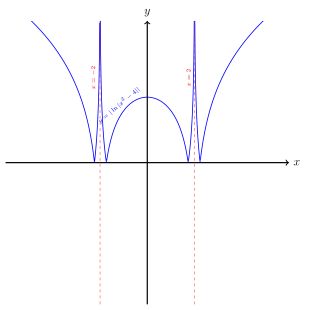
- The curve \(B\) is given by \(y= \vert \ln \vert x^2-4\vert \vert\,\). Find the area between the curve \(B\) and the \(x\)-axis with \(| x| <2\). Note: you may assume that \(t \ln t \to 0\) as \(t\to 0\).
Solution:
- \(\,\) \begin{align*} && \int \ln (2- x) \d x &= \left [ (x-2) \ln (2- x) \right] - \int -\frac{x-2}{2-x} \d x \\ && \int \ln (2- x) \d x &= \left [ (x-2) \ln (2- x) \right] + \int 1 \d x \\ &&&= -(2-x) \ln (2-x) +(2-x) + C \end{align*}
- \(\,\)
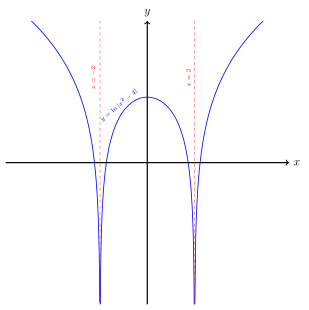
- \begin{align*} && \text{Area} &= \int_0^{\sqrt{3}} \ln | x^2 - 4 | \d x \\ &&&= \int_0^\sqrt{3} \ln(4-x^2) \d x \\ &&&= \int_0^\sqrt{3} \left ( \ln(2-x) + \ln (2+x) \right) \d x \\ &&&= \left [ -(2-x) \ln (2-x) +(2-x) +(2+x)\ln(2+x)-(2+x)\right]_0^{\sqrt{3}} \\ &&&= \left ( -(2-\sqrt{3}) \ln (2-\sqrt{3}) +(2-\sqrt{3}) +(2+\sqrt{3})\ln(2+\sqrt{3})-(2+\sqrt{3}) \right) - \\ &&&\quad \quad \left (- 2\ln (2)+2 +2\ln(2)-2 \right) \\ &&&=\left ( -(2-\sqrt{3}) \ln \left ( \frac{1}{2+\sqrt{3}} \right) -2\sqrt{3} +(2+\sqrt{3})\ln(2+\sqrt{3}) \right) \\ &&&= 4\ln(2 + \sqrt{3}) - 2 \sqrt{3} \end{align*}
- \begin{align*} && \text{Area} &= 2 \left ( \int_0^\sqrt{3} \ln (4-x^2) \d x - \lim_{t \to 2}\int_{\sqrt{3}}^t \ln(4-x^2) \d x \right) \\ &&&= 8\ln(2 + \sqrt{3})-4\sqrt{3} - 2 \lim_{t \to 2}\int_{\sqrt{3}}^t \left ( \ln (2-x) + \ln (2+x) \right) \d x \\ &&&= 8\ln(2 + \sqrt{3})-4\sqrt{3} - 2 \lim_{t \to 2} \left [ -(2-x) \ln (2-x) +(2-x) +(2+x)\ln(2+x)-(2+x)\right]_{\sqrt{3}}^{t} \\ &&&= 16 \ln(2+\sqrt{3})-8\sqrt{3} - 2 \lim_{t \to 2} \left(-(2-t) \ln (2-t) +(2-t) +(2+t)\ln(2+t)-(2+x) \right) \\ &&&= 16 \ln(2+\sqrt{3})-8\sqrt{3} -2(4 \ln4-4) \\ &&&= 16 \ln(2 + \sqrt{3}) - 16 \ln 2 +8(1-\sqrt{3}) \end{align*}
2014 Paper 2 Q2
This question concerns the inequality \begin{equation} \int_0^\pi \bigl( f(x) \bigr)^2 \d x \le \int_0^\pi \bigl( f'(x)\bigr)^2 \d x\,.\tag{\(*\)} \end{equation}
- Show that \((*)\) is satisfied in the case \(f(x)=\sin nx\), where \(n\) is a positive integer. Show by means of counterexamples that \((*)\) is not necessarily satisfied if either \(f(0) \ne 0\) or \(f(\pi)\ne0\).
- You may now assume that \((*)\) is satisfied for any (differentiable) function \(f\) for which \(f(0)=f(\pi)=0\). By setting \(f(x) = ax^2 + bx +c\), where \(a\), \(b\) and \(c\) are suitably chosen, show that \(\pi^2\le 10\). By setting \(f(x) = p \sin \frac12 x + q\cos \frac12 x +r\), where \(p\), \(q\) and \(r\) are suitably chosen, obtain another inequality for \(\pi\). Which of these inequalities leads to a better estimate for \(\pi^2\,\)?
Solution:
- If \(f(x) = \sin nx\) then \(f'(x) = n \cos n x\) and so \begin{align*} && LHS &= \int_0^\pi \sin^2 n x \d x \\ &&&= \left [ \frac{x+\frac1{2n}\sin 2n x}{2} \right ]_0^{\pi} \\ &&&= \frac{\pi}{2} \\ \\ && RHS &= \int_0^{\pi} n^2 \cos^2 n x \d x \\ &&&= n^2 \left [ \frac{\frac{1}{2n}\sin 2n x + x}{2} \right]_0^{\pi} \\ &&&= n^2\frac{\pi}{2} \geq LHS \end{align*} [\(f(0) = 0, f(\pi) \neq 0\)] Suppose \(f(x) = x\) then \(f'(x) = 1\) and \(LHS = \frac{\pi^3}{3} > \pi = RHS\). [\(f(0) \neq 0, f(\pi) = 0\)] Suppose \(f(x) = \pi - x\) then \(f'(x) = -1\) and \(LHS = \frac{\pi^3}{3} > \pi = RHS\)
- Suppose \(f(x) = x(\pi - x)\) then \(f'(x) = \pi - 2x\) and so \begin{align*} && \int_0^\pi x^2(\pi-x)^2 \d x &\leq \int_0^\pi (\pi-2x)^2 \d x \\ \Leftrightarrow && \left [\pi^2 \frac{x^3}{3} - 2\pi \frac{x^4}{4} + \frac{x^5}{5} \right]_0^{\pi} &\leq \left [ \pi^2x - 4\pi \frac{x^2}{2} + \frac{4x^3}{3} \right]_0^{\pi} \\ \Leftrightarrow && \pi^5 \left (\frac13 - \frac12+\frac15 \right) &\leq \pi^3 \left ( 1 - 2+\frac43 \right) \\ \Leftrightarrow && \pi^2 \frac{1}{30} &\leq \frac13 \\ \Leftrightarrow && \pi^2 &\leq 10 \end{align*} Suppose \(f(x) = p\sin \tfrac12 x + q \cos \tfrac12 x + r\), so \(f(0) = q + r\) and \(f(\pi) = p + r\), so say \(p = q = 1, r = -1\) \begin{align*} && LHS &= \int_0^{\pi} \left ( \sin \tfrac12 x + \cos \tfrac12 x-1\right)^2 \d x \\ &&&=\int_0^\pi \left ( \sin^2 \tfrac12 x + \cos^2 \tfrac12 x+1-2\sin \tfrac12 x - 2\cos \tfrac12 x+ \sin x \right)\\ &&&= \left [2x + 4\cos \tfrac12 x - 4\sin \tfrac12 x - \cos x \right]_0^{\pi} \\ &&&= \left ( 2\pi -4+1 \right) - \left ( 4-1 \right) \\ &&&= 2\pi -6\\ \\ && RHS&= \int_0^{\pi} \left ( \tfrac12 \cos \tfrac12 x -\tfrac12 \sin \tfrac12 x\right)^2 \d x \\ &&&= \int_0^{\pi} \left ( \tfrac14 \cos^2 \tfrac12 x +\tfrac14 \sin^2 \tfrac12 x-\tfrac14 \sin x\right) \d x \\ &&&= \frac{\pi}{4} - \frac12 \\ \Rightarrow && 2\pi -6 &\leq \frac{\pi}{4} - \frac12 \\ \Rightarrow && \frac{7\pi}{4} &\leq \frac{11}{2} \\ \Rightarrow && \pi &\leq \frac{22}{7} \end{align*} \(22^2/7^2 = 484/49 < 10\) therefore \(\pi \leq \frac{22}{7}\) is the better estimate.