Problems
Filters
3 problems found
2000 Paper 1 Q3
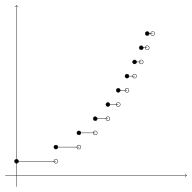
For any number \(x\), the largest integer less than or equal to \(x\) is denoted by \([x]\). For example, \([3.7]=3\) and \([4]=4\). Sketch the graph of \(y=[x]\) for \(0\le x<5\) and evaluate \[ \int_0^5 [x]\;\d x. \] Sketch the graph of \(y=[\e^{x}]\) for \(0\le x< \ln n\), where \(n\) is an integer, and show that \[ \int_{0}^{\ln n}[\e^{x}]\, \d x =n\ln n - \ln (n!). \]
Solution:

1997 Paper 2 Q8
If \({\rm f}(t)\ge {\rm g}(t)\) for \(a\le t\le b\), explain very briefly why \(\displaystyle \int_a^b {\rm f}(t) \d t \ge \int_a^b {\rm g}(t) \d t\). Prove that if \(p>q>0\) and \(x\ge1\) then $$\frac{x^p-1}{ p}\ge\frac{x^q-1}{ q}.$$ Show that this inequality also holds when \(p>q>0\) and \(0\le x\le1\). Prove that, if \(p>q>0\) and \(x\ge0\), then $$\frac{1}{ p}\left(\frac{x^p}{ p+1}-1\right)\ge \frac{1}{q}\left(\frac{x^q}{ q+1}-1\right).$$
Solution: This is just the result that all of the area beneath \(g(t)\) is also below \(f(t)\) If \(p > q > 0, x \geq 1 \Rightarrow x^p \geq x^q\), therefore applying the result we have \begin{align*} && \int_1^x x^p\, \d t & \geq \int_1^x x^q\, \d t \\ \Rightarrow && \frac{x^p-1}{p} & \geq \frac{x^q-1}{q} \end{align*} When \(p > q > 0, 0 \leq x \leq 1\) we have \(x^p \leq x^q\), ie \begin{align*} && \int_x^1 x^q\, \d t & \geq \int_{x}^1 x^p\, \d t \\ \Rightarrow && \frac{1-x^q}{q} & \geq \frac{1-x^p}{p} \\ \Rightarrow && \frac{x^p-1}{p} &\geq \frac{x^q-1}{q} \end{align*} Now looking at the functions \(f(x) = \frac{x^p-1}{p}, g(x) = \frac{x^q-1}{q}\) and \(x \geq 1\) we have \begin{align*} && \int_0^x \frac{t^p-1}{p} \d t & \geq \int_0^x \frac{t^q-1}{q} \d t\\ \Rightarrow &&\frac1p \left[\frac{t^{p+1}}{p+1} - t \right]_0^x &\geq\frac1q \left[\frac{t^{q+1}}{q+1} - t \right]_0^x \\ \Rightarrow &&\frac1p \left(\frac{x^{p+1}}{p+1} -x\right) &\geq\frac1q \left(\frac{x^{q+1}}{q+1} - x \right)\\ \Rightarrow &&\frac1p \left(\frac{x^{p}}{p+1} -1\right) &\geq\frac1q \left(\frac{x^{q}}{q+1} - 1 \right)\\ \end{align*}
1989 Paper 3 Q10
- Prove that \[ \sum_{r=1}^{n}r(r+1)(r+2)(r+3)(r+4)=\tfrac{1}{6}n(n+1)(n+2)(n+3)(n+4)(n+5) \] and deduce that \[ \sum_{r=1}^{n}r^{5}<\tfrac{1}{6}n(n+1)(n+2)(n+3)(n+4)(n+5). \]
- Prove that, if \(n>1,\) \[ \sum_{r=0}^{n-1}r^{5}>\tfrac{1}{6}(n-5)(n-4)(n-3)(n-2)(n-1)n. \]
- Let \(\mathrm{f}\) be an increasing function. If the limits \[ \lim_{n\rightarrow\infty}\sum_{r=0}^{n-1}\frac{a}{n}\mathrm{f}\left(\frac{ra}{n}\right)\qquad\mbox{ and }\qquad\lim_{n\rightarrow\infty}\sum_{r=1}^{n}\frac{a}{n}\mathrm{f}\left(\frac{ra}{n}\right) \] both exist and are equal, the definite integral \({\displaystyle \int_{0}^{a}\mathrm{f}(x)\,\mathrm{d}x}\) is defined to be their common value. Using this definition, prove that \[ \int_{0}^{a}x^{5}\,\mathrm{d}x=\tfrac{1}{6}a^6. \]
Solution:
- Claim: \[ \sum_{r=1}^{n}r(r+1)(r+2)(r+3)(r+4)=\tfrac{1}{6}n(n+1)(n+2)(n+3)(n+4)(n+5) \] Proof: (By Induction) Base case: (n=1) \begin{align*} LHS &= 1 \cdot 2 \cdot 3 \cdot 4 \cdot 5 = 5! \\ RHS &= \frac16 1 \cdot 2 \cdot 3 \cdot 4 \cdot 5 \cdot 6 = 5! \end{align*} Therefore the base case is true. Inductive step: Suppose our statement is true for some \(n=k\), then consider \(n = k+1\) \begin{align*} \sum_{r=1}^{k+1} r(r+1)(r+2)(r+3)(r+4) &= \sum_{r=1}^{k} r(r+1)(r+2)(r+3)(r+4) + (k+1)(k+2)(k+3)(k+4)(k+5) \\ &\underbrace{=}_{\text{assumption}} \frac16 k(k+1)(k+2)(k+3)(k+4)(k+5) + (k+1)(k+2)(k+3)(k+4)(k+5) \\ &= (k+1)(k+2)(k+3)(k+4)(k+5) \l \frac{k}{6} +1\r \\ &= \frac16 (k+1)(k+2)(k+3)(k+4)(k+5)(k+6) \end{align*} Therefore our statement is true for \(n = k+1\). Therefore since our statement is true for \(n=1\) and if it is true for \(n=k\) then it is true for \(n = k+1\) by the principle of mathematical induction it is true for all \(n \geq 1\) Since \begin{align*} \sum_{r=1}^{n}r^5 &< \sum_{r=1}^{n}r(r+1)(r+2)(r+3)(r+4) \\ &= \frac16 n(n+1)(n+2)(n+3)(n+4)(n+5) \end{align*}
- \begin{align*}\sum_{r=0}^{n-1} r^5 &> \sum_{r=0}^{n-1} (r-4)(r-3)(r-2)(r-1)r \\ &= \sum_{r=0}^{n-5} r(r+1)(r+2)(r+3)(r+4) \\ &= \frac16 (n-5)(n-4)(n-3)(n-2)(n-1)n \end{align*}
- Let \(f(x) = x^5\) \begin{align*} S_{1,n} &= \sum_{r=0}^{n-1}\frac{a}{n}f\left(\frac{ra}{n}\right) \\ &= \sum_{r=0}^{n-1}\frac{a}{n}\left(\frac{ra}{n}\right)^5 \\ &=\frac{a^6}{n^6} \sum_{r=0}^{n-1}r^5\\ \end{align*} Therefore \(\frac{a^6}6 \frac{(n-5)(n-4)(n-3)(n-2)(n-1)n}{n^6} < S_{1,n} < \frac{a^6}6 \frac{(n-1)n(n+1)(n+2)(n+3)(n+4)}{n^6}\) and so \(\lim_{n\to\infty} S_{1,n} = \frac{a^6}{6}\). Similarly, \begin{align*} S_{2,n} &= \sum_{r=1}^{n}\frac{a}{n}f\left(\frac{ra}{n}\right) \\ &= \sum_{r=1}^{n}\frac{a}{n}\left(\frac{ra}{n}\right)^5 \\ &= \frac{a^6}{n^6} \sum_{r=1}^{n} r^5 \end{align*} Therefore \(\frac{a^6}6 \frac{(n-4)(n-3)(n-2)(n-1)n(n+1)}{n^6} < S_{2,n} < \frac{a^6}6 \frac{n(n+1)(n+2)(n+3)(n+4)(n+5)}{n^6}\) and so \(\lim_{n\to\infty} S_{2,n} = \frac{a^6}{6}\). Since both limits exist are are equal, we have \[ \int_{0}^{a}x^{5}\,\mathrm{d}x=\tfrac{1}{6}a^6. \]