Problems
Filters
22 problems found
2020 Paper 3 Q7
- Given that the variables \(x\), \(y\) and \(u\) are connected by the differential equations \[ \frac{\mathrm{d}u}{\mathrm{d}x} + \mathrm{f}(x)u = \mathrm{h}(x) \quad \text{and} \quad \frac{\mathrm{d}y}{\mathrm{d}x} + \mathrm{g}(x)y = u, \] show that \[ \frac{\mathrm{d}^2 y}{\mathrm{d}x^2} + (\mathrm{g}(x) + \mathrm{f}(x))\frac{\mathrm{d}y}{\mathrm{d}x} + (\mathrm{g}'(x) + \mathrm{f}(x)\mathrm{g}(x))y = \mathrm{h}(x). \tag{1} \]
- Given that the differential equation \[ \frac{\mathrm{d}^2 y}{\mathrm{d}x^2} + \left(1 + \frac{4}{x}\right)\frac{\mathrm{d}y}{\mathrm{d}x} + \left(\frac{2}{x} + \frac{2}{x^2}\right)y = 4x + 12 \tag{2} \] can be written in the same form as (1), find a first order differential equation which is satisfied by \(\mathrm{g}(x)\). If \(\mathrm{g}(x) = kx^n\), find a possible value of \(n\) and the corresponding value of \(k\). Hence find a solution of (2) with \(y = 5\) and \(\dfrac{\mathrm{d}y}{\mathrm{d}x} = -3\) at \(x = 1\).
2019 Paper 2 Q6
Note: You may assume that if the functions \(y_1(x)\) and \(y_2(x)\) both satisfy one of the differential equations in this question, then the curves \(y = y_1(x)\) and \(y = y_2(x)\) do not intersect.
- Find the solution of the differential equation $$\frac{dy}{dx} = y + x + 1$$ that has the form \(y = mx + c\), where \(m\) and \(c\) are constants. Let \(y_3(x)\) be the solution of this differential equation with \(y_3(0) = k\). Show that any stationary point on the curve \(y = y_3(x)\) lies on the line \(y = -x - 1\). Deduce that solution curves with \(k < -2\) cannot have any stationary points. Show further that any stationary point on the solution curve is a local minimum. Use the substitution \(Y = y + x\) to solve the differential equation, and sketch, on the same axes, the solutions with \(k = 0\), \(k = -2\) and \(k = -3\).
- Find the two solutions of the differential equation $$\frac{dy}{dx} = x^2 + y^2 - 2xy - 4x + 4y + 3$$ that have the form \(y = mx + c\). Let \(y_4(x)\) be the solution of this differential equation with \(y_4(0) = -2\). (Do not attempt to find this solution.) Show that any stationary point on the curve \(y = y_4(x)\) lies on one of two lines that you should identify. What can be said about the gradient of the curve at points between these lines? Sketch the curve \(y = y_4(x)\). You should include on your sketch the two straight line solutions and the two lines of stationary points.
Solution:
- Looking for solution of the form \(y = mx+c\) we find that \(m = mx+c+x+1 \Rightarrow m = -1, c = -2\).
At stationary points \(\frac{\d y}{\d x} = 0 \Rightarrow y = -x-1\).
If \(y_3(0)= k < -2\) then the solution curve lies below \(y = -x-2\) and therefore it cannot cross \(y = -x -2\) to reach \(y = -x-1\) for a stationary point.
Suppose \(Y = y+x\) then \(\frac{\d Y}{\d x} = \frac{\d y}{\d x} + 1=Y+2 \Rightarrow Y = Ae^x-2 \Rightarrow y= (k+2)e^x-x-2\)

- \(\,\)
\begin{align*}
&& m &= x^2 + (mx+c)^2 -2x(mx+c) - 4x+4(mx+c) + 3 \\
&&0&= (m^2-2m+1)x^2+(2mc-2c-4+4m)x + (c^2+4c+3-m)\\
\Rightarrow && m &= 1 \\
\Rightarrow && 0 &= c^2+4c+2 \\
\Rightarrow &&&= (c+2)^2-2 \\
\Rightarrow && c &= -2 \pm \sqrt{2}
\end{align*}
Therefore the lines are \(y = x -2-\sqrt{2}\) and \(y = x -2+\sqrt{2}\).
Any stationary point will satisfy \(y' = 0\), ie \(0 = x^2+y^2-2xy-4x+4y+3 = (x-y)^2-4(x-y)+3 = (x-y-3)(x-y-1)\) therefore they must lie on \(y = x-1\) or \(y = x-3\). Any point between these lines must have negative gradient (since one factor is positive and one factor is negative).

2018 Paper 2 Q8
- Use the substitution \(v= \sqrt y\) to solve the differential equation \[ \frac{\d y}{\d t} = \alpha y^{\frac12} - \beta y \ \ \ \ \ \ \ \ \ \ (y\ge0, \ \ t\ge0) \,, \] where \(\alpha\) and \(\beta\) are positive constants. Find the non-constant solution \(y_1(x)\) that satisfies \(y_1(0)=0\,\).
- Solve the differential equation \[ \frac{\d y}{\d t} = \alpha y^{\frac23} - \beta y \ \ \ \ \ \ \ \ \ \ (y\ge0, \ \ t\ge0) \,, \] where \(\alpha\) and \(\beta\) are positive constants. Find the non-constant solution \(y_2(x)\) that satisfies \(y_2(0)=0\,\).
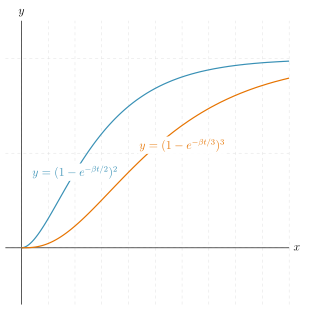
- In the case \(\alpha=\beta\), sketch \(y_1(x)\) and \(y_2(x)\) on the same axes, indicating clearly which is \(y_1(x)\) and which is \(y_2(x)\). You should explain how you determined the positions of the curves relative to each other.
Solution:
- Suppose \(v = \sqrt{y} \Rightarrow v^2 = y \Rightarrow 2v v' = y'\) so \begin{align*} && 2vv' &= \alpha v-\beta v^2 \\ \Rightarrow && 2v' &= \alpha - \beta v \\ \Rightarrow && v' + \frac{\beta}{2} v &= \frac{\alpha}{2} \\ \Rightarrow && \frac{\d}{\d t} \left (e^{\beta t/2} v \right) &= \frac{\alpha}{2} e^{\beta t/2} \\ \Rightarrow && e^{\beta t/2} v &=C+ \frac{\alpha}{\beta}e^{\beta t /2} \\ \Rightarrow && v &= Ce^{-\beta t/2} + \frac{\alpha}{\beta} \\ \Rightarrow && \sqrt{y} &= Ce^{-\beta t/2} + \frac{\alpha}{\beta} \\ y(0) = 0: && 0 &= C+\frac{\alpha}{\beta} \\ \Rightarrow && \sqrt{y} &= \frac{\alpha}{\beta} \left (1-e^{-\beta t/2} \right) \\ \Rightarrow && y &= \frac{ \alpha^2}{\beta^2} \left (1-e^{-\beta t/2} \right)^2 \end{align*}
- Try \(v = y^{1/3} \Rightarrow v^3 = y \Rightarrow 3v^2 v' = y'\) so \begin{align*} && y' &= \alpha v^2 - \beta y \\ \Rightarrow && 3v^2v' &= \alpha v^2 - \beta v^3 \\ \Rightarrow && v' +\frac{\beta}{3} v &= \frac{\alpha}{3} \\ \Rightarrow && (v e^{\beta t/3})' &= \frac{\alpha}{3}e^{\beta t/3} \\ \Rightarrow && v &= Ce^{-\beta t/3} + \frac{\alpha}{\beta} \\ v(0) = 0: && v &= \frac{\alpha}{\beta} \left (1 - e^{-\beta t/3} \right) \\ \Rightarrow && y &= \frac{\alpha^3}{\beta^3} \left (1 - e^{-\beta t/3} \right) ^3 \end{align*}
- \(y_1 = (1-e^{-\beta t/2})^2, y_2 = (1-e^{-\beta t/3})^3\)
By considering the differential equation, notice that \(0 < y_i < 1\) so \(y^{1/2} > y^{2/3}\) and therefore \(y_1' > y_2'\) and so \(y_1\) increases faster.
2018 Paper 2 Q10
A uniform elastic string lies on a smooth horizontal table. One end of the string is attached to a fixed peg, and the other end is pulled at constant speed \(u\). At time \(t=0\), the string is taut and its length is \(a\). Obtain an expression for the speed, at time \(t\), of the point on the string which is a distance \(x\) from the peg at time \(t\). An ant walks along the string starting at \(t=0\) at the peg. The ant walks at constant speed \(v\) along the string (so that its speed relative to the peg is the sum of \(v\) and the speed of the point on the string beneath the ant). At time \(t\), the ant is a distance \(x\) from the peg. Write down a first order differential equation for \(x\), and verify that \[ \frac{\d }{\d t} \left( \frac x {a+ut}\right) = \frac v {a+ut} \,. \] Show that the time \(T\) taken for the ant to reach the end of the string is given by \[uT = a(\e^k-1)\,,\] where \(k=u/v\). On reaching the end of the string, the ant turns round and walks back to the peg. Find in terms of \(T\) and \(k\) the time taken for the journey back.
Solution: Points always maintain a constant fraction of the distance from the start, so the point distance \(x\) from the start at time \(t\) is moving with speed \(\frac{x}{a+ut} u\) The point is moving with speed \(v+\frac{x}{a+ut} u\) or in other words \begin{align*} && \frac{\d x}{\d t} &= v + \frac{x}{a+ut}u \\ \Rightarrow && \frac{\d x }{\d t} - \frac{u}{a+ut} x &= v \\ \Rightarrow && \frac{1}{a+ut} \frac{\d x}{\d t} - \frac{u}{(a+ut)^2} x &= \frac{1}{a+ut} v\\ \Rightarrow && \frac{\d}{\d x} \left ( \frac{x}{a+ut} \right) &= \frac{v}{a+ut} \\ \Rightarrow && \frac{x}{a+ut} &=\frac{v}{u} \ln (a + ut) + C \\ t = 0, x = 0: && 0 &= \frac{v}{u} \ln a + C \\ \Rightarrow && x &= (a+ut) \frac{v}{u} \ln \left ( \frac{a+ut}{a} \right) \\ \\ \Rightarrow && 1 &= \frac{v}{u} \ln \left ( \frac{a+uT}{a} \right) \\ \Rightarrow && e^k &= 1 + \frac{uT}{a} \\ \Rightarrow && uT &= a(e^k-1) \end{align*} On the return journey, we have \begin{align*} && \frac{\d x}{\d t} &= \frac{x}{a+ut}u - v \\ \Rightarrow && \frac{\d x}{\d t} - \frac{u}{a+ut} x &= - v \\ \Rightarrow && \frac{\d }{\d x} \left ( \frac{x}{a+ut} \right) &= -\frac{v}{a+ut} \\ \Rightarrow &&f &= -\frac{v}{u} \ln(a+ut) + K \\ t = T, f = 1: && 1 &= -\frac{v}{u}\ln(a+uT) + K \\ \Rightarrow && f &= 1+\frac{v}{u}\ln \left ( \frac{a+uT}{a+ut} \right) \\ \Rightarrow && 0 &= 1+\frac{v}{u} \ln \left ( \frac{a+uT}{a+uT_2} \right) \\ \Rightarrow && e^k &= \frac{a+uT_2}{a+uT}\\ \Rightarrow && uT_2 &= (a+uT)e^k - a \\ \Rightarrow && T_2 - T &= \frac{1}{u} \left ( (a+uT)e^k - a - uT\right) \\ &&&= \frac{1}{u} \left ((a+a(e^k-1))e^k-a-a(e^k-1) \right) \\ &&&= \frac{1}{u} \left (ae^{2k} -ae^k \right) \\ &&&= \frac{ae^k}{u} \left ( e^k-1 \right) \\ &&&= Te^k \end{align*}
2012 Paper 1 Q8
- Show that substituting \(y=xv\), where \(v\) is a function of \(x\), in the differential equation \[ xy \frac{\d y}{\d x} +y^2- 2x^2 =0 \quad (x\ne0) \] leads to the differential equation \[ xv\frac{\d v}{\d x} +2v^2 -2=0\,. \] Hence show that the general solution can be written in the form \[ x^2(y^2 -x^2) = C \,,\] where \(C\) is a constant.
- Find the general solution of the differential equation \[ y \frac{\d y}{\d x} +6x +5y=0\, \quad (x\ne0). \]
Solution:
- \(\,\) \begin{align*} && y &= xv \\ && y' &= v + xv' \\ \Rightarrow && 0 &= x^2 v \left ( v + x\frac{\d v}{\d x} \right) +(x^2v^2) - 2x^2 \\ &&&= 2x^2v^2 + x^3 v \frac{\d v}{\d x} - 2x^2 \\ \Rightarrow && 0 &= xv \frac{\d v}{\d x} + 2v^2-2 \\ \\ \Rightarrow && \frac{v}{1-v^2} \frac{\d v}{\d x} &= \frac{2}{x} \\ \Rightarrow && \int \frac{v}{1-v^2} \d v &=2 \ln |x| \\ \Rightarrow && -\frac12\ln |1-v^2| &= 2\ln |x| + C \\ \Rightarrow && 4\ln |x| + \ln |1-v^2| &= K \\ \Rightarrow && x^4(1-v^2) &= K \\ \Rightarrow && x^2(x^2-y^2) &= K \end{align*}
- \(\,\) \begin{align*} && 0 &= xv \left (v +x \frac{\d v}{\d x} \right) + 6x + 5xv \\ &&&= x^2 v \frac{\d v}{\d x} +xv^2 + 6x+5xv \\ \Rightarrow && 0 &= xv\frac{\d v}{\d x} +v^2 +5v+6 \\ \Rightarrow && -\int \frac{1}{x} \d x &=\int \frac{v}{v^2+5v+6} \d v \\ \Rightarrow && -\ln |x| &= \int \frac{v}{(v+2)(v+3)} \d v \\ &&&= \int \left (\frac{3}{v+3} - \frac{2}{v+2} \right) \d v \\ \Rightarrow && -\ln |x| &= 3\ln |v+3| - 2 \ln |v+2| + C\\ \Rightarrow && -\ln |x| &= \ln \frac{|v+3|^3}{|v+2|^2} + C \\ \Rightarrow && \frac{1}{|x|}|v+2|^2 &= A|v+3|^3 \\ \Rightarrow && \frac{1}{|x|}|\frac{y}{x} + 2|^2&= A|\frac{y}{x} + 3|^3 \\ \Rightarrow && \frac{1}{|x|^3} |y +2x|^2 &= \frac{A}{|x|^3}|y + 3x|^3 \\ \Rightarrow && (y+2x)^2 &= A|y+3x|^3 \end{align*}
2011 Paper 3 Q1
- Find the general solution of the differential equation \[ \frac{\d u}{\d x} - \left(\frac { x +2}{x+1}\right)u =0\,. \]
- Show that substituting\(y=z\e^{-x}\) (where \(z\) is a function of \(x\)) into the second order differential equation \[ (x+1) \frac{\d ^2 y}{\d x^2} + x \frac{\d y}{\d x} -y = 0 \tag{\(*\)} \] leads to a first order differential equation for \(\dfrac{\d z}{\d x}\,\). Find \(z\) and hence show that the general solution of \((*)\) is \[ y= Ax + B\e^{-x}\,, \] where \(A\) and \(B\) are arbitrary constants.
- Find the general solution of the differential equation \[ (x+1) \frac{\d ^2 y}{\d x^2} + x \frac{\d y}{\d x} -y = (x+1)^2 . \]
Solution:
- \begin{align*} && 0 &= \frac{\d u}{\d x} - \left ( \frac{x+2}{x+1} \right)u \\ \Rightarrow && \int \frac1u \d u &= \int 1 + \frac1{x+1} \d x \\ \Rightarrow && \ln |u| &= x + \ln |x+1| + C \\ \Rightarrow && u &= A(x+1)e^x \end{align*}
- If \(y = ze^{-x}\), \(y' = (z'-z)e^{-x}\), \(y'' = (z''-2z'+z)e^{-x}\) \begin{align*} && 0 &= (x+1) \frac{\d ^2 y}{\d x^2} + x \frac{\d y}{\d x} -y \\ y = ze^{-x}: && 0 &= (x+1) \left ( \frac{\d^2 z}{\d x^2} - 2\frac{\d z}{\d x} +z\right)e^{-x} +x \left ( \frac{\d z}{\d x} -z\right)e^{-x} - ze^{-x} \\ &&&= (x+1) \frac{\d^2 z}{\d x^2} -(x+2)\frac{\d z}{\d x} \\ \Rightarrow && \frac{\d}{\d x} \left ( \frac{\d z}{\d x}\right) &= \left ( \frac{x+2}{x+1}\right) \frac{\d z}{\d x} \end{align*} Therefore \(\frac{\d z}{\d x} = A(x+1)e^x \) and so \begin{align*} z &= A \int (x+1)e^{x} \d x \\ &= A \left ( \left [ (x+1)e^x\right] - \int e^x \d x \right) \\ &= A(x+1)e^x - Ae^x + B \\ y &= Ax + Be^{-x} \end{align*}
- We have found the complementary solution. To find a particular integral consider \(y = ax^2 + bx + c\), then \(y' = 2ax+b, y'' = 2a\) and we have \begin{align*} && x^2+2x+1 &= 2a(x+1) + x(2ax+b) - (ax^2+bx+c) \\ \Rightarrow && x^2+2x+1 &= ax^2+ 2ax + 2a-c \\ \Rightarrow && a = 1, &c=1 \end{align*} so the general solution should be \[ y = Ax + Be^{-x} + x^2+1 \]
2010 Paper 1 Q6
Show that, if \(y=\e^x\), then \[ (x-1) \frac{\d^2 y}{\d x^2} -x \frac{\d y}{\d x} +y=0\,. \tag{\(*\)} \] In order to find other solutions of this differential equation, now let \(y=u\e^x\), where \(u\) is a function of \(x\). By substituting this into \((*)\), show that \[ (x-1) \frac{\d^2 u}{\d x^2} + (x-2) \frac{\d u}{\d x} =0\,. \tag{\(**\)} \] By setting \( \dfrac {\d u}{\d x}= v\) in \((**)\) and solving the resulting first order differential equation for \(v\), find \(u\) in terms of \(x\). Hence show that \(y=Ax + B\e^x\) satisfies \((*)\), where \(A\) and \(B\) are any constants.
Solution: \begin{align*} && y &= e^x \\ && y' &= e^x \\ && y'' &= e^x \\ \Rightarrow && (x-1)y'' - x y' + y &= (x-1)e^x - xe^x + e^x \\ &&&= 0 \end{align*} Suppose \(y = ue^x\) then \begin{align*} && y' &= u'e^x + ue^x \\ && y'' &= (u''+u')e^x + (u'+u)e^x \\ &&&= (u''+2u' +u)e^x \\ \\ && 0 &= (x-1)y'' - x y' + y \\ &&&= [(x-1)(u''+2u'+u) - x(u'+u)+u]e^x \\ &&&= [(x-1)u'' +(x-2)u']e^x \\ \Rightarrow && 0 &= (x-1)u'' + (x-2)u' \\ v = u': && 0 &= (x-1)v' + (x-2) v \\ \Rightarrow && \frac{v'}{v} &= -\frac{x-2}{x-1} \\ &&&= -1-\frac{1}{x-1} \\ \Rightarrow && \ln v &= -x - \ln(x-1) + C \\ \Rightarrow && v &= A(x-1)e^{-x} \\ && u &= \int Axe^{-x} - Ae^{-x} \d x \\ &&&= \left [-Axe^{-x} +Ae^{-x} \right] + \int Ae^{-x} \d x \\ &&&= -Axe^{-x} + D\\ \Rightarrow && y &= ue^x \\ &&&= -Ax + De^x \end{align*}
2010 Paper 3 Q8
Given that \({\rm P} (x) = {\rm Q} (x){\rm R}'(x) - {\rm Q}'(x){\rm R}(x)\), write down an expression for \[ \int \frac{{\rm P} ( x)}{ \big( {\rm Q} ( x)\big )^ 2}\, \d x\, . \]
- By choosing the function \({\rm R}(x)\) to be of the form \(a +bx+c x^2\), find \[ \int \frac{5x^2 - 4x - 3} {(1 + 2x + 3x^2 )^2 } \, \d x \,.\] Show that the choice of \({\rm R}(x)\) is not unique and, by comparing the two functions \({\rm R}(x)\) corresponding to two different values of \(a\), explain how the different choices are related.
- Find the general solution of \[ (1+\cos x +2 \sin x) \frac {\d y}{\d x} +(\sin x -2 \cos x)y = 5 - 3 \cos x + 4 \sin x\,. \]
Solution: \begin{align*} && \int \frac{{\rm P} ( x)}{ \big( {\rm Q} ( x)\big )^ 2}\, \d x &= \int \frac{{\rm Q} (x){\rm R}'(x) - {\rm Q}'(x){\rm R}(x)}{ \big( {\rm Q} ( x)\big )^ 2}\, \d x \\ &&&= \int \frac{\d}{\d x} \left ( \frac{R(x)}{Q(x)} \right) \d x \\ &&&= \frac{R(x)}{Q(x)} + C \end{align*}
- Suppose \(Q(x) = 1 + 2x + 3x^2, P(x) = 5x^2-4x-3\), and \(R(x) = a +bx + cx^2\), then \begin{align*} && 5x^2-4x-3 &= (1 + 2x + 3x^2)(2cx+b) - (6x+2)(a+bx+cx^2) \\ &&&= (6c-6c)x^3 + (3b+4c-6b-2c)x^2 + \\ &&&\quad+(2c+2b-6a-2b)x + (b-2a) \\ \Rightarrow && 2c-3b &= 5 \\ && 2c-6a &= -4 \\ && b - 2a &= -3 \\ \Rightarrow && b &= 2a - 3\\ && c &= 3a-2 \end{align*} So say \(a = 0, b = -3, c = -2\) we will have \begin{align*} \int \frac{5x^2 - 4x - 3} {(1 + 2x + 3x^2 )^2 } \, \d x &= \frac{-3x-2x^2}{1+2x+3x^2} + C \end{align*} Suppose we have a different value of \(a\), then we end up with: \begin{align*} \frac{a+(2a-3)x+(3a-2)x^2}{1+2x+3x^2} = a +\frac{-3x-2x^2}{1+2x+3x^2} \end{align*} So the different antiderivatives differ by a constant.
- \(\,\) \begin{align*} && \frac{\d }{\d x} \left ( \frac{1}{1+\cos x + 2 \sin x } y\right) &= \frac{5-3\cos x + 4 \sin x }{(1+\cos x + 2 \sin x)^2} \\ \end{align*} We want to find \(R(x) = A \cos x + B\sin x + C\) such that \begin{align*} &&5-3\cos x + 4 \sin x &= (1+\cos x + 2 \sin x)R'(x) - R(x)(-\sin x + 2 \cos x) \\ &&&= (1+\cos x + 2 \sin x)(-A\sin x + B \cos x) \\ &&&\quad- (A\cos x + B \sin x + C)(-\sin x + 2 \cos x) \\ &&&=(-A+C) \sin x + (B-2C)\cos x +\\ &&&\quad\quad (2B-A+A-2B)\sin x \cos x \\ &&&\quad\quad (-2A+B)\sin^2x+(B-2A)\cos^2x \\ &&&= (-A+C)\sin x + (B-2C)\cos x +(B-2A) \\ \Rightarrow && B-2A &= 5\\ && C-A &= 4 \\ && B-2C &= -3 \\ \end{align*} There are many solutions so WLOG \(C=4, A = 0, B = 5\) and so \begin{align*} && \int \frac{5-3\cos x + 4 \sin x }{(1+\cos x + 2 \sin x)^2} \d x &= \frac{5\sin x +4}{1+\cos x + 2 \sin x} + K \\ \Rightarrow && y &= 5\sin x + 4 + K(1 + \cos x + 2 \sin x) \end{align*}
2008 Paper 3 Q6
In this question, \(p\) denotes \(\dfrac{\d y}{\d x}\,\).
- Given that \[ y=p^2 +2 xp\,, \] show by differentiating with respect to \(x\) that \[ \frac{\d x}{\d p} = -2 - \frac {2x} p . \] Hence show that \(x = -\frac23p +Ap^{-2}\,,\) where \(A\) is an arbitrary constant. Find \(y\) in terms of \(x\) if \(p=-3\) when \(x=2\).
- Given instead that \[ y=2xp +p \ln p\,,\] and that \(p=1\) when \(x=-\frac14\), show that \(x=-\frac12 \ln p - \frac14\,\) and find \(y\) in terms of \(x\).
2004 Paper 3 Q8
Show that if \[ {\mathrm{d}y \over \mathrm{d} x}=\f(x)y + {\g(x) \over y} \] then the substitution \(u = y^2\) gives a linear differential equation for \(u(x)\,\). Hence or otherwise solve the differential equation \[ {\mathrm{d}y \over \mathrm{d} x}={y \over x} - {1 \over y}\;. \] Determine the solution curves of this equation which pass through \((1 \,, 1)\,\), \((2\, , 2)\) and \((4 \, , 4)\) and sketch graphs of all three curves on the same axes.
Solution: \begin{align*} && \frac{\d y}{\d x} &= f(x) y + \frac{g(x)}{y} \\ && y \frac{\d y}{\d x} &= f(x) y^2 + g(x) \\ u = y^2: && \frac12 \frac{\d u}{\d x} &= f(x) u + g(x) \end{align*} Which is a linear differential equation for \(u\). \begin{align*} && \frac12 u' &= \frac1x u -1 \\ \Rightarrow && u' - \frac2xu &= -1 \\ \Rightarrow && \frac{1}{x^2} u' - \frac{2}{x^3} u &= -\frac{1}{x^2} \\ \Rightarrow && (\frac{u}{x^2})' &= - \frac{1}{x^2} \\ \Rightarrow && \frac{u}{x^2} &= \frac1x + C \\ \Rightarrow && u &= Cx^2 + x \\ \Rightarrow && y^2 &= Cx^2 + x \end{align*} If \((1,1)\) is on the curve then \(1 = C + 1 \Rightarrow C = 0 \Rightarrow y^2 = x\). If \((2,2)\) is on the curve then \(4 = 4C + 2 \Rightarrow C = \frac12 \Rightarrow y^2 = x + \frac12 x^2\). If \((3,3)\) is on the curve then \(9 = 9C + 3 \Rightarrow C = \frac23 \Rightarrow y^2 = x + \frac23 x^2\)

2003 Paper 2 Q8
It is given that \(y\) satisfies $$ {{\d y} \over { \d t}} + k\left({{t^2-3t+2} \over {t+1}}\right)y = 0\;, $$ where \(k\) is a constant, and \(y=A \) when \(t=0\,\), where \(A\) is a positive constant. Find \(y\) in terms of \(t\,\), \(k\) and \(A\,\). Show that \(y\) has two stationary values whose ratio is \((3/2)^{6k}\e^{-5{k}/2}.\) Describe the behaviour of \(y\) as \(t \to +\infty\) for the case where \(k> 0\) and for the case where \(k<0\,.\) In separate diagrams, sketch the graph of \(y\) for \(t>0\) for each of these cases.
Solution: \begin{align*} && \frac{\d y}{\d t} &= - k \left (\frac{t^2-3t+2}{t+1} \right) y \\ \Rightarrow && \int \frac1y \d y &= -k\int \left (t-4 + \frac{6}{t+1}\right) \d t \\ \Rightarrow && \ln y &= -k \left ( \frac12 t^2 -4t + 6\ln (t+1) \right) + C \\ (t,y) = (0,A): && \ln A &=C \\ \Rightarrow && \ln y &= -k \left ( \frac12 t^2 -4t + 6\ln (t+1) \right) + \ln A \\ && \ln \left ( \frac{y}{A}(t+1)^{6k} \right) &= -k \l \frac12 t^2 - 4t \r \\ \Rightarrow && y &= A\frac{\exp \l -k(\frac12 t^2-4t)\r}{(t+1)^{6k}} \end{align*} \(y\) wil have stationary values when \(\frac{\d y}{\d t} = 0\), ie \begin{align*} k \left (\frac{t^2-3t+2}{t+1} \right) y &= 0 \\ k \left ( \frac{(t-2)(t-1)}{t+1} \right) y &= 0 \end{align*} ie when \(y = 0, t = 1, t =2\). Clearly \(y = 0\) is not a solution, so \(y\) has the values: \begin{align*} t = 1: && y &= A\frac{\exp \l -k(\frac12 -4)\r}{(2)^{6k}} \\ &&&= A \frac{e^{7/2 k}}{2^{6k}} \\ t = 2: && y &= A\frac{\exp \l -k(2 -8)\r}{(3)^{6k}} \\ &&&= A \frac{e^{6 k}}{3^{6k}} \\ \text{ratio}: && \frac{e^{7/2k}}{2^{6k}} \cdot \frac{3^{6k}}{e^{6k}} &= (3/2)^{6k} e^{-5k/2} \end{align*} If \(k > 0\) as \(t \to \infty\) \(y \to 0\) since the \(e^{-kt^2/2}\) term dominates everything. If \(k < 0\) as \(t \to \infty\) \(y \to \infty\) as since the \(e^{-kt^2}\) term also dominates but now it growing to infinity faster than everything else.

2003 Paper 3 Q8
- Show that the gradient at a point \(\l x\,, \, y \r\) on the curve \[ \l y + 2x \r^3 \l y - 4x \r = c\;, \] where \(c\) is a constant, is given by \[ \frac{\d y}{\d x} = \frac{16 x -y}{2y-5x} \;. \]
- By considering the derivative with respect to \(x\) of \(\l y + ax \r^n \l y + bx \r\,\), or otherwise, find the general solution of the differential equation \[ \frac{\mathrm{d}y}{ \mathrm{d}x} = \frac{10x - 4y}{ 3x - y}\;. \]
Solution:
- \begin{align*} && c &= \left (y+2x \right)^3\left (y-4x \right) \\ \Rightarrow && 0 &= 3\left (y+2x \right)^2\left (y-4x \right)\left ( \frac{\d y}{\d x} + 2 \right) + \left (y+2x \right)^3 \left ( \frac{\d y}{\d x} - 4 \right) \\ \Rightarrow && 0 &= 3(y-4x)\left ( \frac{\d y}{\d x} + 2 \right) + \left (y+2x \right) \left ( \frac{\d y}{\d x} - 4 \right) \\ \Rightarrow &&&= \frac{\d y}{\d x} \left (3(y-4x) + (y+2x) \right) + 6(y-4x)-4(y+2x) \\ &&&= \frac{\d y}{\d x} \left ( 4y-10x\right) + 2y-32x \\ \Rightarrow && \frac{\d y}{\d x} &= \frac{16x-y}{2y-5x} \end{align*}
- \begin{align*} && c &= \left ( y + ax \right)^n \left ( y + bx \right) \\ \Rightarrow && 0 &= n\left ( y + ax \right)^{n-1} \left ( y + bx \right)\left ( \frac{\d y}{ \d x}+a \right) + \left ( y + ax \right)^{n} \left ( \frac{\d y}{ \d x}+b \right) \\ \Rightarrow && 0 &= n \left ( y + bx \right)\left ( \frac{\d y}{ \d x}+a \right) + \left ( y + ax \right) \left ( \frac{\d y}{ \d x}+b \right) \\ &&&= \frac{\d y}{\d x} \left ( (n+1)y + (nb+a)x \right) + an(y+bx) + by+bax \\ &&&= \frac{\d y}{\d x} \left ( (n+1)y + (nb+a)x \right) + (an+b)y+ab(n+1)x \\ \Rightarrow && \frac{\d y}{\d x} &= -\frac{(an+b)y+ab(n+1)x}{(n+1)y+(nb+a)x} \end{align*} We must have \(ab = 10, a+b = -7\) so say \(a=-5,b=-2,n=2\) and we have \((y-5x)^2(y-2) = c\) is our general solution to the differential equation
2001 Paper 2 Q8
The function \(\f\) satisfies \(\f(x+1)= \f(x)\) and \(\f(x)>0\) for all \(x\).
- Give an example of such a function.
- The function \(\F\) satisfies \[ \frac{\d \F}{\d x} =\f(x) \] and \(\F(0)=0\). Show that \(\F(n) = n\F(1)\), for any positive integer \(n\).
- Let \(y\) be the solution of the differential equation \[ \frac{\d y}{\d x} +\f(x) y=0 \] that satisfies \(y=1\) when \(x=0\). Show that \(y(n) \to 0\) as \(n\to\infty\), where \(n= 1,\,2,\, 3,\, \ldots\)
Solution:
- \(f(x) = \lfloor x \rfloor+1\)
- Clearly \(\displaystyle F(x) = \int_0^x f(t) \d t\), in particular: \begin{align*} && F(n) &= \int_0^n f(t) \d t \\ &&&= \sum_{i=1}^n \int_{i-1}^i f(t) \d t \\ &&&= \sum_{i=1}^n \int_{0}^1 f(t-i+1) \d t \\ &&&= \sum_{i=1}^n \int_{0}^1 f(t) \d t \\ &&&= n \int_{0}^1 f(t) \d t\\ &&&= n F(1) \end{align*}
- \(\,\) \begin{align*} && 0 &= \frac{\d y}{\d x} +f(x) y \\ \Rightarrow && \int -f(x) \d x &= \int \frac1y \d y\\ \Rightarrow && -F(x) & = \ln y + C \\ x=0,y=1: && C &= -F(0) \\ \Rightarrow && y &= \exp(F(0)-F(x)) \end{align*} Well this \(F(0)-F(x)\) is equivalent to \(-F(x)\) where \(F(0) = 0\), in particular \(F(n) = nF(1)\), so \(y(n) = e^{-nF(1)}\) which tends to zero as long as \(F(1) > 0\), but since \(f(x) > 0\) for all \(x\) this must be true.
1996 Paper 1 Q7
- At time \(t=0\) a tank contains one unit of water. Water flows out of the tank at a rate proportional to the amount of water in the tank. The amount of water in the tank at time \(t\) is \(y\). Show that there is a constant \(b < 1\) such that \(y=b^{t}.\)
- Suppose instead that the tank contains one unit of water at time \(t=0,\) but that in addition to water flowing out as described, water is added at a steady rate \(a>0.\) Show that \[ \frac{\mathrm{d}y}{\mathrm{d}t}-y\ln b=a, \] and hence find \(y\) in terms of \(a,b\) and \(t\).
Solution:
- Since water flows out a rate proportional to the water in the tank we must have \(\dot{y} = -ky\), ie \(y = Ae^{-k t}\). Since \(t = 0, y = 1\) we have \(y = e^{-kt} = (e^{-k})^t\), so call \(b = e^{-k}\) and we have the result. (Since \(k > 0 \Rightarrow b < 1\)
- Notice that \begin{align*} && \dot{y} &= -\underbrace{ky}_{\text{flow out}} + \underbrace{a}_{\text{flow in}} \\ &&&= y\ln b + a \\ \Rightarrow && \dot{y} - y \ln b &= a \\ \\ \text{CF}: && y &= Ae^{\ln b t} = Ab^t\\ \text{PI}: && y &= -\frac{a}{\ln b} \\ t = 0, y = 1: && 1 &= A-\frac{a}{\ln b} \\ \Rightarrow && y &= \frac{a}{\ln b} \left ( b^t - 1 \right)+b^t \end{align*}
1995 Paper 1 Q6
- In the differential equation \[ \frac{1}{y^{2}}\frac{\mathrm{d}y}{\mathrm{d}x}+\frac{1}{y}=\mathrm{e}^{2x} \] make the substitution \(u=1/y,\) and hence show that the general solution of the original equation is \[ y=\frac{1}{A\mathrm{e}^{x}-\mathrm{e}^{2x}}\,. \]
- Use a similar method to solve the equation \[ \frac{1}{y^{3}}\frac{\mathrm{d}y}{\mathrm{d}x}+\frac{1}{y^{2}}=\mathrm{e}^{2x}. \]
Solution:
- \(,\) \begin{align*} u = 1/y, \frac{\d u}{\d x} = -1/y^2 y': && -\frac{\d u}{\d x} + u &= e^{2x} \\ \Rightarrow && \frac{\d}{\d x} \left (e^{-x}u \right) = -e^{x} \\ \Rightarrow && e^{-x}u &= -e^x+C \\ \Rightarrow && u &= Ce^x-e^{2x} \\ \Rightarrow && y &= \frac{1}{Ce^x-e^{2x}} \end{align*}
- \(\,\) \begin{align*} u = 1/y^2, u' = -2/y^3 y': && -2u'+u &= e^{2x} \\ \Rightarrow && \frac{\d}{\d x} \left (e^{-1/2x}u\right) &= -\frac12e^{\frac32x} \\ \Rightarrow && e^{-\frac12x}u &= -\frac13e^{\frac32x}+C \\ \Rightarrow && u &= -\frac13e^{2x}+Ce^{\frac12x} \\ \Rightarrow && y &= \left ( \frac{1}{Ce^{\frac12x}-\frac13e^{2x}}\right)^{\frac12} \end{align*}