Problems
Filters
6 problems found
2024 Paper 2 Q7
- Sketch the curve \(C_1\) with equation \[ \left(y^2 + (x-1)^2 - 1\right)\left(y^2 + (x+1)^2 - 1\right) = 0. \]
- Consider the curve \(C_2\) with equation
\[ \left(y^2 + (x-1)^2 - 1\right)\left(y^2 + (x+1)^2 - 1\right) = \tfrac{1}{16}. \]
- Show that the line \(y = k\) meets the curve \(C_2\) at points for which \[ x^4 + 2(k^2 - 2)x^2 + \left(k^4 - \tfrac{1}{16}\right) = 0. \] Hence determine the number of intersections between curve \(C_2\) and the line \(y = k\) for each positive value of \(k\).
- Determine whether the points on curve \(C_2\) with the greatest possible \(y\)-coordinate are further from, or closer to, the \(y\)-axis than those on curve \(C_1\).
- Show that it is not possible for both \(y^2 + (x-1)^2 - 1\) and \(y^2 + (x+1)^2 - 1\) to be negative, and deduce that curve \(C_2\) lies entirely outside curve \(C_1\).
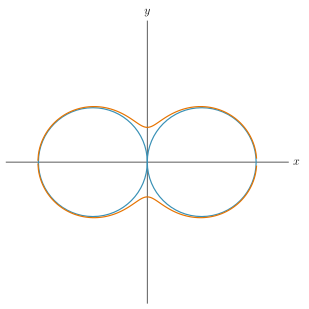
- Sketch the curves \(C_1\) and \(C_2\) on the same axes.
Solution:
- \(\,\)
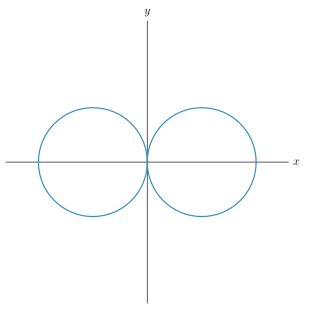
- Suppose \(y=k\) meets the curve \(C_2\) then \begin{align*} && \tfrac1{16} &= (k^2+(x-1)^2-1)(k^2+(x+1)^2-1) \\ &&&= (k^2+x^2-2x)(k^2+x^2+2x) \\ &&&= k^4+2k^2x^2+x^4-4x^2 \\ &&&= x^4+(2k^2-4)x^2+k^4 \\ \Rightarrow && 0 &= x^4+(2k^2-4)x^2+(k^4-\tfrac1{16}) \\ \\ && \Delta &= 4(k^2-2)^2 - 4 \cdot 1 \cdot (k^4-\tfrac1{16}) \\ &&&= 4(k^4-4k^2+4 - k^4 +\tfrac{1}{16}) \\ &&&= 16(1+\tfrac{1}{64} - k^2) \\ &&&= 16(\tfrac{65}{64} - k^2) \end{align*} Therefore if \(|k| < \frac{\sqrt{65}}{8}\) there are \(4\) intersections. If \(|k| = \frac{\sqrt{65}}{8}\) there are \(2\) intersections, otherwise there are \(0\).
- The greatest possible \(y\) value is \( \frac{\sqrt{65}}{8}\) and at this point \(x^2 = \frac{2(2-\frac{65}{64}}{2} =1 - \frac{1}{64} < 1\) so they are close to the \(y\)-axis.
- The regions where \(y^2+(x-1)^2-1 < 0\) and \(y^2+(x+1)^2-1 < 0\) is the interior of the two circles from the first part. However, since they don't overlap they can never both be negative. Therefore in our equation both are positive and therefore \(C_2\) is entirely outside \(C_1\)
- \(\,\)
2020 Paper 2 Q2
The curves \(C_1\) and \(C_2\) both satisfy the differential equation \[\frac{\mathrm{d}y}{\mathrm{d}x} = \frac{kxy - y}{x - kxy},\] where \(k = \ln 2\). All points on \(C_1\) have positive \(x\) and \(y\) co-ordinates and \(C_1\) passes through \((1,\,1)\). All points on \(C_2\) have negative \(x\) and \(y\) co-ordinates and \(C_2\) passes through \((-1,\,-1)\).
- Show that the equation of \(C_1\) can be written as \((x-y)^2 = (x+y)^2 - 2^{x+y}\). Determine a similar result for curve \(C_2\). Hence show that \(y = x\) is a line of symmetry of each curve.
- Sketch on the same axes the curves \(y = x^2\) and \(y = 2^x\), for \(x \geqslant 0\). Hence show that \(C_1\) lies between the lines \(x + y = 2\) and \(x + y = 4\). Sketch curve \(C_1\).
- Sketch curve \(C_2\).
2017 Paper 2 Q3
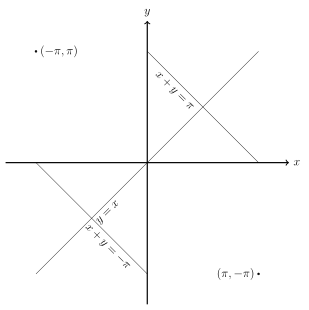
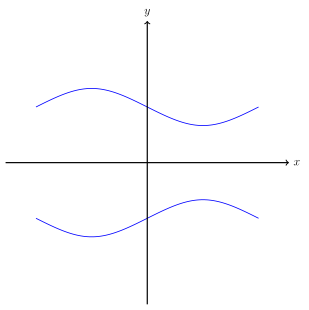
- Sketch, on \(x\)-\(y\) axes, the set of all points satisfying \(\sin y = \sin x\), for \(-\pi \le x \le \pi\) and \(-\pi \le y \le \pi\). You should give the equations of all the lines on your sketch.
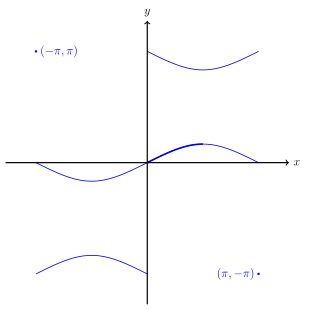
- Given that \[ \sin y = \tfrac12 \sin x \] obtain an expression, in terms of \(x\), for \(y'\) when \(0\le x \le \frac12 \pi\) and \(0\le y \le \frac12 \pi\), and show that \[ y'' = - \frac {3\sin x}{(4-\sin^2 x)^{\frac32}} \;. \] Use these results to sketch the set of all points satisfying \(\sin y = \tfrac12 \sin x\) for \(0 \le x \le \frac12 \pi\) and \(0 \le y \le \frac12 \pi\). Hence sketch the set of all points satisfying \(\sin y = \tfrac12 \sin x\) for \(-\pi\! \le \! x \! \le \! \pi\) and \mbox{\( -\pi \, \le\, y\, \le\, \pi\,\)}.
- Without further calculation, sketch the set of all points satisfying \(\cos y = \tfrac12 \sin x\) for \(- \pi \le x \le \pi\) and \( -\pi \le y \le \pi\).
Solution:
- \(\,\)
- \(\,\) \begin{align*}
&& \sin y &= \tfrac12 \sin x \\
\Rightarrow && \frac{\d y}{\d x} \cos y &= \tfrac12 \cos x \\
\Rightarrow && \frac{\d y}{\d x} &= \frac{\cos x}{2 \cos y} \\
&&&= \frac{\cos x}{2 \sqrt{1-\sin^2 y}} \\
&&&= \frac{\cos x}{2 \sqrt{1-\frac14 \sin^2 x}} \\
&&&= \frac{\cos x}{\sqrt{4-\sin^2 x}} \\
\\
&& y'' &= \frac{-\sin x \cdot (4-\sin^2 x)^{\frac12} - \cos x \cdot (4-\sin^2 x)^{-\frac12} \cdot 2 \sin x \cos x}{(4-\sin^2 x)} \\
&&&= \frac{-\sin x \cdot (4-\sin^2 x) - \cos x \cdot 2 \sin x \cos x}{(4-\sin^2x)^{\frac32}} \\
&&&= \frac{-\sin x \cdot (4-\sin^2 x) - \sin x (1-\sin^2x)}{(4-\sin^2x)^{\frac32}} \\
&&&= \frac{-3\sin x }{(4-\sin^2x)^{\frac32}} \\
\end{align*}
- \(\,\)
1997 Paper 1 Q2
- If \[{\mathrm f}(x)=\tan^{-1}x+\tan^{-1}\left(\frac{1-x}{1+x}\right),\] find \({\mathrm f}'(x)\). Hence, or otherwise, find a simple expression for \({\mathrm f}(x)\).
- Suppose that \(y\) is a function of \(x\) with \(0 < y < (\pi/2)^{1/2}\) and \[x=y\sin y^{2}\] for \(0 < x < (\pi/2)^{1/2}\). Show that (for this range of \(x\)) \[\frac{{\mathrm d}y}{{\mathrm d}x}= \frac{y}{x+2y^2\sqrt{y^{2}-x^{2}}}.\]
Solution:
- \begin{align*} && f(x)&=\tan^{-1}x+\tan^{-1}\left(\frac{1-x}{1+x}\right) \\ \Rightarrow && f'(x) &= \frac{1}{1+x^2} + \frac{1}{1+\l \frac{1-x}{1+x} \r^2} \cdot \l \frac{-2}{(1+x)^2}\r \\ &&&= \frac1{1+x^2}- \frac{2}{(1+x)^2+(1-x)^2} \\ &&&= \frac1{1+x^2} - \frac{2}{2+2x^2} \\ &&&= 0 \end{align*} Therefore $f(x) = \begin{cases} c_1 & \text{if } x < -1 \\ c_2 & \text{if } x > -1 \end{cases}$ \(f(0) = \tan^{-1} 0 + \tan^{-1} 1 = \frac{\pi}{4}\) \(\lim_{x \to \infty} f(x) = -\frac{\pi}{2} + \tan^{-1} -1 = -\frac{3\pi}{4}\) therefore $f(x) = \begin{cases} -\frac{3\pi}{4}& \text{if } x < -1 \\ \frac{\pi}{4} & \text{if } x > -1 \end{cases}$
- \begin{align*} && x &= y \sin y^2 \\ \Rightarrow && \frac{\d x}{\d y} &= \sin y^2 + 2y^2 \cos y^2 \\ \Rightarrow && \frac{\d y}{\d x} &= \frac{1}{\sin y^2+2y^2 \cos y^2} \\ &&&=\frac{1}{\frac{x}{y}+2y^2 \sqrt{1-\sin^2y^2}} \\ &&&= \frac{y}{x + 2y^3 \sqrt{1-\frac{x^2}{y^2}}} \\ &&&= \frac{y}{x+2y^2 \sqrt{y^2-x^2}} \end{align*}
1997 Paper 3 Q2
Let \[\mathrm{f}(t)=\frac{\ln t}t\quad\text{ for }t>0.\] Sketch the graph of \(\mathrm{f}(t)\) and find its maximum value. How many positive values of \(t\) correspond to a given value of \(\mathrm f(t)\)? Find how many positive values of \(y\) satisfy \(x^y=y^x\) for a given positive value of \(x\). Sketch the set of points \((x,y)\) which satisfy \(x^y=y^x\) with \(x,y>0\).
1989 Paper 1 Q7
Sketch the curve \(y^{2}=1-\left|x\right|\). A rectangle, with sides parallel to the axes, is inscribed within this curve. Show that the largest possible area of the rectangle is \(8/\sqrt{27}\). Find the maximum area of a rectangle similarly inscribed within the curve given by \(y^{2m}=\left(1-\left|x\right|\right)^{n}\), where \(m\) and \(n\) are positive integers, with \(n\) odd.
Solution:
