Problems
Filters
2 problems found
2002 Paper 1 Q12
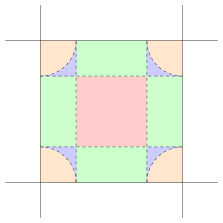
Harry the Calculating Horse will do any mathematical problem I set him, providing the answer is 1, 2, 3 or 4. When I set him a problem, he places a hoof on a large grid consisting of unit squares and his answer is the number of squares partly covered by his hoof. Harry has circular hoofs, of radius \(1/4\) unit. After many years of collaboration, I suspect that Harry no longer bothers to do the calculations, instead merely placing his hoof on the grid completely at random. I often ask him to divide 4 by 4, but only about \(1/4\) of his answers are right; I often ask him to add 2 and 2, but disappointingly only about \(\pi/16\) of his answers are right. Is this consistent with my suspicions? I decide to investigate further by setting Harry many problems, the answers to which are 1, 2, 3, or 4 with equal frequency. If Harry is placing his hoof at random, find the expected value of his answers. The average of Harry's answers turns out to be 2. Should I get a new horse?
Solution: Without loss of generality, let's assume that Harry is putting the center of his hoof within one square.
1996 Paper 2 Q13
By considering the coefficients of \(t^{n}\) in the equation \[(1+t)^{n}(1+t)^{n}=(1+t)^{2n},\] or otherwise, show that \[\binom{n}{0}\binom{n}{n}+\binom{n}{1}\binom{n}{n-1}+\cdots +\binom{n}{r}\binom{n}{n-r}+\cdots+\binom{n}{n}\binom{n}{0} =\binom{2n}{n}.\] The large American city of Triposville is laid out in a square grid with equally spaced streets running east-west and avenues running north-south. My friend is staying at a hotel \(n\) avenues west and \(n\) streets north of my hotel. Both hotels are at intersections. We set out from our own hotels at the same time. We walk at the same speed, taking 1 minute to go from one intersection to the next. Every time I reach an intersection I go north with probability \(1/2\) or west with probability \(1/2\). Every time my friend reaches an intersection she goes south with probability \(1/2\) or east with probability \(1/2\). Our choices are independent of each other and of our previous decisions. Indicate by a sketch or by a brief description the set of points where we could meet. Find the probability that we meet. Suppose that I oversleep and leave my hotel \(2k\) minutes later than my friend leaves hers, where \(k\) is an integer and \(0\leqslant 2k\leqslant n\). Find the probability that we meet. Have you any comment? If \(n=1\) and I leave my hotel \(1\) minute later than my friend leaves hers, what is the probability that we meet and why?
Solution: \begin{align*} && (1+t)^{n}(1+t)^{n}&=(1+t)^{2n} \\ [t^n]: &&\sum_{k=0}^n \underbrace{\binom{n}{k}}_{t^k\text{ from left bracket}} \underbrace{\binom{n}{n-k}}_{t^{n-k}\text{ from right bracket}} &= \binom{2n}{n} \end{align*}
