Problems
Filters
3 problems found
1998 Paper 3 Q12
The mountain villages \(A,B,C\) and \(D\) lie at the vertices of a tetrahedron, and each pair of villages is joined by a road. After a snowfall the probability that any road is blocked is \(p\), and is independent of the conditions of any other road. The probability that, after a snowfall, it is possible to travel from any village to any other village by some route is \(P\). Show that $$ P =1- p^2(6p^3-12p^2+3p+4). $$ %In the case \(p={1\over 3}\) show that this probability is \({208 \over 243}\).
1992 Paper 1 Q16
The four towns \(A,B,C\) and \(D\) are linked by roads \(AB,AC,CB,BD\) and \(CD.\) The probability that any one road will be blocked by snow on the 1st of January is \(p\), independent of what happens to any other \([0 < p < 1]\). Show that the probability that any open route from \(A\) to \(D\) is \(ABCD\) is \[ p^{2}(1-p)^{3}. \] In order to increase the probability that it is possible to get from \(A\) to \(D\) by a sequence of unblocked roads the government proposes either to snow-proof the road \(AB\) (so that it can never be blocked) or to snow-proof the road \(CB.\) Because of the high cost it cannot do both. Which road should it choose (or are both choices equally advantageous)? In fact, \(p=\frac{1}{10}\) and the government decides that it is only worth going ahead if the present probability of \(A\) being cut off from \(D\) is greater than \(\frac{1}{100}.\) Will it go ahead?
1989 Paper 1 Q4
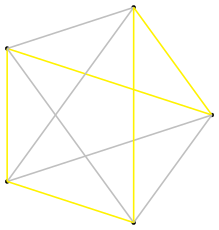
Six points \(A,B,C,D,E\) and \(F\) lie in three dimensional space and are in general positions, that is, no three are collinear and no four lie on a plane. All possible line segments joining pairs of points are drawn and coloured either gold or silver. Prove that there is a triangle whose edges are entirely of one colour. {[}\(Hint\): consider segments radiating from \(A.\){]} Give a sketch showing that the result is false for five points in general positions.
Solution: Consider the \(5\) segements radiating from \(A\). By the pigeonhole principle, at least \(3\) of them must be the same colour (say gold and say reaching \(B,C,D\)). If any of the segments joining any of \(B,C,D\) are gold then we have found a monochromatic gold triangle. But if none of them are gold, they are all silver, therefore \(BCD\) is a monochromatic silver triangle.