Problems
Filters
2 problems found
2020 Paper 2 Q4
D: 1500.0
B: 1500.0
- Given that \(a\), \(b\) and \(c\) are the lengths of the sides of a triangle, explain why \(c < a + b\), \(a < b + c\) and \(b < a + c\).
- Use a diagram to show that the converse of the result in part (i) also holds: if \(a\), \(b\) and \(c\) are positive numbers such that \(c < a + b\), \(a < b + c\) and \(b < c + a\) then it is possible to construct a triangle with sides of length \(a\), \(b\) and \(c\).
- When \(a\), \(b\) and \(c\) are the lengths of the sides of a triangle, determine in each case whether the following sets of three lengths can
- always
- sometimes but not always
- never
- Let \(\mathrm{f}\) be a function defined on the positive real numbers and such that, whenever \(x > y > 0\), \[\mathrm{f}(x) > \mathrm{f}(y) > 0 \quad \text{but} \quad \frac{\mathrm{f}(x)}{x} < \frac{\mathrm{f}(y)}{y}.\] Show that, whenever \(a\), \(b\) and \(c\) are the lengths of the sides of a triangle, then \(\mathrm{f}(a)\), \(\mathrm{f}(b)\) and \(\mathrm{f}(c)\) can also be the lengths of the sides of a triangle.
Solution:
- Not that unless a side is the largest side, it is clearly shorter than the sum of the other two sides (since it's greater than or equal to one on its own). Note also that the distance from one vertex to the other (say \(c\)) is shorter than going via the other vertex \(a+b\), therefore \(c < a+b\).
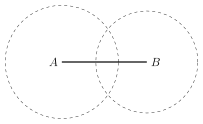
- Draw a line of the length of the largest number, say \(c\), then since \(c < a+b\) we must have circles radius \(a\) and \(b\) at the endpoints cross, and at their intersection we have a vertex of a \(c\)-\(a\)-\(b\) triangle.
- (A) always. Suppose \(c\) is the longest side, then \(c < a+b \Rightarrow c+1 < a + 1 + b+1\) so \((a+1,b+1,c+1)\) are still sides of a triangle. (B) sometimes, but not always. \((1,1,1) \to (1,1,1)\) is still a triangle, but \((10, 10, 1) \to (1, 10, \frac{1}{10})\) is not a triangle since \(10 > 1 + \frac{1}{10}\) (C) never, suppose \(a \leq b \leq c\) then the sides are \(b-a, c-b, c-a\) but \(c-a = (c-b)+(b-a)\) so the triangle inequality cannot be satisfied. (D) always - without loss of generality let \(c\) be the longest side, and since every term is homogeneous degree \(2\) we can divide through by \(c^2\) to see we have the sides \(a^2+b, b^2+a, 1+ab\) and note that \(1 + ab < a+b +ab < a+b+a^2+b^2\), also \(a^2+b < 1 + b < 1 + (a+b)b = 1 + b^2 + ab < (1+ab)+(b^2+a)\).
- Suppose \(f\) is increasing and \(\f(x)/x\) is decreasing, and suppose \(a,b,c\) are side-lengths of a triangle. Wlog \(c\) is the longest side, then note \(f(c) > f(b), f(a)\), so it suffices to prove that \(f(c) < f(a)+f(b)\) \begin{align*} \frac{f(c)}{c} < \frac{f(a)}{a}: && f(a) &> \frac{a}{c} f(c) \\ \frac{f(c)}{c} < \frac{f(b)}{b}: && f(b) &> \frac{b}{c} f(c) \\ \Rightarrow && f(a)+f(b) &> f(c) \underbrace{\left ( \frac{a+b}{c} \right)}_{>1} \\ &&&> f(c) \end{align*} as required
2013 Paper 1 Q8
D: 1516.0
B: 1474.0
functions
composite functions
domain and range
curve sketching
asymptotes
logarithm
square root
inverse functions
- The functions \(\mathrm{a, b, c}\) and \(\mathrm{d}\) are defined by
- \({\rm a}(x) =x^2 \ \ \ \ (-\infty < x < \infty),\)
- \({\rm b}(x) = \ln x \ \ \ \ (x > 0),\)
- \({\rm c}(x) =2x \ \ \ \ (-\infty < x < \infty),\)
- \({\rm d}(x)= \sqrt x \ \ \ \ (x\ge0) \,.\)
- The functions \(\mathrm{f}\) and \(\mathrm{g}\) are defined by
- \(\f(x)= \sqrt{x^2-1\,} \ \ \ \ (\vert x \vert \ge 1),\)
- \(\g(x) = \sqrt{x^2+1\,} \ \ \ \ (-\infty < x < \infty).\)
- Sketch the graphs of the functions \(\h\) and \({\rm k}\) defined by
- \(\h(x) = x+\sqrt{x^2-1\,}\, \ \ \ \ ( x \ge1)\),
- \({\rm k}(x) = x-\sqrt{x^2-1\,}\, \ \ \ \ (\vert x\vert \ge1),\)
Solution:
- \begin{align*} cb(x) &= c(b(x)) \\ &= 2 \ln x \quad (x > 0) \\ ab(x) &= (b(x))^2 \\ &= (\ln x)^2 \quad (x > 0) \\ da(x) &= \sqrt{a(x)} \\ &= \sqrt{x^2} \\ &= |x| \quad (-\infty < x < \infty) \\ ad(x) &= (d(x))^2 \\ &= (\sqrt{x})^2 \\ &= x \quad (x \geq 0) \end{align*} The domains are specified above. The ranges are \(\mathbb{R}, \mathbb{R}_{\geq 0}, \mathbb{R}_{\geq 0}, \mathbb{R}_{\geq 0}\) respectively.
- \begin{align*} fg(x) &= \sqrt{g(x)^2-1} \quad (|g(x)| \geq 1) \\ &= \sqrt{x^2+1-1} \\ &= |x| \end{align*} So \(fg: \mathbb{R} \to \mathbb{R}_{\geq 0}\). \begin{align*} gf(x) &= \sqrt{f(x)^2 + 1} \\ &= \sqrt{\left ( \sqrt{x^2-1} \right)^2+1} \quad (|x| \geq 1) \\ &= |x| \end{align*} So \(gf: \mathbb{R}_{\geq 0} \to \mathbb{R}_{\geq 0}\)

