Problems
Filters
2 problems found
2025 Paper 3 Q7
D: 1500.0
B: 1500.0
integration
inverse trigonometric functions
curve sketching
binomial series
tan-inverse
definite integral
symmetry
function properties
Let \(f(x) = \sqrt{x^2 + 1} - x\).
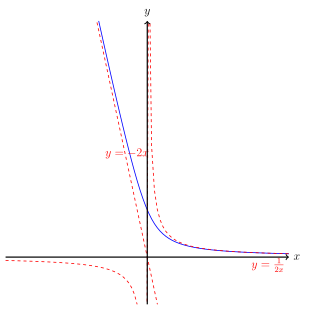
- Using a binomial series, or otherwise, show that, for large \(|x|\), \(\sqrt{x^2 + 1} \approx |x| + \frac{1}{2|x|}\). Sketch the graph \(y = f(x)\).
- Let \(g(x) = \tan^{-1} f(x)\) and, for \(x \neq 0\), let \(k(x) = \frac{1}{2}\tan^{-1}\frac{1}{x}\).
- Show that \(g(x) + g(-x) = \frac{1}{2}\pi\).
- Show that \(k(x) + k(-x) = 0\).
- Show that \(\tan k(x) = \tan g(x)\) for \(x > 0\).
- Sketch the graphs \(y = g(x)\) and \(y = k(x)\) on the same axes.
- Evaluate \(\int_0^1 k(x) \, dx\) and hence write down the value of \(\int_{-1}^0 g(x) \, dx\).
Solution:
- \begin{align*}
\sqrt{x^2+1} &= |x|\sqrt{1+\frac{1}{x^2}} \\
&=|x| \left (1 + \frac12 \frac{1}{x^2} + \cdots \right) & \text{if } \left (\frac{1}{x^2} < 1 \right) \\
&= |x| + \frac12 \frac{1}{|x|} + \cdots \\
&\approx |x| + \frac{1}{2|x|}
\end{align*}
- \begin{align*} && \tan( g(x) + g(-x)) &= \tan \left ( \tan^{-1}(\sqrt{x^2+1}-x) + \tan^{-1}(\sqrt{x^2+1}+x) \right) \\ &&&= \frac{\sqrt{x^2+1}-x+\sqrt{x^2+1}+x}{1-1} \\ \Rightarrow && g(x) + g(-x) &\in \left \{\cdots, -\frac{\pi}{2}, \frac{\pi}{2}, \cdots \right\} \end{align*} But \(g(x), g(-x) > 0\) and \(g(x), g(-x) \in (-\frac{\pi}{2}, \frac{\pi}{2})\), therefore it must be \(\frac{\pi}{2}\).
- \begin{align*} && \tan(2(k(x) + k(-x))) &= \tan(\tan^{-1}x + \tan^{-1}(-x)) \\ &&&= 0 \\ \Rightarrow && k(x)+k(-x) &\in \left \{\cdots, -\frac{\pi}{2}, 0, \frac{\pi}{2}, \cdots \right\} \\ \end{align*} But \(k(x) \in (-\frac{\pi}{4}, \frac{\pi}{4})\), therefore \(k(x) + k(-x) = 0\).
- Let \(t = \tan k(x)\). \begin{align*} && \tan \left ( \tan^{-1} \frac{1}{x} \right) &= \frac{2 \tan\left ( \frac12 \tan^{-1} \frac1x \right)}{ 1-\tan^2\left ( \frac12 \tan^{-1} \frac1x \right)} \\ \Rightarrow && \frac1x &= \frac{2t}{1-t^2} \\ \Rightarrow && 1-t^2 &= 2tx \\ \Rightarrow && 0 &= t^2+2tx - 1 \\ \Rightarrow && 0 &= (t+x)^2 - 1-x^2 \\ \Rightarrow && t &= -x \pm \sqrt{1+x^2} \end{align*} Since \(t > 0\), \(t = \sqrt{1+x^2}-x = f(x) = \tan g(x)\)
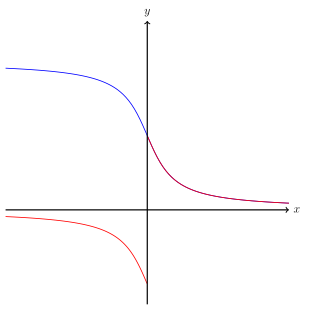
- \begin{align*} \int_0^1 k(x) \d x &= \int_0^1 \frac12 \tan^{-1} \left ( \frac1x \right) \d x \\ &= \left [ \frac{x}{2} \tan^{-1}\left ( \frac1x \right) \right]_0^1 - \int_0^1 \frac{x}{2} \frac{-1/x^2}{1+1/x^2} \d x \\ &= \left [ \frac{x}{2} \tan^{-1}\left ( \frac1x \right) \right]_0^1 + \frac14 \int_0^1 \frac{2x}{1+x^2} \d x \\ &= \frac12 \frac{\pi}{4} + \frac14 \ln(2) \\ &= \frac{\pi + \ln 4}{8}\end{align*} Therefore \(\displaystyle \int_{-1}^0 g(x) \d x = -\frac{\pi + \ln 4}{8}\)
2019 Paper 2 Q8
D: 1500.0
B: 1638.7
matrices
multiplicative function
determinant
2x2 matrix
identity matrix
matrix properties
proof
function properties
The domain of the function f is the set of all \(2 \times 2\) matrices and its range is the set of real numbers. Thus, if \(M\) is a \(2 \times 2\) matrix, then \(f(M) \in \mathbb{R}\). The function f has the property that \(f(MN) = f(M)f(N)\) for any \(2 \times 2\) matrices \(M\) and \(N\).
- You are given that there is a matrix \(M\) such that \(f(M) \neq 0\). Let \(I\) be the \(2 \times 2\) identity matrix. By considering \(f(MI)\), show that \(f(I) = 1\).
- Let \(J = \begin{pmatrix} 0 & 1 \\ 1 & 0 \end{pmatrix}\). You are given that \(f(J) \neq 1\). By considering \(J^2\), evaluate \(f(J)\). Using \(J\), show that, for any real numbers \(a\), \(b\), \(c\) and \(d\), $$.f\left(\begin{pmatrix} a & b \\ c & d \end{pmatrix}\right) = -f\left(\begin{pmatrix} c & d \\ a & b \end{pmatrix}\right) = f\left(\begin{pmatrix} d & c \\ b & a \end{pmatrix}\right)$$
- Let \(K = \begin{pmatrix} 1 & 0 \\ 0 & k \end{pmatrix}\) where \(k \in \mathbb{R}\). Use \(K\) to show that, if the second row of the matrix \(A\) is a multiple of the first row, then \(f(A) = 0\).
- Let \(P = \begin{pmatrix} 1 & 1 \\ 0 & 1 \end{pmatrix}\). By considering the matrices \(P^2\), \(P^{-1}\), and \(K^{-1}PK\) for suitable values of \(k\), evaluate \(f(P)\).
Solution:
- Consider \(f(M) = f(MI) = f(M)f(I)\). Since \(f(M) \neq 0\) we can divide by \(f(M)\) to obtain \(f(I) = 1\)
- Let \(J = \begin{pmatrix} 0 & 1 \\ 1 & 0 \end{pmatrix}\), then \(J^2 = \begin{pmatrix} 1 & 0 \\ 0 & 1 \end{pmatrix} = I\). Therefore \(1 = f(I) = f(J^2) = f(J)f(J) \Rightarrow f(J) = \pm 1 \Rightarrow f(J) = -1\) since \(f(J) \neq 1\). \begin{align*} \begin{pmatrix} a & b \\ c & d \end{pmatrix}J &= \begin{pmatrix} a & b \\ c & d \end{pmatrix}\begin{pmatrix} 0 & 1 \\ 1 & 0 \end{pmatrix} \\ &= \begin{pmatrix} b & a \\ d & c \end{pmatrix} \\ J\begin{pmatrix} a & b \\ c & d \end{pmatrix} &= \begin{pmatrix} 0 & 1 \\ 1 & 0 \end{pmatrix}\begin{pmatrix} a & b \\ c & d \end{pmatrix} \\ &= \begin{pmatrix} c & d \\ a & b \end{pmatrix} \\ J\begin{pmatrix} a & b \\ c & d \end{pmatrix}J &=\begin{pmatrix} d & c \\ b & a \end{pmatrix} \end{align*} Therefore \(f\left(\begin{pmatrix} c & d \\ a & b \end{pmatrix}\right) = f \left (J\begin{pmatrix} a & b \\ c & d \end{pmatrix} \right) = f(J) f\left(\begin{pmatrix} a & b \\ c & d \end{pmatrix}\right) = -f\left(\begin{pmatrix} a & b \\ c & d \end{pmatrix}\right)\) and \(f\left(\begin{pmatrix} d & c \\ b & a \end{pmatrix}\right) = f\left(J\begin{pmatrix} a & b \\ c & d \end{pmatrix}J \right) = f(J)f\left(\begin{pmatrix} a & b \\ c & d \end{pmatrix}\right)f(J) = f\left(\begin{pmatrix} a & b \\ c & d \end{pmatrix}\right)\) as required.
- First consider \(O\) the matrix of \(0\), then \begin{align*} && JO &= O \\ \Rightarrow && f(JO) &= f(O) \\ \Rightarrow && f(J)f(O) &= f(O) \\ \Rightarrow && -f(O) &= f(O) \\ \Rightarrow && f(O) &= 0 \end{align*} Now consider \(K_{k} = \begin{pmatrix} 1 & 0 \\ 0 & k \end{pmatrix}\). Suppose \(A = \begin{pmatrix} a & b \\ ka & kb \end{pmatrix}\) then \begin{align*} K_{\frac1k}A &= \begin{pmatrix} 1 & 0 \\ 0 & \frac1k \end{pmatrix} \begin{pmatrix} a & b \\ ka & kb \end{pmatrix} \\ &= \begin{pmatrix} a & b \\ a & b \end{pmatrix} \end{align*} And so \(f(K_{\frac1k}A) = f\left ( \begin{pmatrix} a & b \\ a & b \end{pmatrix} \right) = - f \left ( \begin{pmatrix} a & b \\ a & b \end{pmatrix} \right) = 0\), therefore either \(f(K_{\frac1k}) = 0\) or \(f(A) = 0\), but we know that \(f(I) \neq 0\) therefore \(f(A) = 0\).
- Let \(P = \begin{pmatrix} 1 & 1 \\ 0 & 1 \end{pmatrix}\), then \(P^2 = \begin{pmatrix} 1 &2 \\ 0 & 1 \end{pmatrix}\), \(P^{-1} = \begin{pmatrix} 1 & -1 \\ 0 & 1 \end{pmatrix}\), \(K_k^{-1}PK_k = K_k^{-1}\begin{pmatrix} 1 & k \\ 0 & k \end{pmatrix} = \begin{pmatrix} 1 & k \\ 0 & 1 \end{pmatrix}\). If \(A\) has an inverse then \(f(A) \neq 0\) since \(1 = f(I) = f(A)f(A^{-1})\), in particular, \(f(A)f(A^{-1}) = 1\). Using this for \(K_2\) we have: \(f(P)^2 = f(P^2) = f(K_2^{-1}PK_2) = f(P)\) therefore \(f(P) = 0, 1\), but since \(f(P)\) has an inverse, \(f(P) \neq 0\) so \(f(P) = 1\)