Problems
Filters
3 problems found
2003 Paper 2 Q6
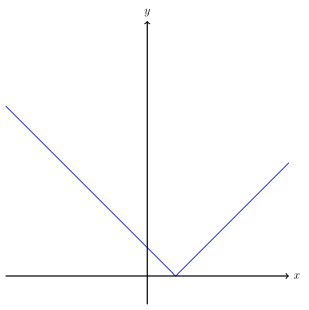
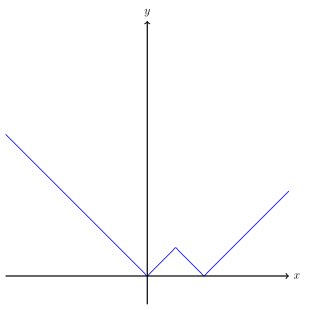
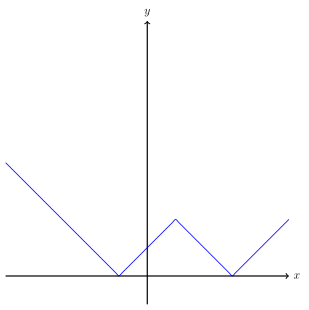
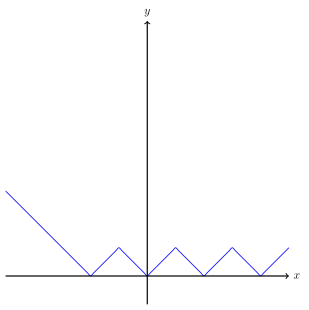
The function \(\f\) is defined by $$ \f(x)= \vert x-1 \vert\;, $$ where the domain is \({\bf R}\,\), the set of all real numbers. The function \(\g_n =\f^n\), with domain \({\bf R}\,\), so for example \(\g_3(x) = \f(\f(\f(x)))\,\). In separate diagrams, sketch graphs of \(\g_1\,\), \(\g_2\,\), \(\g_3\,\) and \(\g_4\,\). The function \(\h\) is defined by \[ \h(x) = |\sin {{{\pi}x} \over 2}|, \] where the domain is \({\bf R}\,\). Show that if \(n\) is even, \[ \int_0^n\,\big( \h(x)-\g_n(x)\big)\,\d x = \frac{2n}{\pi} -\frac{n}2\;. \]
Solution:
1994 Paper 1 Q6
The function \(\mathrm{f}\) is defined, for any complex number \(z\), by \[ \mathrm{f}(z)=\frac{\mathrm{i}z-1}{\mathrm{i}z+1}. \] Suppose throughout that \(x\) is a real number.
- Show that \[ \mathrm{Re}\,\mathrm{f}(x)=\frac{x^{2}-1}{x^{2}+1}\qquad\mbox{ and }\qquad\mathrm{Im}\,\mathrm{f}(x)=\frac{2x}{x^{2}+1}. \]
- Show that \(\mathrm{f}(x)\mathrm{f}(x)^{*}=1,\) where \(\mathrm{f}(x)^{*}\) is the complex conjugate of \(\mathrm{f}(x)\).
- Find expressions for \(\mathrm{Re}\,\mathrm{f}(\mathrm{f}(x))\) and \(\mathrm{Im}\,\mathrm{f}(\mathrm{f}(x)).\)
- Find \(\mathrm{f}(\mathrm{f}(\mathrm{f}(x))).\)
Solution:
- \begin{align*} && f(x) &= \frac{ix-1}{ix+1} \\ &&&= \frac{ix-1}{ix+1} \frac{1-ix}{1-ix} \\ &&&= \frac{ix-1+x^2+ix}{1^2+x^2} \\ &&&= \frac{x^2-1}{x^2+1} + i \frac{2x}{x^2+1} \\ \Rightarrow && \textrm{Re}(f(x)) &= \frac{x^2-1}{x^2+1} \\ && \textrm{Im}(f(x)) &= \frac{2x}{x^2+1} \end{align*}
- \begin{align*} && f(x)f(x)^* &= \frac{ix-1}{ix+1} \frac{(ix-1)^*}{(ix+1)^*} \\ &&&= \frac{ix-1}{ix+1} \frac{-ix-1}{-ix+1} \\ &&&= \frac{ix-1}{ix+1} \frac{-(ix+1)}{-(ix-1)} \\ &&&= 1
- \begin{align*} && \begin{pmatrix} i & -1 \\ i & 1 \end{pmatrix}^2 &= \begin{pmatrix} -1-i & -i-1 \\ -1+i & -i+1 \end{pmatrix} \\ \Rightarrow && f(f(z)) &= \frac{-(1+i)(z+1)}{(-1+i)(z-1)} \\ &&&= \frac{2i}{2} \frac{z+1}{z-1} \\ &&&= i \frac{z+1}{z-1} \\ \Rightarrow && \textrm{Re}(f(f(x))) &= 0 \\ && \textrm{Im}(f(f(x))) &= \frac{x+1}{x-1} \end{align*}
- \begin{align*} && \begin{pmatrix} i & -1 \\ i & 1 \end{pmatrix} \begin{pmatrix} i & i \\ 1 & -1 \end{pmatrix} &= \begin{pmatrix} -2 & 0 \\ 0 & -2 \end{pmatrix} \\ \Rightarrow && f(f(f(z))) &= z \end{align*}
1988 Paper 1 Q2
The function \(\mathrm{f}\) and \(\mathrm{g}\) are related (for all real \(x\)) by \[ \mathrm{g}(x)=\mathrm{f}(x)+\frac{1}{\mathrm{f}(x)}\,. \] Express \(\mathrm{g}'(x)\) and \(\mathrm{g}''(x)\) in terms of \(\mathrm{f}(x)\) and its derivatives. If \(\mathrm{f}(x)=4+\cos2x+2\sin x\), find the stationary points of \(\mathrm{g}\) for \(0\leqslant x\leqslant2\pi,\) and determine which are maxima and which are minima.
Solution: \(g'(x) = f'(x) - \frac{f'(x)}{(f(x))^2} = f'(x) \l 1 - \frac{1}{(f(x))^2} \r\) \(g''(x) = f''(x) - \frac{f''(x)f(x)^2-f'(x)\cdot 2f(x) f'(x)}{(f(x))^4} = f''(x) + \frac{f''(x)f(x)-2(f'(x))^2}{(f(x))^3}\) \begin{align*} f(x) &=4+\cos2x+2\sin x \\ f'(x) &=-2\sin2x+2\cos x \\ f''(x) &= -4\cos2x-2\sin x \end{align*} Therefore, since the stationary points of \(g\), ie points where \(g'(x) = 0\) are where \(f'(x) = 0\) or \(f(x) = \pm 1\) we should look at \begin{align*} && 0 &= f'(x) \\ && 0 &= 2 \cos x - 2 \sin 2x \\ &&&= 2 \cos x - 4 \sin x \cos x \\ &&&= 2\cos x (1 - 2 \sin x) \\ \Rightarrow && x &= \frac{\pi}2, \frac{3\pi}{2}, \frac{\pi}{6}, \frac{5\pi}{6} \end{align*} \begin{align*} && 1 &= f(x) \\ && 1 &= 4 + \cos 2x + 2 \sin x \\ \Rightarrow && \cos 2x = -1,& \sin x = -1 \\ \Rightarrow && x &= \frac{3\pi}{2} \end{align*} which we were already checking. For each of these points we have: \begin{array}{c|c|c|c||c} x & f(x) & f'(x) & f''(x) & g''(x) \\ \hline \frac{\pi}{2} & 5 & 0 & 2 & > 0\\ \frac{3\pi}{2} & 1 & 0 & 6 &> 0\\ \frac{\pi}{6} & 5.5 & 0 & -3 & < 0 \\ \frac{5\pi}{6} & 5.5 & 0 & -3 & < 0\\ \end{array} Therefore \(\frac{\pi}{2}, \frac{3\pi}{2}\) are minimums and \(\frac{\pi}{6}\) and \(\frac{5\pi}{6}\) are maxima.