Problems
Filters
1 problem found
2015 Paper 2 Q8
D: 1600.0
B: 1500.0
\noindent
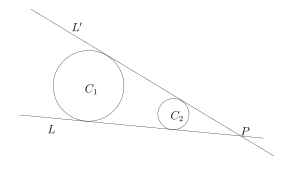
- Let \(\mathbf{x}_1\) and \(\mathbf{x}_2\) be the position vectors of the centres of \(C_1\) and \(C_2\), respectively. Show that the position vector of \(P\) is \[ \frac{r_1 \mathbf{x}_2- r_2 \mathbf{x}_1}{r_1-r_2} \,, \] where \(r_1\) and \(r_2\) are the radii of \(C_1\) and \(C_2\), respectively.
- The circle \(C_3\) does not overlap either \(C_1\) or \(C_2\) and its radius, \(r_3\), satisfies \(r_1 \ne r_3 \ne r_2\). The focus of \(C_1\) and \(C_3\) is \(Q\), and the focus of \(C_2\) and \(C_3\) is \(R\). Show that \(P\), \(Q\) and \(R\) lie on the same straight line.
- Find a condition on \(r_1\), \(r_2\) and \(r_3\) for \(Q\) to lie half-way between \(P\) and \(R\).
Solution:
- Notice that \(P\) lies on \(C_1C_2\), and that the triangles formed from \(C_iPT_i\) where \(T_i\) are the tangent points are similar, with ratios \(\frac{r_1}{r_2}\). Therefore \(\frac{C_1P}{r_1} = \frac{C_2P}{r_2}\), and hence \(\frac{C_1P}{C_1C_2} = \frac{C_1P}{C_1P-C_2P} = \frac{1}{1-\frac{r_2}{r_1}} = \frac{r_1}{r_1-r_2}\) So we have \(\mathbf{p} = \mathbf{x_1} + (\mathbf{x}_2 - \mathbf{x}_1)\cdot\frac{r_1}{r_1-r_2} = \frac{r_1\mathbf{x}_2 - r_2\mathbf{x}_1}{r_1-r_2}\)
- Suppose \(\mathbf{x}_3 = \binom{\alpha}{\beta}\) in the basis of \(\{ \mathbf{x}_1, \mathbf{x}_2 \}\), then we can see that \begin{align*} && \mathbf{p} &= \frac{1}{r_1-r_2}\binom{-r_2}{r_1} \\ && \mathbf{q} &= \frac{r_1(\alpha \mathbf{x}_1 +\beta \mathbf{x}_2) - r_3\mathbf{x}_1}{r_1-r_3} \\ &&&= \frac{1}{r_1-r_3} \binom{r_1\alpha -r_3}{r_1\beta} \\ && \mathbf{r} &=\frac{1}{r_2-r_3} \binom{r_2\alpha}{r_2\beta - r_3} \\ && \mathbf{p}-\mathbf{q} &= \frac{1}{r_1-r_2}\binom{-r_2}{r_1} - \frac{1}{r_1-r_3} \binom{r_1\alpha -r_3}{r_1\beta} \\ &&&= \frac{1}{(r_1-r_2)(r_1-r_3)} \binom{(r_1-r_3)(-r_2)-(r_1-r_2)(r_1\alpha-r_3)}{(r_1-r_3)r_1 - (r_1-r_2)r_1\beta} \\ &&&= \frac{r_1}{(r_1-r_2)(r_1-r_3)} \binom{(r_3-r_2)-\alpha(r_1-r_2)}{(r_1-r_3)-\beta(r_1-r_2)} \\ && \mathbf{q} - \mathbf{r} &= \frac{1}{r_1-r_3} \binom{r_1\alpha -r_3}{r_1\beta} - \frac{1}{r_2-r_3} \binom{r_2\alpha}{r_2\beta - r_3} \\ &&&= \frac{1}{(r_1-r_3)(r_2-r_3)}\binom{(r_2-r_3)(r_1\alpha-r_3) - (r_1-r_3)r_2\alpha)}{(r_2-r_3)r_1\beta - (r_1-r_3)(r_2\beta - r_3)} \\ &&&= \frac{1}{(r_1-r_3)(r_2-r_3)}\binom{(-r_2r_3+r_3^2) - \alpha(r_1r_3-r_3r_2)}{r_3(r_1-r_3)-\beta(r_1-r_2)} \\ &&&= \frac{r_3}{(r_1-r_3)(r_2-r_3)}\binom{(r_3-r_2)-\alpha(r_1-r_2)}{(r_1-r_3)-\beta(r_1-r_2)} \end{align*} Therefore they are clearly parallel, and hence lie on a line.
- \(Q\) is halfway between \(P\) and \(R\) if \begin{align*} && \frac{r_1}{(r_1-r_2)(r_1-r_3)} &= \frac{r_3}{(r_1-r_3)(r_2-r_3)} \\ \Leftrightarrow && r_1(r_2-r_3) &= r_3(r_1-r_2) \\ \Leftrightarrow && r_1r_2 - r_1r_3 &= r_1r_3 - r_2r_3 \\ \Leftrightarrow && r_2 &= \frac{2r_1r_3}{r_1+r_3} \end{align*}