Problems
Filters
7 problems found
2021 Paper 2 Q4
- Sketch the curve \(y = xe^x\), giving the coordinates of any stationary points.
- The function \(f\) is defined by \(f(x) = xe^x\) for \(x \geqslant a\), where \(a\) is the minimum possible value such that \(f\) has an inverse function. What is the value of~\(a\)? Let \(g\) be the inverse of \(f\). Sketch the curve \(y = g(x)\).
- For each of the following equations, find a real root in terms of a value of the function~\(g\), or demonstrate that the equation has no real root. If the equation has two real roots, determine whether the root you have found is greater than or less than the other root.
- \(e^{-x} = 5x\)
- \(2x \ln x + 1 = 0\)
- \(3x \ln x + 1 = 0\)
- \(x = 3\ln x\)
- Given that the equation \(x^x = 10\) has a unique positive root, find this root in terms of a value of the function~\(g\).
2018 Paper 1 Q2
If \(x=\log_bc\,\), express \(c\) in terms of \(b\) and \(x\) and prove that $ \dfrac{\log_a c}{\log_a b} = \ds \log_b c \,$.
- Given that \(\pi^2 < 10\,\), prove that \[ \frac{1}{\log_2 \pi}+\frac{1}{\log_5 \pi} > 2\,. \]
- Given that \(\ds \log_2 \frac{\pi}{\e} > \frac{1}{5}\) and that \(\e^2 < 8\), prove that \(\ln \pi > \frac{17}{15}\,\).
- Given that \(\e^3 >20\), \, \(\pi^2 < 10\,\) and \(\log_{10}2 >\frac{3}{10}\,\), prove that \(\ln \pi < \frac{15}{13}\,\).
Solution: \(x = \log_bc\) means that \(b^x = c\) Therefore, we can write \(\frac{\log_ac}{\log_ab} = \frac{\log_ab^{x}}{\log_ab} = \frac{x \log_ab}{\log_ab} = x = \log_bc\), giving us the change of base rule. Rearranging the chance of base rule, we get \(\frac{1}{\log_bc} = \frac{\log_ab}{\log_ac}\)
- Since \(\pi^2 < 10\), we have \begin{align*} \Leftrightarrow && \pi^2 &< 10 \\ \Leftrightarrow && 2\log_{10} \pi &< 1 \\ \Leftrightarrow && 2 &< \frac{1}{\log_{10} \pi} \\ \Leftrightarrow && 2 &< \frac{\log_{10} 2 + \log_{10} 5}{\log_{10} \pi} \\ \Leftrightarrow && 2 &< \frac{\log_{10} 2}{\log_{10} \pi} + \frac{\log_{10} 5}{\log_{10} \pi} \\ \Leftrightarrow && 2 &< \frac1{\log_2\pi}+ \frac1{\log_5\pi} \\ \end{align*}
- Since \(e^2 < 8 \Rightarrow 2 < 3 \ln 2 \Rightarrow \ln 2 > \frac23\) \begin{align*} && \log_2 \frac{\pi}{e} &= \frac{\ln \frac{\pi}{e}}{\ln 2} \\ &&&= \frac{\ln \frac{\pi}{e}}{\ln 2} \\ &&&< \frac{3(\ln \pi - 1)}{2} \\ \Rightarrow && \frac{1}{5} &< \frac{3 \ln \pi - 1}{2} \\ \Rightarrow && \frac{2}{15} + 1 = \frac{17}{15}&< \ln \pi \end{align*}
- From the inequalities given we can set up two linear inequalities in \(\ln 2\) and \(\ln 5\) \begin{align*} && 20 &< e^3 \\ \Rightarrow && 2\ln 2 + \ln 5 &< 3 \tag{*}\\ \\ && \frac{3}{10} &< \log_{10} 2 \\ \Rightarrow && \frac{3}{10} &< \frac{\ln 2}{\ln 10} \\ \Rightarrow && 3 \ln 2 + 3 \ln 5 &< 10 \ln 2 \\ \Rightarrow && -7 \ln 2 + 3 \ln 5 &< 0 \tag{**}\\ \\ \\ && \pi^2 & < 10 \\ \Rightarrow && 2 \ln \pi &< \ln 2 + \ln 5 \tag{***}\\ \end{align*} It would be nice to combine \((*)\) and \((**)\) to bound \(\ln 2+ \ln 5\), so we want to use a linear combination such that \begin{align*} && \begin{cases} 2x -7y &= 1 \\ x + 3y &= 1\end{cases} \\ \Rightarrow && \begin{cases} y &= \frac1{13} \\ x &= \frac{10}{13}\end{cases} \\ \\ \Rightarrow && \ln 2 + \ln 5 < \frac{30}{13} + 0 \\ \Rightarrow && \ln \pi < \frac{15}{13} \end{align*}
2007 Paper 2 Q7
A function \(\f(x)\) is said to be concave on some interval if \(\f''(x)<0\) in that interval. Show that \(\sin x\) is concave for \(0< x < \pi\) and that \(\ln x\) is concave for \(x > 0\). Let \(\f(x)\) be concave on a given interval and let \(x_1\), \(x_2\), \(\ldots\), \(x_n\) lie in the interval. Jensen's inequality states that \[ \frac1 n \sum_{k=1}^n\f(x_k) \le \f \bigg (\frac1 n \sum_{k=1}^n x_k\bigg) \] and that equality holds if and only if \(x_1=x_2= \cdots =x_n\). You may use this result without proving it.
- Given that \(A\), \(B\) and \(C\) are angles of a triangle, show that \[ \sin A + \sin B + \sin C \le \frac{3\sqrt3}2 \,. \]
- By choosing a suitable function \(\f\), prove that
\[
\sqrt[n]{t_1t_2\cdots t_n}\; \le \; \frac{t_1+t_2+\cdots+t_n}n
\]
for any positive integer \(n\) and for any positive numbers \(t_1\), \(t_2\), \(\ldots\), \(t_n\).
Hence:
- show that \(x^4+y^4+z^4 +16 \ge 8xyz\), where \(x\), \(y\) and \(z\) are any positive numbers;
- find the minimum value of \(x^5+y^5+z^5 -5xyz\), where \(x\), \(y\) and \(z\) are any positive numbers.
Solution: \begin{align*} && f(x) &= \sin x \\ \Rightarrow && f''(x) &= -\sin x \end{align*} which is clearly negative on \((0,\pi)\) since \(\sin\) is positive on this interval. \begin{align*} && f(x) &= \ln x \\ \Rightarrow && f''(x) &= -1/x^2 \end{align*} which is clearly negative for \(x > 0\)
- Since \(A,B,C\) are angles in a triangle, we must have \(0 < A,B,C< \pi\) and so we can apply Jensen with \(f = \sin\) to obtain: \begin{align*} &&\frac13( \sin A + \sin B + \sin C) &\leq \sin \left ( \frac{A+B+C}{3}\right) \\ &&&= \sin \frac{\pi}{3} = \frac{\sqrt{3}}2 \\ \Rightarrow && \sin A + \sin B + \sin C &\leq\frac{3\sqrt{3}}2 \end{align*}
- Suppose \(f(x) = \ln x\), then applying Jensen on the positive numbers \(t_1, \ldots, t_n\) we obtain
\begin{align*}
&& \frac1n \left ( \sum_{i=1}^n \ln t_n \right) &\leq \ln \left ( \frac1n\sum_{i=1}^n t_n \right) \\
\Rightarrow && \frac1n \ln\left (\prod_{i=1} t_n\right)&\leq \ln \left ( \frac1n\sum_{i=1}^n t_n \right) \\
\Rightarrow && \ln\left (\left (\prod_{i=1} t_n\right)^{1/n}\right)&\leq \ln \left ( \frac1n\sum_{i=1}^n t_n \right) \\
\Rightarrow && \left (\prod_{i=1} t_n\right)^{1/n}&\leq\frac1n\sum_{i=1}^n t_n \\
\Rightarrow && \sqrt[n]{t_1t_2 \cdots t_n}&\leq\frac1n(t_1 + t_2 + \cdots + t_n) \tag{AM-GM}\\
\end{align*}
- Applying AM-GM with \(t_1 = x^4, t_2 = y^4, t_3 = z^4, t_4 = 2^4\) we have \begin{align*} && \frac{x^4+y^4+z^4+16}{4} & \geq \sqrt[4]{x^4y^4z^42^4} \\ \Rightarrow && x^4+y^4+z^4+16 &\geq 8xyz \end{align*}
- Applying AM-GM with \(t_1 = x^5, t_2 = y^5, t_3 = z^5, t_4 = 1^5, t_5 = 1^5\) we have \begin{align*} && \frac{x^5+y^5+z^5+1+1}{5} & \geq \sqrt[5]{x^5y^5z^5} \\ \Rightarrow && x^5+y^5+z^5+2 &\geq 5xyz \\ \Rightarrow && x^5+y^5+z^5 - 5xyz &\geq -2 \end{align*} Therefore the minimum is \(-2\)
1999 Paper 2 Q1
Let \(x=10^{100}\), \(y=10^{x}\), \(z=10^{y}\), and let $$ a_1=x!, \quad a_2=x^y,\quad a_3=y^x,\quad a_4=z^x,\quad a_5=\e^{xyz},\quad a_6=z^{1/y},\quad a_7 = y^{z/x}. $$
- Use Stirling's approximation \(n! \approx \sqrt{2 \pi}\, {n^{n+{1\over2}}\e^{-n}}\), which is valid for large \(n\), to show that \(\log_{10}\left(\log_{10} a_1 \right) \approx 102\).
- Arrange the seven numbers \(a_1\), \(\ldots\) , \(a_7\) in ascending order of magnitude, justifying your result.
Solution:
- \begin{align*} \log_{10}(\log_{10} a_1) &= \log_{10} (\log_{10} (x!) \\ &\approx \log_{10} (\log_{10} \sqrt{2 \pi} x^{x+\frac12} e^{-x}) \\ &= \log_{10} \l \log_{10} \sqrt{2 \pi} + (x+\frac12) \log_{10} x-x \r \\ &= \log_{10} \l \log_{10} \sqrt{2 \pi} + (100x+50)-x \r \\ &= \log_{10} \l 99x + \epsilon \r \\ &\approx \log_{10} 99 + \log_{10} x \\ &\approx 2 + 100 = 102 \end{align*}
- \begin{align*} \log_{10}(\log_{10} a_2) &= \log_{10}(\log_{10} x^y) \\ &= \log_{10} y + \log_{10} \log_{10} x \\ &= x + 2 \end{align*} \begin{align*} \log_{10}(\log_{10} a_3) &= \log_{10}(\log_{10} y^x) \\ &= \log_{10} x + \log_{10} \log_{10} y \\ &= 100 + \log_{10} x \\ &= 200 \end{align*} \begin{align*} \log_{10}(\log_{10} a_4) &= \log_{10}(\log_{10} z^x) \\ &= \log_{10} x + \log_{10} \log_{10} z \\ &= 100 + \log_{10} y \\ &= 100+x \end{align*} \begin{align*} \log_{10}(\log_{10} a_5) &= \log_{10}(\log_{10} e^{xyz}) \\ &= \log_{10} x + \log_{10}y+\log_{10} z+ \log_{10} \log_{10} e \\ &\approx 100 + x + y \end{align*} \begin{align*} \log_{10}(\log_{10} a_6) &= \log_{10}(\log_{10} z^{1/y}) \\ &= \log_{10}(\log_{10} 10) \\ &= 0 \end{align*} \begin{align*} \log_{10}(\log_{10} a_7) &= \log_{10}(\log_{10} y^{z/x}) \\ &= \log_{10}z-\log_{10} x + \log_{10} \log_{10} y \\ &= y \end{align*} Since \(0 < 102 < 200 < x+2 < x+100 < y < y+x+100\) we must have \(a_6 < a_1 < a_3 < a_2 < a_4 < a_7 < a_5\)
1997 Paper 1 Q3
Let \(a_{1}=3\), \(a_{n+1}=a_{n}^{3}\) for \(n\geqslant 1\). (Thus \(a_{2}=3^{3}\), \(a_{3}=(3^{3})^{3}\) and so on.)
- What digit appears in the unit place of \(a_{7}\)?
- Show that \(a_{7}\geqslant 10^{100}\).
- What is \(\dfrac{a_{7}+1}{2a_{7}}\) correct to two places of decimals? Justify your answer.
Solution:
- Notice that \(a_n = 3^{3^{n-1}}\) in particular, \(a_7 = 3^{3^6}\). Using Fermat's little theorem, we can see that \(3^4 \equiv 1 \pmod{5}\) and so we need to figure out \(3^6 \pmod{4}\), which is clearly \(1\). Therefore \(3^{3^6} \equiv 3^{4k+1} \equiv 3 \pmod{5}\). Therefore the units digit is \(3\).
- Notice that \(3^5 > 100\) and \(3^3 > 10\). Therefore \begin{align*} a_7 &= 3^{3^6} \\ &= (3^3)^{3^5} \\ &> 10^{3^5} \\ &> 10^{100} \end{align*}
- \begin{align*} \frac{a_7+1}{2a_7} &= \frac12 + \frac1{2a_7} \\ &= 0.5 + 0.\underbrace{000\cdots}_{\text{at least }99\text{ zeros}} \\ &= 0.50 \end{align*} Since \(a_7 > 10^{100}, \, \frac{1}{2a_7} < 10^{-100}\)
1997 Paper 3 Q2
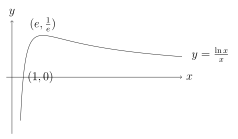
Let \[\mathrm{f}(t)=\frac{\ln t}t\quad\text{ for }t>0.\] Sketch the graph of \(\mathrm{f}(t)\) and find its maximum value. How many positive values of \(t\) correspond to a given value of \(\mathrm f(t)\)? Find how many positive values of \(y\) satisfy \(x^y=y^x\) for a given positive value of \(x\). Sketch the set of points \((x,y)\) which satisfy \(x^y=y^x\) with \(x,y>0\).
1988 Paper 1 Q1
Sketch the graph of the function \(\mathrm{h}\), where \[ \mathrm{h}(x)=\frac{\ln x}{x},\qquad(x>0). \] Hence, or otherwise, find all pairs of distinct positive integers \(m\) and \(n\) which satisfy the equation \[ n^{m}=m^{n}. \]
Solution: