Problems
Filters
5 problems found
2018 Paper 2 Q10
A uniform elastic string lies on a smooth horizontal table. One end of the string is attached to a fixed peg, and the other end is pulled at constant speed \(u\). At time \(t=0\), the string is taut and its length is \(a\). Obtain an expression for the speed, at time \(t\), of the point on the string which is a distance \(x\) from the peg at time \(t\). An ant walks along the string starting at \(t=0\) at the peg. The ant walks at constant speed \(v\) along the string (so that its speed relative to the peg is the sum of \(v\) and the speed of the point on the string beneath the ant). At time \(t\), the ant is a distance \(x\) from the peg. Write down a first order differential equation for \(x\), and verify that \[ \frac{\d }{\d t} \left( \frac x {a+ut}\right) = \frac v {a+ut} \,. \] Show that the time \(T\) taken for the ant to reach the end of the string is given by \[uT = a(\e^k-1)\,,\] where \(k=u/v\). On reaching the end of the string, the ant turns round and walks back to the peg. Find in terms of \(T\) and \(k\) the time taken for the journey back.
Solution: Points always maintain a constant fraction of the distance from the start, so the point distance \(x\) from the start at time \(t\) is moving with speed \(\frac{x}{a+ut} u\) The point is moving with speed \(v+\frac{x}{a+ut} u\) or in other words \begin{align*} && \frac{\d x}{\d t} &= v + \frac{x}{a+ut}u \\ \Rightarrow && \frac{\d x }{\d t} - \frac{u}{a+ut} x &= v \\ \Rightarrow && \frac{1}{a+ut} \frac{\d x}{\d t} - \frac{u}{(a+ut)^2} x &= \frac{1}{a+ut} v\\ \Rightarrow && \frac{\d}{\d x} \left ( \frac{x}{a+ut} \right) &= \frac{v}{a+ut} \\ \Rightarrow && \frac{x}{a+ut} &=\frac{v}{u} \ln (a + ut) + C \\ t = 0, x = 0: && 0 &= \frac{v}{u} \ln a + C \\ \Rightarrow && x &= (a+ut) \frac{v}{u} \ln \left ( \frac{a+ut}{a} \right) \\ \\ \Rightarrow && 1 &= \frac{v}{u} \ln \left ( \frac{a+uT}{a} \right) \\ \Rightarrow && e^k &= 1 + \frac{uT}{a} \\ \Rightarrow && uT &= a(e^k-1) \end{align*} On the return journey, we have \begin{align*} && \frac{\d x}{\d t} &= \frac{x}{a+ut}u - v \\ \Rightarrow && \frac{\d x}{\d t} - \frac{u}{a+ut} x &= - v \\ \Rightarrow && \frac{\d }{\d x} \left ( \frac{x}{a+ut} \right) &= -\frac{v}{a+ut} \\ \Rightarrow &&f &= -\frac{v}{u} \ln(a+ut) + K \\ t = T, f = 1: && 1 &= -\frac{v}{u}\ln(a+uT) + K \\ \Rightarrow && f &= 1+\frac{v}{u}\ln \left ( \frac{a+uT}{a+ut} \right) \\ \Rightarrow && 0 &= 1+\frac{v}{u} \ln \left ( \frac{a+uT}{a+uT_2} \right) \\ \Rightarrow && e^k &= \frac{a+uT_2}{a+uT}\\ \Rightarrow && uT_2 &= (a+uT)e^k - a \\ \Rightarrow && T_2 - T &= \frac{1}{u} \left ( (a+uT)e^k - a - uT\right) \\ &&&= \frac{1}{u} \left ((a+a(e^k-1))e^k-a-a(e^k-1) \right) \\ &&&= \frac{1}{u} \left (ae^{2k} -ae^k \right) \\ &&&= \frac{ae^k}{u} \left ( e^k-1 \right) \\ &&&= Te^k \end{align*}
2012 Paper 1 Q3
- Sketch the curve \(y=\sin x\) for \(0\le x \le \tfrac12 \pi\) and add to your diagram the tangent to the curve at the origin and the chord joining the origin to the point \((b, \sin b)\), where \(0 < b < \frac12\pi\). By considering areas, show that \[ 1-\tfrac12 b^2 <\cos b < 1-\tfrac 12 b \sin b\,. \]
- By considering the curve \(y=a^x\), where \(a>1\), show that \[ \frac{2(a-1)}{a+1} < \ln a < -1 + \sqrt{2a-1\,}\,. \] [Hint: You may wish to write \(a^x\) as \(\e^{x\ln a}\).]
Solution:
- \(\,\)
The area under the blue curve is \(1-\cos b\). The area under the green line is \(\frac12 b \sin b\) The area under the red line is \(\frac12 b^2\) Therefore \(\frac12 b \sin b < 1- \cos b < \frac12 b^2 \Rightarrow 1- \frac12 b^2 < \cos b < 1 - \frac12 b \sin b\)

- \(\,\)
\begin{align*} &&\text{Area under blue curve}: &= \int_0^1 a^x \d x\\ &&&= \left [ \frac{1}{\ln a}e^{x \ln a} \right]_0^1 \\ &&&= \frac{a-1}{\ln a} \\ \\ &&\text{Area under green line}: &=\frac12 \cdot 1 \cdot (a + 1)\\ &&&= \frac{a+1}{2} \\ \\ &&\text{Area under tangent}: &=\frac12 \cdot 1 \cdot (1+\ln a + 1)\\ &&&= \frac{\ln a+2}{2} \\ \\ \Rightarrow && \frac{a+1}{2} & > \frac{a-1}{\ln a} \\ \Rightarrow && \ln a& > \frac{2(a-1)}{a+1} \\ \\ \Rightarrow && \frac{a-1}{\ln a} &> \frac{\ln a +2}{2} \\ \Rightarrow && 2(a-1) -2\ln a - (\ln a)^2 &> 0 \\ \Rightarrow && \ln a & < -1 + \sqrt{2a-1} \end{align*}

2006 Paper 1 Q7
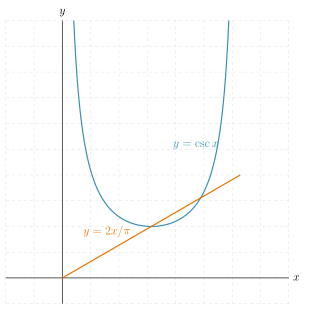
- Sketch on the same axes the functions \({\rm cosec}\, x\) and \(2x/ \pi\), for \(0 < x < \pi\,\). Deduce that the equation \(x\sin x = \pi/2 \) has exactly two roots in the interval \(0 < x < \pi\,\). Show that \[ \displaystyle \int_{\pi/2}^{\pi} \left \vert x\sin x - \frac{\pi} { 2} \right \vert \; \mathrm{d}x = 2\sin\alpha +\frac{3\pi^2} 4 - \alpha \pi -\pi -2\alpha \cos\alpha -1 \] where \(\alpha\) is the larger of the roots referred to above.
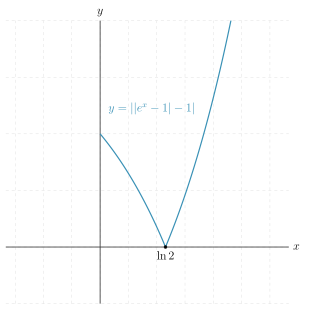
- Show that the region bounded by the positive \(x\)-axis, the \(y\)-axis and the curve \[y = \Bigl| \vert \e^x - 1 \vert - 1 \Bigr|\] has area \(\ln 4-1\).
Solution:
- \(\,\)
Notice that they are equal at \(1\) when \(x = \pi/2\), but this is a local minimum for \(\csc x\) whereas \(2x/\pi\) is increasing so there is a second intersection. Notice that \(\csc x = \frac{2x}{\pi} \Leftrightarrow x \sin x = \frac{\pi}{2}\) therefore our intersections are also the roots of \(x \sin x = \frac{\pi}{2}\) and the larger one is greater than \(\pi/2\) \begin{align*} && I &= \int_{\pi/2}^{\pi} \Bigl| x \sin x - \frac{\pi}{2} \Bigr| \d x \\ &&&= \int_{\pi/2}^{\alpha} \left ( x \sin x - \frac{\pi}{2} \right )\d x +\int_{\alpha}^{\pi} \left ( \frac{\pi}{2} -x \sin x \right) \d x \\ &&&= \left ( \pi - 2\alpha + \frac{\pi}{2}\right) \frac{\pi}{2} + \int_{\pi/2}^{\alpha} x \sin x\d x -\int_{\alpha}^{\pi} x \sin x \d x \\ &&&= \frac{3\pi^2}{4} - \alpha \pi + \left [-x \cos x \right]_{\pi/2}^{\alpha}+\left[x \cos x \right]_{\alpha}^{\pi} + \int_{\pi/2}^{\alpha} \cos x \d x - \int_{\alpha}^{\pi} \cos x \d x \\ &&&= \frac{3\pi^2}{4} - \alpha \pi -\alpha \cos \alpha -\pi -\alpha \cos \alpha+ \sin \alpha - 1+\sin \alpha \\ &&&= 2\sin \alpha + \frac{3\pi^2}{4} - \alpha \pi - 2\alpha \cos \alpha - 1 \end{align*}
- \(\,\)
\begin{align*} && A &= \int_0^{\ln 2} ||e^x-1|-1| \d x \\ &&&= \int_0^{\ln 2} |e^x-2| \d x \\ &&&=\int_0^{\ln 2} (2-e^x) \d x \\ &&&= 2 \ln 2 - \left [e^x \right]_0^{\ln 2} \\ &&&= \ln 4 - (2-1) = \ln 4 - 1 \end{align*}
2004 Paper 2 Q11
The maximum power that can be developed by the engine of train \(A\), of mass \(m\), when travelling at speed \(v\) is \(Pv^{3/2}\,\), where \(P\) is a constant. The maximum power that can be developed by the engine of train \(B\), of mass \(2m\), when travelling at speed \(v\) is \(2Pv^{3/2}.\) For both \(A\) and \(B\) resistance to motion is equal to \(kv\), where \(k\) is a constant. For \(t\le0\), the engines are crawling along at very low equal speeds. At \(t = 0\,\), both drivers switch on full power and at time \(t\) the speeds of \(A\) and \(B\) are \(v_{\vphantom{\dot A}\!A}\) and \(v_{\vphantom{\dot B}\hspace{-1pt}B},\) respectively.
- Show that \[ v_{\vphantom{\dot A}\!A} = \frac{P^2 \left(1-\e^{-kt/2m}\right)^2}{k^2} \] and write down the corresponding result for \(v_{\vphantom{\dot B}B}\).
- Find \(v_{\vphantom{\dot B}A}\) and \(v_{\vphantom{\dot B}B}\) when \(9 v_{\vphantom{\dot B}A} =4v_{\vphantom{\dot B}B}\;\). [Not on original paper] Show that \(1 < v_{\vphantom{\dot B}\hspace{-1pt}B} /v_{\vphantom{\dot A}\!A} < 4\) for \(t > 0\,\).
- Both engines are switched off when \(9 v_{\vphantom{\dot B}A} =4v_{\vphantom{\dot B}B}\,\). Show that thereafter \(k^2 v_{\vphantom{\dot B}B}^2 = 4 P^2 v_{\vphantom{\dot B}A}\,\).
Solution:
- \(\,\) \begin{align*} && P &= Fv \\ \text{N2}(\rightarrow): && Pv^{1/2} - kv &= ma \\ \Rightarrow && \dot{v} &= \frac{P}{m} \sqrt{v}-\frac{k}{m}v \\ \Rightarrow && \int \d t & = \int \frac{m}{\sqrt{v}\left (P-k\sqrt{v} \right)} \d v \\ &&t &= -\frac{2m}k\ln\left (P - k\sqrt{v_A}\right) + C \\ t = 0, v_A \approx 0: && 0 & =-\frac{2m}{k} \ln P+ C \\ \Rightarrow && C &= \frac{2m}{k} \ln P \\ \Rightarrow && e^{-kt/2m} &= \frac{P- k \sqrt{v_A}}{P} \\ \Rightarrow && v_A &= \frac{P^2(1-e^{-kt/2m})^2}{k^2} \end{align*} The equation of motion for \(B\) is \(\dot{v_B} = \frac{P}{m}\sqrt{v} - \frac{k}{2m} v\), ie \(k \to \frac{k}{2}\), so \[ v_B = \frac{4P^2(1-e^{-kt/4m})^2}{k^2} \]
- Suppose \(9v_A = 4v_B\), then and let \(e^{-kt/4m} = X\) \begin{align*} && 9 \frac{P^2(1-e^{-kt/2m})^2}{k^2} &= 4 \frac{4P^2(1-e^{-kt/4m})^2}{k^2} \\ \Rightarrow && \frac{3}{4} &= \frac{1-X}{1-X^2} \\ \Rightarrow && 0 &= 3X^2-4X+1 \\ &&&= (3X-1)(X-1) \\ \Rightarrow && X &= 1, \frac13 \\ X = 1: && t &= 0 \\ X = \frac13: && e^{-kt/4m} &= \frac13\\ \Rightarrow && t &= \frac{4m}{k}\ln 3 \\ && v_A &= \frac{P^2(1-\frac19)^2}{k^2} \\ &&&= \frac{64P^2}{81k^2} \\ && v_B &= \frac{P^2(1-\frac13)^2}{k^2} \\ &&&= \frac{4P^2}{9k^2} \end{align*} Notice also that \begin{align*} && \frac{v_B}{v_A} &= 4\left ( \frac{1-X}{1-X^2} \right)^2 \\ &&&= 4 \frac{1}{(1+X)^2} \end{align*} Since \(X \in (0,1)\) \(\frac{v_B}{v_A} \in (1, 4)\)
- Once the engines are switched off, the equation of motion for \(A\) is (where \(t\) is measured from that point) \begin{align*} && \dot{v} &= -\frac{k}{m}v \\ \Rightarrow && v &= Ae^{-kt/m} \\ \Rightarrow && v_A &= \frac{64P^2}{81k^2}e^{-kt/m} \end{align*} Similarly, \(v_B = \frac{4P^2}{9k^2}e^{-kt/2m}\) so \begin{align*} && \frac{v_A}{v_B^2} &= \frac{64P^2}{81k^2} \cdot \frac{81k^4}{16P^4} = \frac{4k^2}{P^2} \end{align*} as required.
1997 Paper 1 Q11
A particle of unit mass is projected vertically upwards in a medium whose resistance is \(k\) times the square of the velocity of the particle. If the initial velocity is \(u\), prove that the velocity \(v\) after rising through a distance \(s\) satisfies \begin{equation*} v^{2}=u^{2}\e^{-2ks}+\frac{g}{k}(\e^{-2ks}-1). \tag{*} \end{equation*} Find an expression for the maximum height of the particle above he point of projection. Does equation \((*)\) still hold on the downward path? Justify your answer.
Solution: \begin{align*} \text{N2}(\uparrow): && 1 \cdot v\frac{\d v}{\d s} &= -g - kv^2 \\ \Rightarrow && \int \frac{v}{g+kv^2} \d v &= \int -1 \d s \\ \Rightarrow && \frac{1}{2k}\ln(g+kv^2) &= -s + C \\ s =0, v = u: && \frac{1}{2k} \ln(g+ku^2) &= C \\ \Rightarrow && s &= \frac{1}{2k} \ln \frac{g+ku^2}{g+kv^2} \\ \Rightarrow && e^{-2ks} &= \frac{g+kv^2}{g+ku^2} \\ \Rightarrow && v^2 &= u^2e^{-2ks} + \frac{g}{k}(e^{-2ks}-1) \end{align*} The maximum height will be when \(v = 0\), ie \(\displaystyle s = \frac{1}{2k}\ln\left(1 + \frac{k}{g}u^2 \right)\). On the downward path the resistance will be going upwards, ie \begin{align*} \text{N2}(\uparrow): && 1 \cdot v\frac{\d v}{\d s} &= -g + kv^2 \end{align*} but our solution is solving a different differential equation, therefore unless \(k=0\) the equation will be different.