Problems
Filters
5 problems found
2006 Paper 3 Q11
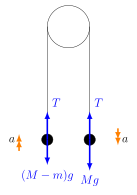
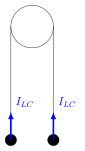
A lift of mass \(M\) and its counterweight of mass \(M\) are connected by a light inextensible cable which passes over a fixed frictionless pulley. The lift is constrained to move vertically between smooth guides. The distance between the floor and the ceiling of the lift is \(h\). Initially, the lift is at rest, and the distance between the top of the lift and the pulley is greater than \(h\). A small tile of mass \(m\) becomes detached from the ceiling of the lift and falls to the floor of the lift. Show that the speed of the tile just before the impact is \[ \sqrt{\frac{(2M-m)gh \;}{M}}\;. \] The coefficient of restitution between the tile and the floor of the lift is \(e\). Given that the magnitude of the impulsive force on the lift due to tension in the cable is equal to the magnitude of the impulsive force on the counterweight due to tension in the cable, show that the loss of energy of the system due to the impact is \(mgh(1-e^2)\). Comment on this result.
2004 Paper 2 Q10
In this question take \(g = 10 ms^{-2}.\) The point \(A\) lies on a fixed rough plane inclined at \(30^{\circ}\) to the horizontal and \(\ell\) is the line of greatest slope through \(A\). A particle \(P\) is projected up \(\ell\) from \(A\) with initial speed \(6\)ms\(^{-1}\). A time \(T\) seconds later, a particle \(Q\) is projected from \(A\) up \(\ell\), also with speed \(6\)ms\(^{-1}\). The coefficient of friction between each particle and the plane is \(1/(5\sqrt{3})\,\) and the mass of each particle is \(4\)kg.
- Given that \(T<1+\sqrt{3/2}\), show that the particles collide at a time \((3-\sqrt6)T+1\) seconds after \(P\) is projected.
- In the case \(T=1+\sqrt{2/3}\,\), determine the energy lost due to friction from the instant at which \(P\) is projected to the time of the collision.
Solution: Since the particles are identical and are projected with the same speed, the only way they can reach the same point \(x\) at the same time, is if \(A\) has reached it's apex and started descending. Considering \(P\), we must have (setting the level of \(A\) to be the \(0\) G.P.E. level), suppose it travels a distance \(x\) before becoming stationary: \begin{align*} \text{N2}(\nwarrow): && R - 4g \cos(30^\circ) &= 0 \\ \Rightarrow && R &= 20\sqrt{3} \\ \Rightarrow && \mu R &= \frac1{5 \sqrt{3}} (20 \sqrt{3}) \\ &&&= 4 \\ \end{align*} Therefore in the two phases of the journey the particle is being accelerated down the slope by either \(6\) or \(4\). \(v^2 = u^2 + 2as \Rightarrow 0 = 36 - 12s \Rightarrow s = 3\). \(v = u + at \Rightarrow t = 1\). Therefore after \(1\) second \(P\) reaches its highest point having travelled \(3\) metres. It will pass back to the start in \(s = ut + \frac12 a t^2 \Rightarrow 3 = \frac12 4 t^2 \Rightarrow t = \sqrt{3/2}\) seconds, ie the constraint is that the particle hasn't already past \(Q\) before the collision. The collision will occur when \(s = 6t - \frac12 6 t^2\) and \(s =3 - \frac12 4 (t+T-1)^2\) coincide, ie: \begin{align*} && 6t - 3t^2 &= 3 - 2(t+T-1)^2 \\ && 0 &= 3 -2(T-1)^2 -(4(T-1)+6)t + t^2 \\ && 0 &= 3 -2(T-1)^2 -(4T+2)t + t^2 \\ \Rightarrow && t &= \frac{4T+2 \pm \sqrt{(4T+2)^2 - 4(3-2(T-1)^2)}}{2} \\ &&&= \frac{4T+2 \pm \sqrt{24T^2}}{2} \\ &&&= 2T + 1 \pm \sqrt{6} T \\ &&&= (2 \pm \sqrt{6})T + 1 \end{align*} we must take the smaller root, ie \((2-\sqrt{6})T + 1\). In the case the collision occurs exactly at the start, the particle \(P\) has traveled \(6\) meters, against a force of \(4\) newtons of friction, ie work done is \(24\) Joules.
1998 Paper 3 Q10
Two identical spherical balls, moving on a horizontal, smooth table, collide in such a way that both momentum and kinetic energy are conserved. Let \({\bf v}_1\) and \({\bf v}_2\) be the velocities of the balls before the collision and let \({\bf v}'_1\) and \({\bf v}'_2\) be the velocities of the balls after the collision, where \({\bf v}_1\), \({\bf v}_2\), \({\bf v}'_1\) and \({\bf v}'_2\) are two-dimensional vectors. Write down the equations for conservation of momentum and kinetic energy in terms of these vectors. Hence show that their relative speed is also conserved. Show that, if one ball is initially at rest but after the collision both balls are moving, their final velocities are perpendicular. Now suppose that one ball is initially at rest, and the second is moving with speed \(V\). After a collision in which they lose a proportion \(k\) of their original kinetic energy (\(0\le k\le 1\)), the direction of motion of the second ball has changed by an angle \(\theta\). Find a quadratic equation satisfied by the final speed of the second ball, with coefficients depending on \(k\), \(V\) and \(\theta\). Hence show that \(k\le \frac{1}{2}\).
Solution: \begin{align*} \text{COM}: && \mathbf{v}_1+\mathbf{v}_2 &= \mathbf{v}_1'+\mathbf{v}_2' \tag{1}\\ \text{COE}: && \mathbf{v}_1\cdot\mathbf{v}_1+\mathbf{v}_2\cdot\mathbf{v}_2 &= \mathbf{v}_1'\cdot\mathbf{v}_1'+\mathbf{v}_2'\cdot\mathbf{v}_2' \tag{2} \\ \\ (1): && (\mathbf{v}_1+\mathbf{v}_2 )\cdot(\mathbf{v}_1+\mathbf{v}_2 ) &= (\mathbf{v}_1'+\mathbf{v}_2' )\cdot(\mathbf{v}_1'+\mathbf{v}_2' ) \\ \Rightarrow && \mathbf{v}_1 \cdot \mathbf{v}_2 &= \mathbf{v}_1'\cdot \mathbf{v}_2' \\ && \text{Initial relative speed}^2 &= |\mathbf{v}_1 - \mathbf{v}_2|^2 \\ &&&= (\mathbf{v}_1 - \mathbf{v}_2) \cdot (\mathbf{v}_1 - \mathbf{v}_2) \\ &&&= \mathbf{v}_1\cdot \mathbf{v}_1 - 2 \mathbf{v}_1\cdot \mathbf{v}_2 + \mathbf{v}_2\cdot \mathbf{v}_2 \\ &&&= \mathbf{v}_1'\cdot\mathbf{v}_1'+\mathbf{v}_2'\cdot\mathbf{v}_2' -2 \mathbf{v}_1\cdot\mathbf{v}_2\\ &&&= \mathbf{v}_1'\cdot\mathbf{v}_1'+\mathbf{v}_2'\cdot\mathbf{v}_2' -2 \mathbf{v}_1'\cdot\mathbf{v}_2'\\ &&&= | \mathbf{v}_1'-\mathbf{v}_2'|^2 \\ &&&= \text{Final relative speed}^2 \end{align*} Since \(\mathbf{v}_1 \cdot 0 = 0\) we must have \(\mathbf{v}_1'\cdot\mathbf{v}_2' = \mathbf{v}_1\cdot0 = 0\) therefore their final velocities are perpendicular. We now must have \begin{align*} \text{COM}: && \mathbf{v}_1+\mathbf{v}_2 &= \mathbf{v}_1'+\mathbf{v}_2' \tag{3}\\ \Delta\text{E}: && (1-k)(\mathbf{v}_1\cdot\mathbf{v}_1+\mathbf{v}_2\cdot\mathbf{v}_2) &= \mathbf{v}_1'\cdot\mathbf{v}_1'+\mathbf{v}_2'\cdot\mathbf{v}_2' \tag{4} \\ \\ && 0 + \mathbf{v}_2 &= \mathbf{v}_1' + \mathbf{v}_2' \\ \Rightarrow && V^2 &= ( \mathbf{v}_1' + \mathbf{v}_2' ) \cdot ( \mathbf{v}_1' + \mathbf{v}_2' ) \\ &&&= \mathbf{v}_1'\cdot\mathbf{v}_1'+\mathbf{v}_2'\cdot\mathbf{v}_2' +2 \mathbf{v}_1'\cdot \mathbf{v}_2' \\ &&&= (1-k)V^2 + 2 (\mathbf{v}_2-\mathbf{v}_2') \cdot \mathbf{v}_2' \\ &&&= (1-k)V^2 + 2 \mathbf{v}_2 \cdot \mathbf{v}_2'-2\mathbf{v}_2'\cdot \mathbf{v}_2' \\ &&&= (1-k)V^2 + 2Vx \cos \theta - 2x^2 \\ \Rightarrow && 0 &= -kV^2 + 2Vx \cos \theta -2x^2 \\ \Delta \geq 0: && 0 &\leq 4V^2 \cos^2 \theta -8kV^2 \\ \Rightarrow && k &\leq \frac12\cos^2\theta \leq \frac12 \end{align*}
1993 Paper 2 Q14
A ball of mass \(m\) is thrown vertically upwards from the floor of a room of height \(h\) with speed \(\sqrt{2kgh},\) where \(k>1.\) The coefficient of restitution between the ball and the ceiling or floor is \(a\). Both the ceiling and floor are level. Show that the kinetic energy of the ball immediately before hitting the ceiling for the \(n\)th time is \[ mgh\left(a^{4n-4}(k-1)+\frac{a^{4n-4}-1}{a^{2}+1}\right). \] Hence show that the number of times the ball hits the ceiling is at most \[ 1-\frac{\ln[a^{2}(k-1)+k]}{4\ln a}. \]
Solution: \begin{align*} && \text{energy when projected} &= \frac12 m(2kgh) \\ &&&= kghm \\ && \text{energy when hitting ceiling the first time} &= mgh + \frac12 m v^2 \\ \text{COE}: && kghm &= mgh + \frac12 mv^2 \\ \Rightarrow && v^2 &= 2gh(k-1) \end{align*} It will rebound with speed \(\sqrt{2gh(k-1)}a\). \begin{align*} && \text{energy when rebounding from ceiling} &=gh(k-1)a^2 + mgh \\ && \text{energy before hitting the floor} &= \frac12 mv^2 \\ \text{COE}: && gh(k-1)a^2 + mgh &= \frac12 mv^2 \\ \Rightarrow && v^2 &= 2gh((k-1)a^2+1) \end{align*} The ball will rebound with kinetic energy \(m gh((k-1)a^2+1)a^2 = mgh((k-1)a^4+a^2)\) And will reach the ceiling with kinetic energy \(mgh((k-1)a^4+a^2-1)\). When \(n = 1\), the kinetic energy (before hitting the ceiling for the first time) is \(mgh(k-1)\). Suppose \(s_n\) is the expression for the kinetic energy divided by \(mgh\), ie \(s_1 = k-1\), then: Clearly \(s_1 = k-1 = a^{4\cdot1-4}(k-1) + \frac{a^{4\cdot-4}-1}{a^2+1}\), so our hypothesis holds for \(n=1\). Suppose it is true for \(n\), then the \(n+1\)th time it will be: \begin{align*} s_{n+1} &= s_n a^4+a^2-1 \\ &= \left ( a^{4n-4}(k-1)+\frac{a^{4n-4}-1}{a^{2}+1} \right) a^4 + a^2 - 1 \\ &= a^{4(n+1)-4}(k-1) + \frac{a^{4(n+1)-4}-a^4}{a^2+1} + \frac{a^4-1}{a^2+1} \\ &= a^{4(n+1)-4}(k-1) + \frac{a^{4(n+1)-4}-a^4+a^4-1}{a^2+1} \\ &= a^{4(n+1)-4}(k-1) + \frac{a^{4(n+1)-4}-1}{a^2+1} \end{align*} Which is our desired expression, therefore it is true by induction. We wont reach the ceiling if this energy is not positive, ie: \begin{align*} && 0 &\leq a^{4n-4}(k-1)+\frac{a^{4n-4}-1}{a^{2}+1} \\ \Rightarrow && \frac{1}{a^2+1}&\geq a^{4n-4}\left (k - 1 + \frac{1}{a^2+1} \right) \\ \Rightarrow && a^{4n-4} &\geq \frac{1}{a^2+1} \cdot \frac{1}{k - 1 + \frac{1}{a^2+1}} \\ \Rightarrow && a^{4n-4} &\geq \frac{1}{(k-1)(a^2+1)+1} \\ \Rightarrow && 4(n-1) \ln a &\geq - \ln[(k-1)(a^2+1)+1] \\ \underbrace{\Rightarrow}_{\ln a < 0} && (n-1) &\leq \frac{ - \ln[(k-1)(a^2+1)+1]}{4\ln a} \\ \Rightarrow && n & \leq 1 -\frac{ \ln[(k-1)(a^2+1)+1]}{4\ln a} \\ &&&= 1 -\frac{ \ln[(k-1)a^2+k]}{4\ln a} \end{align*}
1989 Paper 2 Q11
A lift of mass \(M\) and its counterweight of mass \(M\) are connected by a light inextensible cable which passes over a light frictionless pulley. The lift is constrained to move vertically between smooth guides. The distance between the floor and the ceiling of the lift is \(h\). Initially, the lift is at rest, and the distance between the top of the lift and the pulley is greater than \(h\). A small tile of mass \(m\) becomes detached from the ceiling of the lift. Show that the time taken for it to fall to the floor is \[ t=\sqrt{\frac{\left(2M-m\right)h}{Mg}}. \] The collision between the tile and the lift floor is perfectly inelastic. Show that the lift is reduced to rest by the collision, and that the loss of energy of the system is \(mgh\). Note: the question on the STEP database is \[ t=\sqrt{\frac{2\left(M-m\right)h}{Mg}}. \]
Solution: