Problems
Filters
3 problems found
2023 Paper 3 Q1
D: 1500.0
B: 1500.0
conic sections
parabola
tangent to circle
distance from point to line
quadratic equation
discriminant
triangle
The distinct points \(P(2ap,\, ap^2)\) and \(Q(2aq,\, aq^2)\) lie on the curve \(x^2 = 4ay\), where \(a > 0\).
- Given that \[(p+q)^2 = p^2q^2 + 6pq + 5\,,\tag{\(*\)}\] show that the line through \(P\) and \(Q\) is a tangent to the circle with centre \((0,\, 3a)\) and radius \(2a\).
- Show that, for any given value of \(p\) with \(p^2 \neq 1\), there are two distinct real values of \(q\) that satisfy equation \((*)\). Let these values be \(q_1\) and \(q_2\). Find expressions, in terms of \(p\), for \(q_1 + q_2\) and \(q_1 q_2\).
- Show that, for any given value of \(p\) with \(p^2 \neq 1\), there is a triangle with one vertex at \(P\) such that all three vertices lie on the curve \(x^2 = 4ay\) and all three sides are tangents to the circle with centre \((0,\, 3a)\) and radius \(2a\).
2014 Paper 2 Q3
D: 1600.0
B: 1516.0
implicit differentiation
distance from point to line
tangent line
curve sketching
differential equation
circle
optimisation
geometric proof
- Show, geometrically or otherwise, that the shortest distance between the origin and the line \(y= mx+c\), where \(c\ge0\), is \(c(m^2+1)^{-\frac12}\).
- The curve \(C\) lies in the \(x\)-\(y\) plane. Let the line \(L\) be tangent to \(C\) at a point \(P\) on \(C\), and let \(a\) be the shortest distance between the origin and \(L\). The curve \(C\) has the property that the distance \(a\) is the same for all points \(P\) on \(C\). Let \(P\) be the point on \(C\) with coordinates \((x,y(x))\). Given that the tangent to \(C\) at \(P\) is not vertical, show that \begin{equation} (y-xy')^2 = a^2\big (1+(y')^2 \big) \,. \tag{\(*\)} \end{equation} By first differentiating \((*)\) with respect to \(x\), show that either \(y= mx \pm a(1+m^2)^{\frac12}\) for some \(m\) or \(x^2+y^2 =a^2\).
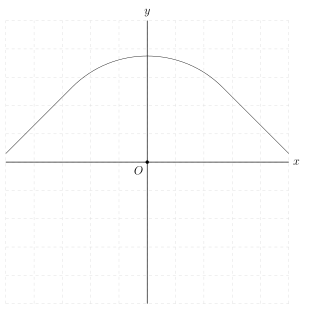
- Now suppose that \(C\) (as defined above) is a continuous curve for \(-\infty < x < \infty\), consisting of the arc of a circle and two straight lines. Sketch an example of such a curve which has a non-vertical tangent at each point.
Solution:
- \(\,\)
Note that we have a right angled triangle, with the sides in a ratio of \(m\). So if our target length is \(x\) we have \(x^2 + (mx)^2 = c^2\) and so \(x = c(m^2+1)^{-\frac12}\)
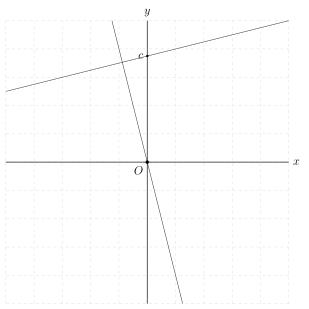
- The distance from the origin to \(L\) is \(a = c(m^2+1)^{-\frac12}\) so \begin{align*} && a^2(m^2+1) &= c^2 \\ && \frac{c-y(x)}{0-x} &= y' \\ \Rightarrow && c-y &= -xy' \\ \Rightarrow && a^2((y')^2+1) &= (y-xy')^2 \\ \\ && 2a^2y'y'' &= 2(y-xy')(y'-xy''-y') \\ &&&= 2(xy'-y)xy'' \\ \Rightarrow && y'' &= 0 \\ \text{ or } && 2a^2y' &= 2(xy'-y)x \end{align*} If \(y'' = 0\) then \(y = mx + c\) and the result follows immediately. \begin{align*} && 0 &= (a^2-x^2)y' + yx \\ \Rightarrow &&\frac1{y} y' &= -\frac{x}{a^2-x^2} \\ \Rightarrow && \ln y &= \frac12\ln (a^2-x^2) + K \\ \Rightarrow && y^2 &= M(a^2-x^2) \\ \Rightarrow && x^2 + y^2 &= a^2 \end{align*} Where in the last step we know the tangents from an ellipse are not all equidistant to the origin.
2009 Paper 1 Q8
D: 1500.0
B: 1484.0
circle
tangent
incircle
triangle
trigonometric identity
tan 2α
double angle formula
distance from point to line
coordinate geometry
- The equation of the circle \(C\) is \[ (x-2t)^2 +(y-t)^2 =t^2, \] where \(t\) is a positive number. Show that \(C\) touches the line \(y=0\,\). Let \(\alpha\) be the acute angle between the \(x\)-axis and the line joining the origin to the centre of \(C\). Show that \(\tan2\alpha=\frac43\) and deduce that \(C\) touches the line \(3y=4x\,\).
- Find the equation of the incircle of the triangle formed by the lines \(y=0\), \(3y=4x\) and \(4y+3x=15\,\). Note: The incircle of a triangle is the circle, lying totally inside the triangle, that touches all three sides.
Solution:
- This is a circle centre \((2t,t)\) with radius \(t\). Therefore it is exactly \(t\) away from the line \(y = 0\) so just touches that line. Not that \(\tan \alpha = \frac{t}{2t} = \frac12\) so \(\tan 2\alpha = \frac{2\tan \alpha}{1-\tan^2\alpha} = \frac{1}{1-\frac14} = \frac43\). Therefore the line \(y = \frac43x\) or \(3y = 4x\) is tangent to \(C\).
- Note that \(3y=4x\) and \(4y+3x=15\) are perpendicular, so this is a right-angled triangle with incenter \((2t,t)\) for some \(t\) and hypotenuse \(15\) We can find the third coordinate when \(3y-4x = 0\) and \(4y+3x = 15\) meet, ie \((\frac{9}{5}, \frac{12}5)\) The incentre lies on the bisector of the right angle at this point, which is the line through \((\frac{9}{5}, \frac{12}5)\) and \((\frac{15}{2}, 0)\), so \begin{align*} && \frac{2t-\frac{12}{5}}{t - \frac{9}{5}} &= \frac{-\frac{12}{5}}{\frac{15}2-\frac95} \\ \Rightarrow && \frac{10t-12}{5t-9} &= \frac{-24}{57} = -\frac{8}{19} \\ \Rightarrow && 190t - 12 \cdot 19 &= -40t + 72 \\ \Rightarrow && t &= 2 \end{align*} Therefore the center is \((4, 2)\) and the equation is \((x-4)^2+(y-2)^2=2^2\)