Problems
Filters
4 problems found
2011 Paper 3 Q11
A thin uniform circular disc of radius \(a\) and mass \(m\) is held in equilibrium in a horizontal plane a distance \(b\) below a horizontal ceiling, where \(b>2a\). It is held in this way by \(n\) light inextensible vertical strings, each of length \(b\); one end of each string is attached to the edge of the disc and the other end is attached to a point on the ceiling. The strings are equally spaced around the edge of the disc. One of the strings is attached to the point \(P\) on the disc which has coordinates \((a,0,-b)\) with respect to cartesian axes with origin on the ceiling directly above the centre of the disc. The disc is then rotated through an angle \(\theta\) (where \(\theta<\pi\)) about its vertical axis of symmetry and held at rest by a couple acting in the plane of the disc. Show that the string attached to~\(P\) now makes an angle \(\phi\) with the vertical, where \[ b\sin\phi = 2a \sin\tfrac12 \theta\,. \] Show further that the magnitude of the couple is \[ \frac {mga^2\sin\theta}{\sqrt{b^2-4a^2\sin^2 \frac12\theta \ } \ }\,. \] The disc is now released from rest. Show that its angular speed, \(\omega\), when the strings are vertical is given by \[ \frac{a^2\omega^2}{4g} = b-\sqrt{b^2 - 4a^2\sin^2 \tfrac12\theta \;}\,. \]
1994 Paper 2 Q14
When Septimus Moneybags throws darts at a dart board they are certain to end on the board (a disc of radius \(a\)) but, it must be admitted, otherwise are uniformly randomly distributed over the board.
- Show that the distance \(R\) that his shot lands from the centre of the board is a random variable with variance \(a^{2}/18.\)
- At a charity fete he can buy \(m\) throws for \(\pounds(12+m)\), but he must choose \(m\) before he starts to throw. If at least one of his throws lands with \(a/\sqrt{10}\) of the centre he wins back \(\pounds 12\). In order to show that a good sport he is, he is determined to play but, being a careful man, he wishes to choose \(m\) so as to minimise his expected loss. What values of \(m\) should he choose?
Solution:
- \(\,\) \begin{align*} && \mathbb{P}(R < d) &= \frac{\pi d^2}{\pi a^2} \\ &&&= \frac{d^2}{a^2} \\ \Rightarrow && f_R(d) &= \frac{2d}{a^2}\\ \\ && \E[R] &= \int_0^a x \cdot f_R(x) \d x \\ &&&= \int_0^a \frac{2x^2}{a^2} \d x \\ &&&= \frac{2a}{3} \\ \\ && \E[R^2] &= \int_0^a x^2 \cdot f_R(x) \d x \\ &&&= \int_0^a \frac{2x^3}{a^2} \d x \\ &&&= \frac{a^2}{2} \\ \Rightarrow && \var[R] &= \frac{a^2}2 - \frac{4a^2}{9} \\ &&7= \frac{a^2}{18} \end{align*}
- Let \(p = \mathbb{P}(R < \frac{a}{\sqrt{10}}) = \frac{a^2}{10a^2} = \frac{1}{10}\) be the probability of hitting the target on each throw. His expected loss is \((12+m)p^m + m(1-p^m) = 12p^m + m\). \begin{array}{c|c} m & \text{expected loss} \\ \hline 0 & 12 \\ 1 & \frac{12}{10} + 1 \approx 2.2 \\ 2 & \frac{12}{100} + 2 \approx 2.12 \\ \end{array} If he takes more than \(2\) throws it will definitely cost more than \(3\), therefore he should take exactly \(2\) throws.
1990 Paper 2 Q11
A disc is free to rotate in a horizontal plane about a vertical axis through its centre. The moment of inertia of the disc about this axis is \(mk^{2}.\) Along one diameter is a narrow groove in which a particle of mass \(m\) slides freely. At time \(t=0,\) the disc is rotating with angular speed \(\Omega,\) and the particle is at a distance \(a\) from the axis and is moving towards the axis with speed \(V\), where \(k^{2}V^{2}=\Omega^{2}a^{2}(k^{2}+a^{2}).\) Show that, at a later time \(t,\) while the particle is still moving towards the axis, the angular speed \(\omega\) of the disc and the distance \(r\) of the particle from the axis are related by \[ \omega=\frac{\Omega(k^{2}+a^{2})}{k^{2}+r^{2}}\qquad\mbox{ and }\qquad\frac{\mathrm{d}r}{\mathrm{d}t}=-\frac{\Omega r(k^{2}+a^{2})}{k(k^{2}+r^{2})^{\frac{1}{2}}}. \] Deduce that \[ k\frac{\mathrm{d}r}{\mathrm{d}\theta}=-r(k^{2}+r^{2})^{\frac{1}{2}}, \] where \(\theta\) is the angle through which the disc has turned at time \(t\). By making the substitution \(u=1/r\), or otherwise, show that \(r\sinh(\theta+\alpha)=k,\) where \(\sinh\alpha=k/a.\) Hence, or otherwise, show that the particle never reaches the axis.
1989 Paper 3 Q14
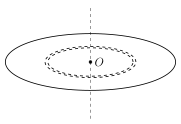
- A solid circular disc has radius \(a\) and mass \(m.\) The density is proportional to the distance from the centre \(O\). Show that the moment of inertia about an axis through \(C\) perpendicular to the plane of the disc is \(\frac{3}{5}ma^{2}.\)
- A light inelastic string has one end fixed at \(A\). It passes under and supports a smooth pulley \(B\) of mass \(m.\) It then passes over a rough pulley \(C\) which is a disc of the type described in (i), free to turn about its axis which is fixed and horizontal. The string carries a particle \(D\) of mass \(M\) at its other end. The sections of the string which are not in contact with the pulleys are vertical. The system is released from rest and moves under gravity for \(t\) seconds. At the end of this interval the pulley \(B\) is suddenly stopped. Given that \(m<2M\), find the resulting impulse on \(D\) in terms of \(m,M,g\) and \(t\). {[}You may assume that the string is long enough for there to be no collisions between the elements of the system, and that the pulley \(C\) is rough enough to prevent slipping throughout.{]}
Solution:
- \begin{align*} m &= \int_0^a \underbrace{(\rho r)}_{\text{mass per area}} \underbrace{\pi r^2}_{\text{area}} \d r \\ &= \rho \pi \frac{a^3}{3} \\ \\ I &= \sum m r^2 \\ &= \sum (\rho r) \pi r^2 \cdot r^2 \\ &\to \int_0^a \rho \pi r^4 \\ &= \frac15 \rho \pi a^5 \\ &= \frac35 m a^2 \end{align*}
- \begin{align*} \text{N2}(\downarrow, D): && Mg -T_C &= Mf \\ \overset{\curvearrowright}{C} && (T_C - T_B)a &= I \frac{f}{a} \\ &&&= \frac35 m a f \\ \text{N2}(\uparrow, B): && 2T_B-mg &= \frac12 m f \\ \\ \Rightarrow && Mg-T_B &= \left (M + \frac35 m \right)f \\ \Rightarrow && Mg - \frac12 mg &= \left (M + \frac35 m + \frac14 m \right)f \\ \Rightarrow && f &= \frac{(M-\frac12 m)g}{M + \frac{17}{20} m} \\ &&&= \frac{(2M-m)g}{2M +\frac{17}{10}m} \end{align*} Therefore the speed after a time \(t\) is \(\displaystyle \frac{(2M-m)g}{2M +\frac{17}{10}m} t\) and the impulse will be the change in momentum, ie \(\displaystyle \frac{(2M-m)g}{2M +\frac{17}{10}m} Mt\)
