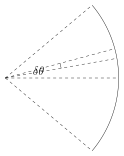
Derive a formula for the position of the centre of mass of a uniform circular arc of radius \(r\) which subtends an angle \(2\theta\) at the centre.
A plane framework consisting of a rectangle and a semicircle, as in the above diagram, is constructed of uniform thin rods. It can stand in equilibrium if it is placed in a vertical plane with any point of the semicircle in contact with a horizontal floor. Express \(h\) in terms of \(r\).
Solution:
Splitting the arc up into strips of width \(\delta \theta\), then we must have
\begin{align*} && \sum r\cos \theta (r \delta \theta) &= \bar{x}\sum (r \delta \theta) \\
\lim_{\delta \theta \to 0}: && \int_{-\theta}^{\theta} r^2 \cos \theta \d \theta &= \bar{x}2 \theta r \\
\Rightarrow && 2r^2 \sin \theta &= \bar{x} 2 \theta r \\
\Rightarrow && \bar{x} &= \frac{r\sin \theta}{\theta}
\end{align*}
The centre of mass will lie on the line of symmetry. It also must lie at the center of the base of the semi-circle (see diagram). Using a coordinate frame where that point is the origin we must have
\begin{align*}
&& 0 &= -2r \cdot 2h - 4h \cdot h + \pi r \frac{r}{\frac{\pi}{2}} \\
&&&= -4rh-4h^2+2r^2\\
\Rightarrow && 0 &= r^2-2rh-h^2 \\
\Rightarrow && \frac{r}{h} &= 1 \pm \sqrt{3} \\
\Rightarrow && r &= (1+\sqrt{3})h \\
&& h & = \frac12 (\sqrt{3}-1) r
\end{align*}