Problems
Filters
1 problem found
2019 Paper 3 Q10
D: 1500.0
B: 1500.0
momentum
oblique collision
coefficient of restitution
Newton's law of restitution
deflection angle
trigonometric identity
optimisation
smooth spheres
Two identical smooth spheres \(P\) and \(Q\) can move on a smooth horizontal table. Initially, \(P\) moves with speed \(u\) and \(Q\) is at rest. Then \(P\) collides with \(Q\). The direction of travel of \(P\) before the collision makes an acute angle \(\alpha\) with the line joining the centres of \(P\) and \(Q\) at the moment of the collision. The coefficient of restitution between \(P\) and \(Q\) is \(e\) where \(e < 1\). As a result of the collision, \(P\) has speed \(v\) and \(Q\) has speed \(w\), and \(P\) is deflected through an angle \(\theta\).
- Show that $$u \sin \alpha = v \sin(\alpha + \theta)$$ and find an expression for \(w\) in terms of \(v\), \(\theta\) and \(\alpha\).
- Show further that $$\sin \theta = \cos(\theta + \alpha) \sin \alpha + e \sin(\theta + \alpha) \cos \alpha$$ and find an expression for \(\tan \theta\) in terms of \(\tan \alpha\) and \(e\). Find, in terms of \(e\), the maximum value of \(\tan \theta\) as \(\alpha\) varies.
Solution:
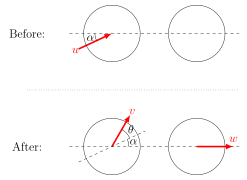
- Since the impulse is along the line of centres, the velocities are as show in the diagram. Additionally, vertical velocity is unchanged, so: \(v \sin (\theta + \alpha) = u \sin \alpha\) \begin{align*} \text{COM}(\rightarrow): && u \cos\alpha &= v \cos(\alpha + \theta) + w \\ \Rightarrow && w &= u \cos \alpha - v \cos (\alpha + \theta) \end{align*}
- Since the approach speed (horizontally) is \(u \cos \alpha\) the speed of separation is \(e u \cos \alpha\), in particular \(w - v \cos(\theta + \alpha) = e u \cos \alpha\) or \(w = v \cos (\theta + \alpha) + e u \cos \alpha\). \begin{align*} && w &= w \\ && v \cos (\theta + \alpha) + e u \cos \alpha &= u \cos \alpha - v \cos (\alpha + \theta) \\ \Rightarrow && \frac{u \sin \alpha}{\sin (\alpha + \theta)} \cos (\theta + \alpha) + e u \cos \alpha &= u \cos \alpha - \frac{u \sin \alpha}{\sin (\alpha + \theta)} \cos (\alpha + \theta) \\ \Rightarrow && \sin \alpha \cos(\theta + \alpha) + e \sin (\alpha+\theta)\cos \alpha &= \sin(\alpha+\theta) \cos \alpha - \cos(\alpha+\theta)\sin \alpha \\ &&&= \sin ((\alpha+\theta)-\alpha) \\ &&&= \sin \theta \end{align*} as required. \begin{align*} && \sin \theta &= \cos(\theta+ \alpha)\sin \alpha + e \sin (\theta + \alpha) \cos \alpha \\ &&&= \cos \theta \cos \alpha \sin \alpha - \sin \theta \sin^2 \alpha + e \sin \theta \cos ^2 \alpha + e \cos \theta \sin \alpha \cos \alpha \\ \Rightarrow && \tan \theta \sec^2 \alpha &= \tan \alpha - \tan \theta \tan^2 \alpha + e \tan \theta + e \tan \alpha \\ \Rightarrow && \tan \theta (1 + \tan^2 \alpha+\tan^2 \alpha-e) &= \tan \alpha + e \tan \alpha \\ \Rightarrow && \tan \theta &= \frac{(1+e)\tan \alpha}{1-e + 2\tan^2 \alpha} \end{align*} We seek to maximise \(y = \frac{x}{c+2x^2}\), \begin{align*} && \frac{\d y}{\d x} &= \frac{c+2x^2-4x^2}{(c+2x^2)^2} \\ &&&= \frac{c-2x^2}{(c+2x^2)^2} \end{align*} Therefore the maximum will occur at \(x = \sqrt{c/2}\), ie \(\tan \alpha = \sqrt{(1-e)/2}\) and theta will be \(\displaystyle \frac{(1+e)\sqrt{(1-e)/2}}{2(1-e)} =\frac{1}{2\sqrt{2}} \frac{1+e}{\sqrt{1-e}}\)