Problems
Filters
2 problems found
2019 Paper 1 Q2
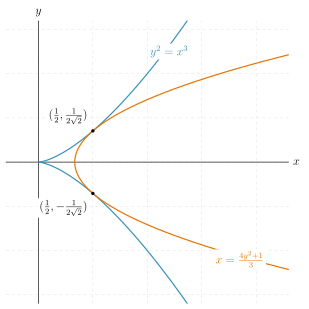
The curve \(C\) is given parametrically by the equations \(x = 3t^2\), \(y = 2t^3\). Show that the equation of the tangent to \(C\) at the point \((3p^2 , 2p^3)\) is \(y = px - p^3\). Find the point of intersection of the tangents to \(C\) at the distinct points \((3p^2 , 2p^3)\) and \((3q^2 , 2q^3)\). Hence show that, if these two tangents are perpendicular, their point of intersection is \((u^2 + 1 , -u)\), where \(u = p + q\). The curve \(\tilde{C}\) is given parametrically by the equations \(x = u^2 + 1\), \(y = -u\). Find the coordinates of the points that lie on both \(C\) and \(\tilde{C}\). Sketch \(C\) and \(\tilde{C}\) on the same axes.
Solution: \begin{align*} && \frac{\d y}{\d x} &= \frac{\frac{\d y}{\d t}}{\frac{\d x}{\d t}} \\ &&&= \frac{6t^2}{6t} = t \\ \Rightarrow && \frac{y-2p^3}{x - 3p^2} &= p \\ \Rightarrow && y &= px-3p^3+2p^3 \\ && y &= px - p^3 \end{align*} The two lines will be \begin{align*} && y &= px - p^3 \\ && y &= qx - q^3 \\ \Rightarrow && p^3-q^3 &= (p-q)x \\ \Rightarrow && x &= p^2+pq+q^2 \\ && y &= p(p^2+pq+q^2)-p^3 \\ &&&= pq(p+q) \\ && (x,y) &= (p^2+pq+q^2,pq(p+q)) \\ \end{align*} If the tangents are \(\perp\) then \(pq=-1\), so we have \begin{align*} && (x,y) &= (p^2+2pq+q^2-pq, pq(p+q)) \\ &&&= ((p+q)^2-1, -(p+q)) \\ &&&= (u^2-1, -u) \end{align*} We have \(x = y^2+1\) and \(\left ( \frac{x}{3} \right)^3 = \left ( \frac{y}{2}\right)^2 \Rightarrow y^2 = \frac{4}{27}x^3\) so \begin{align*} && 0 &= \frac{4}{27}x^3-x+1 \\ &&0&=4x^3-27x+27 \\ &&&= (x+3)(2x-3)^2 \end{align*} So we have the points \((x,y) = \left (\frac32, \pm\frac{1}{\sqrt{2}}\right)\)

2016 Paper 2 Q1
The curve \(C_1\) has parametric equations \(x=t^2\), \(y= t^3\), where \(-\infty < t < \infty\,\). Let \(O\) denote the point \((0,0)\). The points \(P\) and \(Q\) on \(C_1\) are such that \(\angle POQ\) is a right angle. Show that the tangents to \(C_1\) at \(P\) and \(Q\) intersect on the curve \(C_2\) with equation \(4y^2=3x-1\). Determine whether \(C_1\) and \(C_2\) meet, and sketch the two curves on the same axes.
Solution: \(\angle POQ = 90^\circ\) means that if \(P(p^2,p^3)\) and \(Q(q^2,q^3)\) are our points then \(OP^2+OQ^2 = PQ^2\), so \begin{align*} && p^4+p^6+q^4+q^6 &= (p^2-q^2)^2+(p^3-q^3)^2 \\ &&&= p^4+q^4-2p^2q^2+p^6+q^6-2p^3q^3 \\ \Rightarrow && 0 &= 2p^2q^2(1+pq) \\ \Rightarrow && pq &= -1 \\ \\ && \frac{\d y}{ \d x} &= \frac{\frac{\d y }{\d t}}{\frac{\d x}{\d t}} \\ &&&= \frac{3t^2}{2t} = \tfrac32t \\ \Rightarrow && \frac{y-p^3}{x-p^2} &= \tfrac32p \\ \Rightarrow && 2(y-p^3) &=3p(x-p^2) \\ && 2(y-q^3) &=3q(x-q^2) \\ \Rightarrow && 2(q^3-p^3) &= (3p-3q)x+3(q^3-p^3) \\ && p^3-q^3 &= 3(p-q)x \\ \Rightarrow && x &= \tfrac13(p^2+q^2+pq) \\ && 2y &= 3p(\tfrac13(p^2+q^2+pq)-p^2)+2p^3 \\ &&&= p(p^2+q^2+pq)-p^3 \\ &&&= pq^2+p^2q \\ &&&= -p-q \\ &&y&= -\frac{p+q}{2} \\ \\ && 4y^2 &= p^2+q^2 \\ && 3x-1 &= p^2+q^2 \\ \end{align*} To check if they meet, try \(4t^6=3t^2 - 1\). Consider \(y = 4x^3-3x+1\) \(y(0) = 1\) and \(y' = 12x^2-3 = 3(4x^2-1)\) which has roots at \(\pm \tfrac12\), therefore we need to test \(y(\tfrac12) = \tfrac12-\tfrac32 + 1 = 0\), so there is a one intersection at \(x = \tfrac1{2}, y = \tfrac1{2\sqrt{2}}\)