Problems
Filters
1 problem found
1992 Paper 3 Q3
D: 1700.0
B: 1484.0
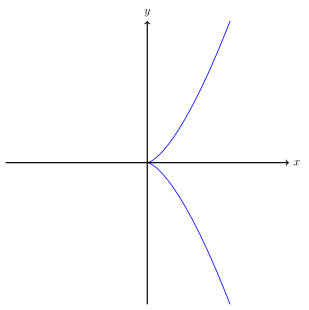
Sketch the curve \(C_{1}\) whose parametric equations are \(x=t^{2},\) \(y=t^{3}.\) The circle \(C_{2}\) passes through the origin \(O\). The points \(R\) and \(S\) with real non-zero parameters \(r\) and \(s\) respectively are other intersections of \(C_{1}\) and \(C_{2}.\) Show that \(r\) and \(s\) are roots of an equation of the form \[ t^{4}+t^{2}+at+b=0, \] where \(a\) and \(b\) are real constants. By obtaining a quadratic equation, with coefficients expressed in terms of \(r\) and \(s\), whose roots would be the parameters of any further intersections of \(C_{1}\) and \(C_{2},\) or otherwise, show that \(O\), \(R\) and \(S\) are the only real intersections of \(C_{1}\) and \(C_{2}.\)
Solution: