Problems
Filters
6 problems found
2024 Paper 3 Q10
A cube of uniform density \(\rho\) is placed on a horizontal plane and a second cube, also of uniform density \(\rho\), is placed on top of it. The lower cube has side length \(1\) and the upper cube has side length \(a\), with \(a \leqslant 1\). The centre of mass of the upper cube is vertically above the centre of mass of the lower cube and all the edges of the upper cube are parallel to the corresponding edges of the lower cube. The contacts between the two cubes, and between the lower cube and the plane, are rough, with the same coefficient of friction \(\mu < 1\) in each case. The midpoint of the base of the upper cube is \(X\) and the midpoint of the base of the lower cube is \(Y\). A horizontal force \(P\) is exerted, perpendicular to one of the vertical faces of the upper cube, at a point halfway between the two vertical edges of this face, and a distance \(h\), with \(h < a\), above the lower edge of this face.
- Show that, if the two cubes remain in equilibrium, the normal reaction of the plane on the lower cube acts at a point which is a distance \[\frac{P(1+h)}{(1+a^3)\rho g}\] from \(Y\), and find a similar expression for the distance from \(X\) of the point at which the normal reaction of the lower cube on the upper cube acts.
- Show that, if neither cube topples, equilibrium will be broken by the slipping of the upper cube on the lower cube, and not by the slipping of the lower cube on the ground.
- Show that, if \(a = 1\), then equilibrium will be broken by the slipping of the upper cube on the lower cube if \(\mu(1+h) < 1\) and by the toppling of the lower and upper cube together if \(\mu(1+h) > 1\).
- Show that, in a situation where \(a < 1\) and \(h\bigl(1 + a^3(1-a)\bigr) > a^4\), and no slipping occurs, equilibrium will be broken by the toppling of the upper cube.
- Show, by considering \(a = \frac{1}{2}\) and choosing suitable values of \(h\) and \(\mu\), that the situation described in (iv) can in fact occur.
2019 Paper 1 Q5
- The four points \(P\), \(Q\), \(R\) and \(S\) are the vertices of a plane quadrilateral. What is the geometrical shape of \(PQRS\) if \(\vec{PQ} = \vec{SR}\)? What is the geometrical shape of \(PQRS\) if \(\vec{PQ} = \vec{SR}\) and \(|\vec{PQ}| = |\vec{PS}|\)?
- A cube with edges of unit length has opposite vertices at \((0,0,0)\) and \((1,1,1)\). The points
$$P(p,0,0), \quad Q(1,q,0), \quad R(r,1,1) \quad \text{and} \quad S(0,s,1)$$
lie on edges of the cube. Given that the four points lie in the same plane, show that
$$rq = (1-s)(1-p).$$
- Show that \(\vec{PQ} = \vec{SR}\) if and only if the centroid of the quadrilateral \(PQRS\) is at the centre of the cube. Note: the centroid of the quadrilateral \(PQRS\) is the point with position vector $$\frac{1}{4}(\vec{OP} + \vec{OQ} + \vec{OR} + \vec{OS}),$$ where \(O\) is the origin.
- Given that \(\vec{PQ} = \vec{SR}\) and \(|\vec{PQ}| = |\vec{PS}|\), express \(q\), \(r\) and \(s\) in terms of \(p\). Show that $$\cos PQR = \frac{4p-1}{5-4p+8p^2}.$$ Write down the values of \(p\), \(q\), \(r\) and \(s\) if \(PQRS\) is a square, and show that the length of each side of this square is greater than \(\frac{21}{20}\).
Solution:
- If \(\vec{PQ} = \vec{SR}\) we have a parallelogram. \(\vec{PQ} = \vec{SR}\) and \(|\vec{PQ}| = |\vec{PS}|\) then we have a rhombus.
- If the four points lie in a plane then
\((\vec{RS} \times \vec{RP}) \cdot \vec{RQ} =0\), so
\begin{align*}
&& 0 &=\left ( \begin{pmatrix}-r\\ s-1 \\ 0 \end{pmatrix} \times \begin{pmatrix}p-r\\ -1 \\ -1 \end{pmatrix}\right) \cdot \begin{pmatrix}1-r\\ q-1 \\ -1 \end{pmatrix} \\
&& &= \begin{pmatrix}1-s \\ -r \\r+(p-r)(1-s) \end{pmatrix} \cdot \begin{pmatrix}1-r\\ q-1 \\ -1 \end{pmatrix} \\
&&&= (1-s)(1-r)-r(q-1)-r-(p-r)(1-s) \\
&&&=(1-s)(1-r-p+r)-rq \\
\Rightarrow && rq &= (1-s)(1-p)
\end{align*}
- \(\,\) \begin{align*} && \vec{PQ} &= \vec{SR} \\ \Leftrightarrow && \begin{pmatrix}1-p\\q \\ 0 \end{pmatrix} &= \begin{pmatrix}r\\1-s \\ 0 \end{pmatrix} \\ \Leftrightarrow && 1-p = r & \quad ; \quad q = 1-s\\ \Leftrightarrow && 1= r+p & \quad ; \quad 1 = q+s\\ \end{align*} The centroid is \(\frac14 (p+1+r, q+s+1, 2)\) which is clearly \(\frac12(1,1,1)\) iff those equations are true.
- \(\,\) \begin{align*} && |\vec{PQ}| &= |\vec{PS}| \\ \Leftrightarrow && (1-p)^2+q^2+ 0^2 &= p^2+s^2+1)\\ \Leftrightarrow && 1-2p+p^2+q^2 &= p^2 + s^2 + 1 \\ \Leftrightarrow && -2p+q^2 &= s^2 \end{align*} From the previous equations we have \(r = 1-p\), and \(-2p+(1-s)^2 = s^2 \Rightarrow -2p + 1 -2s = 0 \Rightarrow s = \frac12 - p\) and \(q = \frac12 + p\) \begin{align*} && \cos PQR &= \frac{\vec{QP}\cdot \vec{QR}}{|\vec{QP}||\vec{QR}|} \\ &&&= \frac{ \begin{pmatrix}p-1\\ -q \\ 0 \end{pmatrix} \cdot \begin{pmatrix}r-1\\ 1-q \\ 1 \end{pmatrix}}{\sqrt{(p-1)^2+q^2}\sqrt{(r-1)^2+(1-q)^2+1^2}} \\ &&&= \frac{ \begin{pmatrix}p-1\\ -\frac12-p \\ 0 \end{pmatrix} \cdot \begin{pmatrix}-p\\ \frac12-p \\ 1 \end{pmatrix}}{\sqrt{(p-1)^2+(-\frac12-p)^2}\sqrt{p^2+(\frac12-p)^2+1^2}} \\ &&&= \frac{ p-p^2-\frac14+p^2}{\sqrt{p^2-2p+1+\frac14+p+p^2}\sqrt{p^2+\frac14-p+p^2+1}} \\ &&&= \frac{4p-1}{\sqrt{8p^2-4p+5}\sqrt{8p^2-4p+5}}\\ &&&= \frac{4p-1}{8p^2-4p+5}\\ \end{align*} For \(PQRS\) to be a square \(\cos PQR = 0\), ie \(p = \frac14\) and so \((p,q,r,s) = (\frac14, \frac34, \frac34, \frac14)\) and \(|PQ| = \sqrt{(1-p)^2+q^2} = \sqrt{\left ( \frac34 \right)^2 + \left ( \frac34 \right)^2 } = \frac{3\sqrt{2}}4\), notice that \(\left ( \frac{21}{20} \right)^2 = \frac{441}{400} < \frac{9}{8}\) (\(441 < 450\)) therefore the sides are at least as long as \(\frac{21}{20}\)
2017 Paper 1 Q11
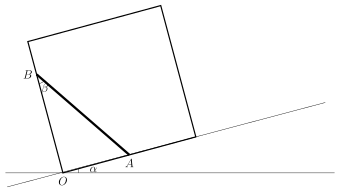
A plane makes an acute angle \(\alpha\) with the horizontal. A box in the shape of a cube is fixed onto the plane in such a way that four of its edges are horizontal and two of its sides are vertical. A uniform rod of length \(2L\) and weight \(W\) rests with its lower end at \(A\) on the bottom of the box and its upper end at \(B\) on a side of the box, as shown in the diagram below. The vertical plane containing the rod is parallel to the vertical sides of the box and cuts the lowest edge of the box at \(O\). The rod makes an acute angle~\(\beta\) with the side of the box at \(B\). The coefficients of friction between the rod and the box at the two points of contact are both \(\tan \gamma\), where \(0 < \gamma < \frac12\pi\). %The frictional force on the rod at \(A\) acts toward \(O\), %and the frictional force on the rod at~\(B\) %acts away from \(O\). The rod is in limiting equilibrium, with the end at \(A\) on the point of slipping in the direction away from \(O\) and the end at \(B\) on the point of slipping towards \(O\). Given that \(\alpha < \beta\), show that \(\beta = \alpha + 2\gamma\). [\(Hint\): You may find it helpful to take moments about the midpoint of the rod.]
Solution:

1998 Paper 3 Q6
- Show that four vertices of a cube, no two of which are adjacent, form the vertices of a regular tetrahedron. Hence, or otherwise, find the volume of a regular tetrahedron whose edges are of unit length.
- Find the volume of a regular octahedron whose edges are of unit length.
- Show that the centres of the faces of a cube form the vertices of a regular octahedron. Show that its volume is half that of the tetrahedron whose vertices are the vertices of the cube.
1993 Paper 3 Q11
In this question, all gravitational forces are to be neglected. A rigid frame is constructed from 12 equal uniform rods, each of length \(a\) and mass \(m,\) forming the edges of a cube. Three of the edges are \(OA,OB\) and \(OC,\) and the vertices opposite \(O,A,B\) and \(C\) are \(O',A',B'\) and \(C'\) respectively. Forces act along the lines as follows, in the directions indicated by the order of the letters: \begin{alignat*}{3} 2mg\mbox{ along }OA, & \qquad & mg\mbox{ along }AC', & \qquad & \sqrt{2}mg\mbox{ along }O'A,\\ \sqrt{2}mg\mbox{ along }OA', & & 2mg\mbox{ along }C'B, & & mg\mbox{ along }A'C. \end{alignat*}
- The frame is freely pivoted at \(O\). Show that the direction of the line about which it will start to rotate is $\begin{pmatrix}1\\ 1\\ 2 \end{pmatrix}$ with respect to axes along \(OA\), \(OB\) and \(OC\) respectively.
- Show that the moment of inertia of the rod \(OA\) about the axis \(OO'\) is \(2ma^2/9\) and about a parallel axis through its mid-point is \(ma^2/18\). Hence find the moment of inertia of \(B'C\) about \(OO'\) and show that the moment of inertia of the frame about \(OO'\) is \(14ma^2/3\). If the frame is freely pivoted about the line \(OO'\) and the forces continue to act along the specified lines, find the initial angular acceleration of the frame.
1990 Paper 3 Q14
The edges \(OA,OB,OC\) of a rigid cube are taken as coordinate axes and \(O',A',B',C'\) are the vertices diagonally opposite \(O,A,B,C,\) respectively. The four forces acting on the cube are \[ \begin{pmatrix}\alpha\\ \beta\\ \gamma \end{pmatrix}\mbox{ at }O\ (0,0,0),\ \begin{pmatrix}\lambda\\ 0\\ 1 \end{pmatrix}\mbox{ at }O'\ (a,a,a),\ \begin{pmatrix}-1\\ 0\\ 2 \end{pmatrix}\mbox{ at }B\ (0,a,0),\ \mbox{ and }\begin{pmatrix}1\\ \mu\\ \nu \end{pmatrix}\mbox{ at }B'\ (a,0,a). \] The moment of the system about \(O\) is zero: find \(\lambda,\mu\) and \(\nu\).
- Given that \(\alpha=\beta=\gamma=0,\) find the system consisting of a single force at \(B\) together with a couple which is equivalent to the given system.
- Given that \(\alpha=2,\beta=3\) and \(\gamma=2,\) find the equation of the locus about each point of which the moment of the system is zero. Find the number of units of work done on the cube when it moves (without rotation) a distance in the direction of this line under the action of the given forces only.
Solution: \begin{align*} &&\mathbf{M} &= \begin{pmatrix}\lambda \\ 0\\ 1 \end{pmatrix} \times \begin{pmatrix}a\\ a \\ a \end{pmatrix} + \begin{pmatrix}-1\\ 0\\ 2 \end{pmatrix} \times \begin{pmatrix} 0 \\ a \\ 0 \end{pmatrix} + \begin{pmatrix}1\\ \mu\\ \nu \end{pmatrix} \times \begin{pmatrix} a \\ 0 \\ a \end{pmatrix} \\ &&&= \begin{pmatrix} -a \\ -a(\lambda -1) \\ \lambda a \end{pmatrix} + \begin{pmatrix} -2a \\ 0 \\ -a \end{pmatrix} + \begin{pmatrix} \mu a \\ -a(1-\nu) \\ -a \mu \end{pmatrix} \\ &&&=a \begin{pmatrix} \mu - 3 \\ \nu - \lambda \\ \lambda-1-\mu \end{pmatrix} \\ \Rightarrow && \mu &= 3, \lambda = 4, \nu = 4 \end{align*}
- To find the force we add all vectors: \begin{align*} \mathbf{F} &= \begin{pmatrix}\lambda \\ 0\\ 1 \end{pmatrix} + \begin{pmatrix}-1\\ 0\\ 2 \end{pmatrix} + \begin{pmatrix}1\\ \mu\\ \nu \end{pmatrix} \\ &= \begin{pmatrix}4\\ 0\\ 1 \end{pmatrix} + \begin{pmatrix}-1\\ 0\\ 2 \end{pmatrix} + \begin{pmatrix}1\\ 3 \\ 4 \end{pmatrix} \\ &= \begin{pmatrix} 4 \\ 3 \\ 7 \end{pmatrix} \end{align*} Since the moment about \(O\) is \(0\), we have the moment about \(B\) is: \begin{align*} \mathbf{M} &= \begin{pmatrix} 0 \\ a \\ 0 \end{pmatrix} \times \begin{pmatrix} 4 \\ 3 \\ 7\end{pmatrix} \\ &= \begin{pmatrix} 7a \\ 0 \\ -4a\end{pmatrix} \end{align*}
- \begin{align*} \mathbf{0} &= \mathbf{r} \times \begin{pmatrix} 4 + 2 \\ 3+3 \\ 7+2 \end{pmatrix} \\ &= \mathbf{r} \times \begin{pmatrix} 6 \\ 6 \\ 9 \end{pmatrix} \\ \end{align*} Therefore \(\mathbf{r} = t\begin{pmatrix} 2 \\ 2 \\ 3 \end{pmatrix}\) (ie a line) \begin{align*} \text{Work done} &= \text{Force} \cdot \text{distance} \end{align*} Since they are parallel, it's just the magnitude of the force, which is \(3\sqrt{2^2+2^2+3^2} = 3\sqrt{17}\)