Problems
Filters
2 problems found
2019 Paper 3 Q1
The coordinates of a particle at time \(t\) are \(x\) and \(y\). For \(t \geq 0\), they satisfy the pair of coupled differential equations \[ \begin{cases} \dot{x} &= -x -ky \\ \dot{y} &= x - y \end{cases}\] where \(k\) is a constant. When \(t = 0\), \(x = 1\) and \(y = 0\).
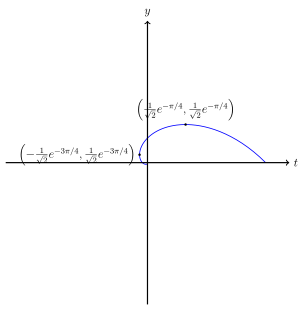
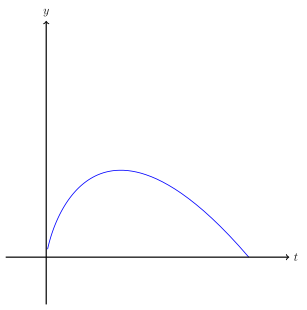
- Let \(k = 1\). Find \(x\) and \(y\) in terms of \(t\) and sketch \(y\) as a function of \(t\). Sketch the path of the particle in the \(x\)-\(y\) plane, giving the coordinates of the point at which \(y\) is greatest and the coordinates of the point at which \(x\) is least.
- Instead, let \(k = 0\). Find \(x\) and \(y\) in terms of \(t\) and sketch the path of the particle in the \(x\)-\(y\) plane.
Solution:
- Let \(k = 1\), then
\begin{align*}
\dot{x} &= - x - y \\
\dot{y} &= x - y \\
\dot{x}-\dot{y} &= -2x \\
\ddot{x} &= -\dot{x}-\dot{y} \\
&= -\dot{x} - (\dot{x}+2x) \\
&= -2\dot{x}- 2x \\
\dot{x}+\dot{y} &= -2y \\
\ddot{y} &= \dot{x}-\dot{y} \\
&= -2y-2\dot{y}
\end{align*}
So we have an auxiliary equation for \(x\) and \(y\) which is \(\lambda^2 + 2 \lambda+2 = 0 \Rightarrow \lambda = -1 \pm i\).
Therefore \(x = Ae^{-t} \cos t + B e^{-t} \sin t, y = Ce^{-t}\cos t + De^{-t} \sin t\). We also must have that, \(A = 1, C = 0\), so \(x = e^{-t} \cos t + Be^{-t} \sin t\) and \(y = De^{-t} \sin x\).
\begin{align*}
\dot{y} &= -De^{-t} \sin t +De^{-t} \cos t \\
&= e^{-t} \cos x + Be^{-t} \sin t- De^{-t} \sin t \\
\end{align*}
therefore \(B = 0, D = 1\) and \(x = e^{-t} \cos t, y = e^{-t} \sin t\)
\begin{align*} y &= e^{-t} \sin t \\ \dot{y} &= -e^{-t} \sin t + e^{-t} \cos t \\ \dot{x} &= e^{-t} \cos t -e^{-t} \sin t \end{align*}

- \begin{align*}
\dot{x} = -x \\
\dot{y} = x-y
\end{align*}
So \(x = e^{-t}\). \(\dot{y} + y = e^{-t}\) so \(y = (t+B)e^{-t}\) and so \(y =te^{-t}\).
2012 Paper 3 Q7
A pain-killing drug is injected into the bloodstream. It then diffuses into the brain, where it is absorbed. The quantities at time \(t\) of the drug in the blood and the brain respectively are \(y(t)\) and \(z(t)\). These satisfy \[ \dot y = - 2(y-z)\,, \ \ \ \ \ \ \ \dot z = - \dot y -3z\, , \] where the dot denotes differentiation with respect to \(t\). Obtain a second order differential equation for \(y\) and hence derive the solution \[ y= A\e^{-t} + B\e ^{-6t}\,, \ \ \ \ \ \ \ z= \tfrac12 A \e^{-t} - 2 B \e^{-6t}\,, \] where \(A\) and \(B\) are arbitrary constants. \begin{questionparts} \item Obtain the solution that satisfies \(z(0)=0\) and \(y(0)= 5\). The quantity of the drug in the brain for this solution is denoted by \(z_1(t)\). \item Obtain the solution that satisfies $ z(0)=z(1)= c$, where \(c\) is a given constant. %\[ %C=2(1-\e^{-1})^{-1} - 2(1-\e^{-6})^{-1}\,. %\] The quantity of the drug in the brain for this solution is denoted by \(z_2(t)\). \item Show that for \(0\le t \le 1\), \[ z_2(t) = \sum _{n=-\infty}^{0} z_1(t-n)\,, \] provided \(c\) takes a particular value that you should find. \end {questionparts}