Problems
Filters
11 problems found
2020 Paper 2 Q4
- Given that \(a\), \(b\) and \(c\) are the lengths of the sides of a triangle, explain why \(c < a + b\), \(a < b + c\) and \(b < a + c\).
- Use a diagram to show that the converse of the result in part (i) also holds: if \(a\), \(b\) and \(c\) are positive numbers such that \(c < a + b\), \(a < b + c\) and \(b < c + a\) then it is possible to construct a triangle with sides of length \(a\), \(b\) and \(c\).
- When \(a\), \(b\) and \(c\) are the lengths of the sides of a triangle, determine in each case whether the following sets of three lengths can
- always
- sometimes but not always
- never
- Let \(\mathrm{f}\) be a function defined on the positive real numbers and such that, whenever \(x > y > 0\), \[\mathrm{f}(x) > \mathrm{f}(y) > 0 \quad \text{but} \quad \frac{\mathrm{f}(x)}{x} < \frac{\mathrm{f}(y)}{y}.\] Show that, whenever \(a\), \(b\) and \(c\) are the lengths of the sides of a triangle, then \(\mathrm{f}(a)\), \(\mathrm{f}(b)\) and \(\mathrm{f}(c)\) can also be the lengths of the sides of a triangle.
Solution:
- Not that unless a side is the largest side, it is clearly shorter than the sum of the other two sides (since it's greater than or equal to one on its own). Note also that the distance from one vertex to the other (say \(c\)) is shorter than going via the other vertex \(a+b\), therefore \(c < a+b\).
- Draw a line of the length of the largest number, say \(c\), then since \(c < a+b\) we must have circles radius \(a\) and \(b\) at the endpoints cross, and at their intersection we have a vertex of a \(c\)-\(a\)-\(b\) triangle.
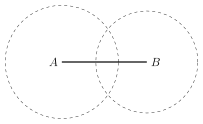
- (A) always. Suppose \(c\) is the longest side, then \(c < a+b \Rightarrow c+1 < a + 1 + b+1\) so \((a+1,b+1,c+1)\) are still sides of a triangle. (B) sometimes, but not always. \((1,1,1) \to (1,1,1)\) is still a triangle, but \((10, 10, 1) \to (1, 10, \frac{1}{10})\) is not a triangle since \(10 > 1 + \frac{1}{10}\) (C) never, suppose \(a \leq b \leq c\) then the sides are \(b-a, c-b, c-a\) but \(c-a = (c-b)+(b-a)\) so the triangle inequality cannot be satisfied. (D) always - without loss of generality let \(c\) be the longest side, and since every term is homogeneous degree \(2\) we can divide through by \(c^2\) to see we have the sides \(a^2+b, b^2+a, 1+ab\) and note that \(1 + ab < a+b +ab < a+b+a^2+b^2\), also \(a^2+b < 1 + b < 1 + (a+b)b = 1 + b^2 + ab < (1+ab)+(b^2+a)\).
- Suppose \(f\) is increasing and \(\f(x)/x\) is decreasing, and suppose \(a,b,c\) are side-lengths of a triangle. Wlog \(c\) is the longest side, then note \(f(c) > f(b), f(a)\), so it suffices to prove that \(f(c) < f(a)+f(b)\) \begin{align*} \frac{f(c)}{c} < \frac{f(a)}{a}: && f(a) &> \frac{a}{c} f(c) \\ \frac{f(c)}{c} < \frac{f(b)}{b}: && f(b) &> \frac{b}{c} f(c) \\ \Rightarrow && f(a)+f(b) &> f(c) \underbrace{\left ( \frac{a+b}{c} \right)}_{>1} \\ &&&> f(c) \end{align*} as required
2016 Paper 1 Q7
The set \(S\) consists of all the positive integers that leave a remainder of 1 upon division by 4. The set \(T\) consists of all the positive integers that leave a remainder of 3 upon division by 4.
- Describe in words the sets \(S \cup T\) and \(S \cap T\).
- Prove that the product of any two integers in \(S\) is also in \(S\). Determine whether the product of any two integers in \(T\) is also in \(T\).
- Given an integer in \(T\) that is not a prime number, prove that at least one of its prime factors is in \(T\).
- For any set \(X\) of positive integers,
an integer in \(X\) (other than 1) is said to be
\(X\)-prime if it cannot be expressed as the product of
two or more integers all in \(X\) (and all different from 1).
- \(\bf (a)\) Show that every integer in \(T\) is either \(T\)-prime or is the product of an odd number of \(T\)-prime integers.
- \(\bf (b)\) Find an example of an integer in \(S\) that can be expressed as the product of \(S\)-prime integers in two distinct ways. [Note: \(s_1s_2\) and \(s_2s_1\) are not counted as distinct ways of expressing the product of \(s_1\) and \(s_2\).]
Solution:
- \(S \cup T\) is the set of odd positive integers. \(S \cap T\) is the empty set.
- Suppose we have two integers in \(S\), say \(4n+1\) and \(4m+1\), so \((4n+1)(4m+1) = 16nm + 4(n+m) + 1 = 4(4nm + n+m) + 1\) which clearly is in \(S\). The product of any two integers in \(T\) is in \(S\), since \((4n+3)(4m+3) = 16nm + 12(n+m) + 9 = 4(4nm+3(n+m) + 2) + 1\)
- Suppose \(p \in T\) is not prime, then it must have prime factors. They must all be odd, so they are in \(T\) or \(S\). If they are all in \(S\) then \(p\) must also be in \(S\) (as the product of numbers in \(S\)) but this is a contraction. Therefore \(p\) must have a prime factor in \(T\).
- \(3, 7, 11, 19\) are all primes in \(T\). Notice therefore that any product of two of them must be \(S\)-prime. But then \((3 \times 7) \times (11 \times 19)\) and \((3 \times 11) \times (7 \times 19)\) are distinct factorisations into \(S\)-prime factors.
2015 Paper 3 Q2
If \(s_1\), \(s_2\), \(s_3\), \(\ldots\) and \(t_1\), \(t_2\), \(t_3\), \(\ldots\) are sequences of positive numbers, we write \[ (s_n)\le (t_n) \] to mean
- \((1000n) \le (n^2)\,\).
- If it is not the case that \((s_n)\le (t_n)\), then it is the case that \((t_n)\le (s_n)\,\).
- If \((s_n)\le (t_n)\) and \((t_n) \le (u_n)\), then \((s_n)\le (u_n)\,\).
- \((n^2)\le (2^n)\,\).
Solution:
- If \(m = 1000\), then \(n \geq m \Rightarrow n^2 \geq 1000n \Rightarrow (1000n) \leq (n^2)\)
- This is false. Let \(s_i = 1,2,1,2,\cdots\) and \(t_i = 2,1,2,1,\cdots\).
- Suppose that for \(n \geq m_1, s_n \le t_n\) and for \(n \geq m_2, s_t \le u_n\), then for \(n \geq m = \max(m_1, m_2), s_n \leq t_n \leq u_n \Rightarrow s_n \leq u_n \Rightarrow (s_n) \leq (u_n)\)
- Let \(m = 6\), then if \(n \geq m, 2^n \geq 1 + n + \frac{n(n-1)}{2} + \frac{n(n-1)}{2} + n + 1 = n^2 + n + 2 \geq n^2\), so \((2^n) \geq (n^2)\)
2015 Paper 3 Q6
- Let \(w\) and \(z\) be complex numbers, and let \(u= w+z\) and \(v=w^2+z^2\). Prove that \(w\) and \(z\) are real if and only if \(u\) and \(v\) are real and \(u^2\le2v\).
- The complex numbers \(u\), \(w\) and \(z\) satisfy the equations \begin{align*} w+z-u&=0 \\ w^2+z^2 -u^2 &= - \tfrac 23 \\ w^3+z^3 -\lambda u &= -\lambda\, \end{align*} where \(\lambda \) is a positive real number. Show that for all values of \(\lambda\) except one (which you should find) there are three possible values of \(u\), all real. Are \(w\) and \(z\) necessarily real? Give a proof or counterexample.
Solution:
- Notice that \(u^2 = v+2wz\), so \(w,z\) are roots of the quadratic \(t^2 -ut+\frac{u^2-v}{2}\). Therefore they are both real if \(u^2 \geq 2(u^2-v) \Rightarrow 2v \geq u^2\).
- \begin{align*} && w+z &= u \\ && w^2+z^2 &= u^2 - \tfrac23 \\ && w^3+z^3 &= \lambda(u-1) \\ \\ && wz &= \frac{u^2 - (u^2-\tfrac23)}{2} = \tfrac13\\ \\ && (w+z)(w^2+z^2) &= w^3+z^3+wz(w+z) \\ &&u(u^2-\tfrac23)&= \lambda(u-1)+\frac13u \\ \Rightarrow && u^3-u&= \lambda (u-1) \\ \Rightarrow && 0 &= (u-1)(u(u+1) - \lambda) \\ \Rightarrow && 0 &= (u-1)(u^2+u - \lambda) \end{align*} Therefore there will be at most 3 values for \(u\), unless \(1\) is a root of \(u^2+u-\lambda\), ie \(\lambda = 2\). Suppose \(u = 1\), then we have: \(w+z = 1, wz = 1/3 \Rightarrow w,z = \frac{-1 \pm \sqrt{-1/3}}{2}\) which are clearly complex.
2014 Paper 2 Q2
This question concerns the inequality \begin{equation} \int_0^\pi \bigl( f(x) \bigr)^2 \d x \le \int_0^\pi \bigl( f'(x)\bigr)^2 \d x\,.\tag{\(*\)} \end{equation}
- Show that \((*)\) is satisfied in the case \(f(x)=\sin nx\), where \(n\) is a positive integer. Show by means of counterexamples that \((*)\) is not necessarily satisfied if either \(f(0) \ne 0\) or \(f(\pi)\ne0\).
- You may now assume that \((*)\) is satisfied for any (differentiable) function \(f\) for which \(f(0)=f(\pi)=0\). By setting \(f(x) = ax^2 + bx +c\), where \(a\), \(b\) and \(c\) are suitably chosen, show that \(\pi^2\le 10\). By setting \(f(x) = p \sin \frac12 x + q\cos \frac12 x +r\), where \(p\), \(q\) and \(r\) are suitably chosen, obtain another inequality for \(\pi\). Which of these inequalities leads to a better estimate for \(\pi^2\,\)?
Solution:
- If \(f(x) = \sin nx\) then \(f'(x) = n \cos n x\) and so \begin{align*} && LHS &= \int_0^\pi \sin^2 n x \d x \\ &&&= \left [ \frac{x+\frac1{2n}\sin 2n x}{2} \right ]_0^{\pi} \\ &&&= \frac{\pi}{2} \\ \\ && RHS &= \int_0^{\pi} n^2 \cos^2 n x \d x \\ &&&= n^2 \left [ \frac{\frac{1}{2n}\sin 2n x + x}{2} \right]_0^{\pi} \\ &&&= n^2\frac{\pi}{2} \geq LHS \end{align*} [\(f(0) = 0, f(\pi) \neq 0\)] Suppose \(f(x) = x\) then \(f'(x) = 1\) and \(LHS = \frac{\pi^3}{3} > \pi = RHS\). [\(f(0) \neq 0, f(\pi) = 0\)] Suppose \(f(x) = \pi - x\) then \(f'(x) = -1\) and \(LHS = \frac{\pi^3}{3} > \pi = RHS\)
- Suppose \(f(x) = x(\pi - x)\) then \(f'(x) = \pi - 2x\) and so \begin{align*} && \int_0^\pi x^2(\pi-x)^2 \d x &\leq \int_0^\pi (\pi-2x)^2 \d x \\ \Leftrightarrow && \left [\pi^2 \frac{x^3}{3} - 2\pi \frac{x^4}{4} + \frac{x^5}{5} \right]_0^{\pi} &\leq \left [ \pi^2x - 4\pi \frac{x^2}{2} + \frac{4x^3}{3} \right]_0^{\pi} \\ \Leftrightarrow && \pi^5 \left (\frac13 - \frac12+\frac15 \right) &\leq \pi^3 \left ( 1 - 2+\frac43 \right) \\ \Leftrightarrow && \pi^2 \frac{1}{30} &\leq \frac13 \\ \Leftrightarrow && \pi^2 &\leq 10 \end{align*} Suppose \(f(x) = p\sin \tfrac12 x + q \cos \tfrac12 x + r\), so \(f(0) = q + r\) and \(f(\pi) = p + r\), so say \(p = q = 1, r = -1\) \begin{align*} && LHS &= \int_0^{\pi} \left ( \sin \tfrac12 x + \cos \tfrac12 x-1\right)^2 \d x \\ &&&=\int_0^\pi \left ( \sin^2 \tfrac12 x + \cos^2 \tfrac12 x+1-2\sin \tfrac12 x - 2\cos \tfrac12 x+ \sin x \right)\\ &&&= \left [2x + 4\cos \tfrac12 x - 4\sin \tfrac12 x - \cos x \right]_0^{\pi} \\ &&&= \left ( 2\pi -4+1 \right) - \left ( 4-1 \right) \\ &&&= 2\pi -6\\ \\ && RHS&= \int_0^{\pi} \left ( \tfrac12 \cos \tfrac12 x -\tfrac12 \sin \tfrac12 x\right)^2 \d x \\ &&&= \int_0^{\pi} \left ( \tfrac14 \cos^2 \tfrac12 x +\tfrac14 \sin^2 \tfrac12 x-\tfrac14 \sin x\right) \d x \\ &&&= \frac{\pi}{4} - \frac12 \\ \Rightarrow && 2\pi -6 &\leq \frac{\pi}{4} - \frac12 \\ \Rightarrow && \frac{7\pi}{4} &\leq \frac{11}{2} \\ \Rightarrow && \pi &\leq \frac{22}{7} \end{align*} \(22^2/7^2 = 484/49 < 10\) therefore \(\pi \leq \frac{22}{7}\) is the better estimate.
2008 Paper 1 Q1
What does it mean to say that a number \(x\) is irrational? Prove by contradiction statements A and B below, where \(p\) and \(q\) are real numbers.
- A: If \(pq\) is irrational, then at least one of \(p\) and \(q\) is irrational.
- B: If \(p+q\) is irrational, then at least one of \(p\) and \(q\) is irrational.
- C: If \(p\) and \(q\) are irrational, then \(p+q\) is irrational.
Solution:
- A: Suppose for sake of contradiction that neither \(p\) nor \(q\) is irrational, then \(pq\) is the product of two rational numbers, ie is also rational. Therefore \(pq\) is rational. Contradiction.
- B: Suppose for the sake of contradiction both \(p\) and \(q\) are rational, but then \(p+q\) is also rational, contradicting \(p+q\) is irrational.
- C: Note that \(\sqrt{2}\) and \(-\sqrt{2}\) are both irrational, but \(\sqrt{2}+(-\sqrt{2}) = 0\) which is rational.
2005 Paper 2 Q2
For any positive integer \(N\), the function \(\f(N)\) is defined by \[ \f(N) = N\Big(1-\frac1{p_1}\Big)\Big(1-\frac1{p_2}\Big) \cdots\Big(1-\frac1{p_k}\Big) \] where \(p_1\), \(p_2\), \(\dots\) , \(p_k\) are the only prime numbers that are factors of \(N\). Thus \(\f(80)=80(1-\frac12)(1-\frac15)\,\).
- (a) Evaluate \(\f(12)\) and \(\f(180)\). (b) Show that \(\f(N)\) is an integer for all \(N\).
- Prove, or disprove by means of a counterexample, each of the following: (a) \(\f(m) \f(n) = \f(mn)\,\); (b) \(\f(p) \f(q) = \f(pq)\) if \(p\) and \(q\) are distinct prime numbers; (c) \(\f(p) \f(q) = \f(pq)\) only if \(p\) and \(q\) are distinct prime numbers.
- Find a positive integer \(m\) and a prime number \(p\) such that \(\f(p^m) = 146410\,\).
Solution:
- \(f(12) = f(2^2 \cdot 3) = 12 \cdot (1-\frac12)\cdot(1-\frac13) = 12 \cdot \frac12 \cdot \frac 23 = 4\) \(f(180) = f(2^2 \cdot 3^2 \cdot 5) = 180 \cdot \frac12 \cdot \frac23 \cdot \frac 45 = 12 \cdot 4 = 48\) Suppose \(N\) has prime decomposition \(p_1^{a_1} \cdots p_k^{a_k}\), then \(f(N) = p_1^{a_1} \cdots p_k^{a_k} (1 - \frac{1}{p_1})\cdots ( 1- \frac{1}{p_k}) = p_1^{a_1-1} \cdots p_k^{a_k-1}(p_1-1) \cdots (p_k-1)\) which is clearly an integer.
- \(f(2) = 1, f(4) = 2 \neq f(2) \cdot f(2)\) If \(p, q\) are distinct primes then \(f(p) = p \cdot \frac{p-1}{p} = p-1\) and \(f(q) = q-1\). \(f(pq) = pq \frac{p-1}{p} \cdot \frac{q-1}{q} = (p-1)(q-1) = f(p)f(q)\) \(f(12) = 4 = 2\cdot 2 = f(4) \cdot f(3)\)
- \(f(p^m) = p^{m-1} (p-1)\) \(146410 = 10 \cdot 14641 = 10 \cdot 11^4\). Therefore \(p = 11, m = 5\)
2000 Paper 3 Q14
The random variable \(X\) takes only the values \(x_1\) and \(x_2\) (where \( x_1 \not= x_2 \)), and the random variable \(Y\) takes only the values \(y_1\) and \(y_2\) (where \(y_1 \not= y_2\)). Their joint distribution is given by $$ \P ( X = x_1 , Y = y_1 ) = a \ ; \ \ \P ( X = x_1 , Y = y_2 ) = q - a \ ; \ \ \P ( X = x_2 , Y = y_1 ) = p - a \ . $$ Show that if \(\E(X Y) = \E(X)\E(Y)\) then $$ (a - p q ) ( x_1 - x_2 ) ( y_1 - y_2 ) = 0 . $$ Hence show that two random variables each taking only two distinct values are independent if \(\E(X Y) = \E(X) \E(Y)\). Give a joint distribution for two random variables \(A\) and \(B\), each taking the three values \(- 1\), \(0\) and \(1\) with probability \({1 \over 3}\), which have \(\E(A B) = \E( A)\E (B)\), but which are not independent.
Solution: \begin{align*} \mathbb{P}(X = x_1) &= a + q - a = q \\ \mathbb{P}(X = x_2) &= 1 - q \\ \mathbb{P}(Y = y_1) & = a + p - a = p \\ \mathbb{P}(Y = y_2) & = 1 - p \end{align*} \begin{align*} \mathbb{E}(X)\mathbb{E}(Y) &= \l qx_1 + (1-q)x_2 \r \l p y_1 + (1-p)y_2\r \\ &= qpx_1y_1 + q(1-p)x_1y_2 + (1-q)px_2y_1 + (1-q)(1-p)x_2y_2 \\ \mathbb{E}(XY) &= ax_1y_1 + (q-a)x_1y_2 + (p-a)x_2y_1 + (1 + a - p - q)x_2y_2 &= \end{align*} Therefore \(\mathbb{E}(XY) - \mathbb{E}(X)\mathbb{E}(Y)\) is a degree 2 polynomial in the \(x_i, y_i\). If \(x_1 = x_2\) then we have: \begin{align*} \mathbb{E}(X)\mathbb{E}(Y) &=x_1 \l p y_1 + (1-p)y_2\r \\ \mathbb{E}(XY) &= x_1(ay_1 + (q-a)y_2 + (p-a)y_1 + (1 + a - p - q)y_2) \\ &= x_1 (py_1 + (1-p)y_2) \end{align*} Therefore \(x_1 - x_2\) is a root and by symmetry \(y_1 - y_2\) is a root. Therefore it remains to check the coefficient of \(x_1y_1\) which is \(a - pq\) to complete the factorisation. For any two random variables taking two distinct values, we can find \(a, q, p\) satisfying the relations above. We also note that \(X\) and \(Y\) are independent if \(\mathbb{P}(X = x_i, Y = y_i) = \mathbb{P}(X = x_i)\mathbb{P}(Y = y_i)\). Since \(x_1 \neq x_2\) and \(y_1 \neq y_2\) and \(\E(A B) = \E( A)\E (B) \Rightarrow a = pq\). But if \(a = pq\), we have \(\mathbb{P}(X = x_1, Y = y_1) = \mathbb{P}(X = x_1)\mathbb{P}(Y = y_1)\) and all the other relations drop out similarly. Consider \begin{align*} \mathbb{P}(A = -1, B = 1) &= \frac{1}{6} \\ \mathbb{P}(A = -1, B = -1) &= \frac{1}{6} \\ \mathbb{P}(A = 0, B = 0) &= \frac{1}{3} \\ \mathbb{P}(A = 1, B = -1) &= \frac{1}{6} \\ \mathbb{P}(A = -1, B = -1) &= \frac{1}{6} \end{align*}
1993 Paper 2 Q6
In this question, \(\mathbf{A,\mathbf{B\) }}and \(\mathbf{X\) are non-zero \(2\times2\) real matrices.} Are the following assertions true or false? You must provide a proof or a counterexample in each case.
- If \(\mathbf{AB=0}\) then \(\mathbf{BA=0}.\)
- \((\mathbf{A-B)(A+B)=}\mathbf{A}^{2}-\mathbf{B}^{2}.\)
- The equation \(\mathbf{AX=0}\) has a non-zero solution \(\mathbf{X}\) if and only if \(\det\mathbf{A}=0.\)
- For any \(\mathbf{A}\) and \(\mathbf{B}\) there are at most two matrices \(\mathbf{X}\) such that \(\mathbf{X}^{2}+\mathbf{AX}+\mathbf{B}=\mathbf{0}.\)
Solution:
- This is false, for example let \(\mathbf{A} = \begin{pmatrix} 0 & 1 \\ 0 & 1 \end{pmatrix}\) and \(\mathbf{B} = \begin{pmatrix} 0 & 1 \\ 0 & 0 \end{pmatrix}\), then \begin{align*} \mathbf{AB} &= \begin{pmatrix} 0 & 1 \\ 0 & 1 \end{pmatrix}\begin{pmatrix} 0 & 1 \\ 0 & 0 \end{pmatrix} \\ &= \begin{pmatrix}0 & 0 \\ 0 & 0\end{pmatrix} \\ \mathbf{BA} &= \begin{pmatrix} 0 & 1 \\ 0 & 0 \end{pmatrix}\begin{pmatrix} 0 & 1 \\ 0 & 1 \end{pmatrix} \\ &= \begin{pmatrix}0 & 1 \\ 0 & 0\end{pmatrix} \\ \end{align*}
- This is also false, using the same matrices from part (i), we find: \begin{align*} (\mathbf{A - B})(\mathbf{A + B}) &= \mathbf{A}^2-\mathbf{BA}+\mathbf{AB}-\mathbf{B}^2 \\ &= \mathbf{A}^2-\mathbf{B}^2+\begin{pmatrix}0 & 1 \\ 0 & 0\end{pmatrix} \\ &\neq \mathbf{A}^2-\mathbf{B}^2 \end{align*}
- This is true. Claim: The equation \(\mathbf{AX=0}\) has a non-zero solution \(\mathbf{X}\) if and only if \(\det\mathbf{A}=0.\) Proof: \((\Rightarrow)\) Suppose \(\det\mathbf{A} \neq 0\) then \(\mathbf{A}\) has an inverse, and so we must have \(\mathbf{A}^{-1}\mathbf{AX} = \mathbf{0} \Rightarrow \mathbf{X} = \mathbf{0}\). \((\Leftarrow)\) Suppose \(\det \mathbf{A} = 0\) then \(ad-bc=0\), so consider the matrix \(\mathbf{X} = \begin{pmatrix} d & d\\ -c & -c\end{pmatrix}\) (or if this is zero, \(\mathbf{X} = \begin{pmatrix} a & a\\ -b & -b\end{pmatrix}\))
- This is false. Consider \(\mathbf{A} = \mathbf{B} = \mathbf{0}\), then \(\mathbf{X} = \begin{pmatrix} 0 & x \\ 0 & 0\end{pmatrix}\) has the property that \(\mathbf{X}^2 = \mathbf{0}\) for all \(x\), so at least more than 2 values
1990 Paper 2 Q10
Two square matrices \(\mathbf{A}\) and \(\mathbf{B}\) satisfies \(\mathbf{AB=0}.\) Show that either \(\det\mathbf{A}=0\) or \(\det\mathbf{B}=0\) or \(\det\mathbf{A}=\det\mathbf{B}=0\). If \(\det\mathbf{B}\neq0\), what must \(\mathbf{A}\) be? Give an example to show that the condition \(\det\mathbf{A}=\det\mathbf{B}=0\) is not sufficient for the equation \(\mathbf{AB=0}\) to hold. Find real numbers \(p,q\) and \(r\) such that \[ \mathbf{M}^{3}+2\mathbf{M}^{2}-5\mathbf{M}-6\mathbf{I}=(\mathbf{M}+p\mathbf{I})(\mathbf{M}+q\mathbf{I})(\mathbf{M}+r\mathbf{I}), \] where \(\mathbf{M}\) is any square matrix and \(\mathbf{I}\) is the appropriate identity matrix. Hence, or otherwise, find all matrices \(\mathbf{M}\) of the form $\begin{pmatrix}a & c\\ 0 & b \end{pmatrix}$ which satisfy the equation \[ \mathbf{M}^{3}+2\mathbf{M}^{2}-5\mathbf{M}-6\mathbf{I}=\mathbf{0}. \]
Solution: Since \(0 = \det \mathbf{0} = \det \mathbf{AB} = \det \mathbf{A} \det\mathbf{B}\) at least one of \(\det \mathbf{A}\) or \(\det \mathbf{B}\) is zero. If \(\det \mathbf{B} \neq 0\) then \(\mathbf{B}\) is invertible, and multiplying on the right by \(\mathbf{B}^{-1}\) gives us \(\mathbf{A} = \mathbf{0}\). If \(\mathbf{A} = \begin{pmatrix} 1 & 1 \\ 0 & 0 \end{pmatrix}\) and \(\mathbf{B} = \begin{pmatrix} 1 & 0 \\1 & 0 \end{pmatrix}\), then \(\det \mathbf{A} = \det \mathbf{B} = 0\), but \(\mathbf{AB} = \begin{pmatrix} 1 & 0 \\ 0 & 0 \end{pmatrix} \neq \mathbf{0}\) Since \(\mathbf{M}\) commutes with itself and the identity matrix, this is equivalent to factorising the polynomial over the reals. Therefore $$\mathbf{M}^{3}+2\mathbf{M}^{2}-5\mathbf{M}-6\mathbf{I}=(\mathbf{M}-2\mathbf{I})(\mathbf{M}+\mathbf{I})(\mathbf{M}+3\mathbf{I}),$$ Since we now know at least one of \(\det (\mathbf{M}-2\mathbf{I})\), \(\det (\mathbf{M}+\mathbf{I})\), \(\det (\mathbf{M}+3\mathbf{I})\), we should look at cases: Since at least one of those must be non-zero, we must have the following cases: \((a,b) = (2,-1), (-1,2), (-1,-3), (-3,-1), (2,-3), (-3,2)\) In each of those cases, we will have: \(\begin{pmatrix} 0 & c \\ 0 & b+k \end{pmatrix}\begin{pmatrix} a+l & c \\ 0 & 0 \end{pmatrix} = \begin{pmatrix} 0 & 0 \\ 0 & 0\end{pmatrix}\) and so all of those solutions are valid. So \(c\) can be anything as long as \((a,b)\) are in that set of solutions
1988 Paper 2 Q9
Give a careful argument to show that, if \(G_{1}\) and \(G_{2}\) are subgroups of a finite group \(G\) such that every element of \(G\) is either in \(G_{1}\) or in \(G_{2},\) then either \(G_{1}=G\) or \(G_{2}=G\). Give an example of a group \(H\) which has three subgroups \(H_{1},H_{2}\) and \(H_{3}\) such that every element of \(H\) is either in \(H_{1},H_{2}\) or \(H_{3}\) and \(H_{1}\neq H,H_{2}\neq H,H_{3}\neq H\).
Solution: Suppose \(|G_1|, |G_2| < |G|\) for sake of contraction. Then by Lagrange's theorem \(|G_1| \mid |G|\) and \(|G_2| \mid |G|\), so \(|G_1|, |G_2| \leq \frac{|G|}{2}\). But \(|G_1 \cup G_2| = |G_1| + |G_2| - |G_1 \cap G_2|\). \(|G_1 \cup G_2| = |G|\) by assumption, and \(e \in G_1 \cap G_2\), so \(|G_1 \cap G_2| \geq 1\). Therefore \(|G| = |G_1| + |G_2| - |G_1 \cap G_2| \leq \frac{|G|}{2} + \frac{|G|}{2} - 1 = |G| - 1 < |G|\), contradiction! Let \(H = K_4 = \{e, a, b, c\}\) with \(a^2 = b^2 = c^2 = e\). then \(H = \{e, a\} \cup \{e, b\} \cup \{e, c\}\) with all subgroups distinct