Problems
Filters
4 problems found
2011 Paper 2 Q3
D: 1600.0
B: 1500.0
differentiation
increasing function
trigonometric
inequality
arcsin
arctan
cosec
monotonic functions
In this question, you may assume without proof that any function \(\f\) for which \(\f'(x)\ge 0\) is increasing; that is, \(\f(x_2)\ge \f(x_1)\) if \(x_2\ge x_1\,\).
- Let \(\f(x) =\sin x -x\cos x\). Show that \(\f(x)\) is increasing for \(0\le x \le \frac12\pi\,\) and deduce that \(\f(x)\ge 0\,\) for \(0\le x \le \frac12\pi\,\).
- Given that \(\dfrac{\d}{\d x} (\arcsin x) \ge1\) for \(0\le x< 1\), show that \[ \arcsin x\ge x \quad (0\le x < 1). \]
- Let \(\g(x)= x\cosec x\, \text{ for }0< x < \frac12\pi\). Show that \(\g\) is increasing and deduce that \[ ({\arcsin x})\, x^{-1} \ge x\,{\cosec x} \quad (0 < x < 1). \]
- Given that $\dfrac{\d}{\d x} (\arctan x)\le 1\text{ for }x\ge 0$, show by considering the function \(x^{-1} \tan x\) that \[ (\tan x)( \arctan x) \ge x^2 \quad (0< x < \tfrac12\pi). \]
Solution:
- Given \(\frac{\d}{\d x} (\arctan x) \leq 1\) we must have \(\frac{\d}{ \d x} (x-\arctan x) \geq 0\) for \(x \geq 0\), but since \( 0 - \arctan 0 = 0\) this means that \(x - \arctan x \geq 0\), ie \( \arctan x \geq x\) for \(x \geq 0\) \(g(x) = x^{-1} \tan x \Rightarrow g'(x) = -x^{-2}\tan x +x^{-1} \sec^2 x\). If we can show \(f(x) = x \sec ^2 x - \tan x\) is positive that would be great. However \(f'(x) = x 2 \tan x \sec^2 x \geq 0\) and \(f(0) = 0\) so \(f(x)\) is positive and \(g'(x)\) is positive and hence increasing, therefore \(g(x) \geq g(\arctan x) \Rightarrow \frac{\tan x}{x} \geq \frac{x}{\arctan x}\) from which the result follows.
2006 Paper 1 Q7
D: 1516.0
B: 1503.2
integration
curve sketching
absolute value
trigonometric
exponential
area between curves
cosec
roots of equations
modulus function
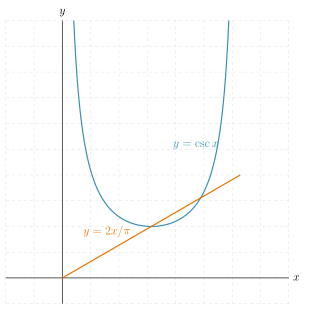
- Sketch on the same axes the functions \({\rm cosec}\, x\) and \(2x/ \pi\), for \(0 < x < \pi\,\). Deduce that the equation \(x\sin x = \pi/2 \) has exactly two roots in the interval \(0 < x < \pi\,\). Show that \[ \displaystyle \int_{\pi/2}^{\pi} \left \vert x\sin x - \frac{\pi} { 2} \right \vert \; \mathrm{d}x = 2\sin\alpha +\frac{3\pi^2} 4 - \alpha \pi -\pi -2\alpha \cos\alpha -1 \] where \(\alpha\) is the larger of the roots referred to above.
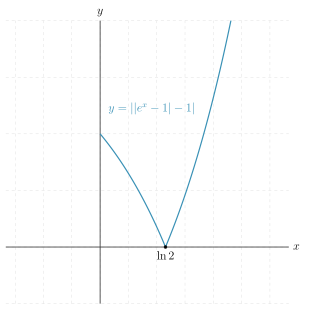
- Show that the region bounded by the positive \(x\)-axis, the \(y\)-axis and the curve \[y = \Bigl| \vert \e^x - 1 \vert - 1 \Bigr|\] has area \(\ln 4-1\).
Solution:
- \(\,\)
Notice that they are equal at \(1\) when \(x = \pi/2\), but this is a local minimum for \(\csc x\) whereas \(2x/\pi\) is increasing so there is a second intersection. Notice that \(\csc x = \frac{2x}{\pi} \Leftrightarrow x \sin x = \frac{\pi}{2}\) therefore our intersections are also the roots of \(x \sin x = \frac{\pi}{2}\) and the larger one is greater than \(\pi/2\) \begin{align*} && I &= \int_{\pi/2}^{\pi} \Bigl| x \sin x - \frac{\pi}{2} \Bigr| \d x \\ &&&= \int_{\pi/2}^{\alpha} \left ( x \sin x - \frac{\pi}{2} \right )\d x +\int_{\alpha}^{\pi} \left ( \frac{\pi}{2} -x \sin x \right) \d x \\ &&&= \left ( \pi - 2\alpha + \frac{\pi}{2}\right) \frac{\pi}{2} + \int_{\pi/2}^{\alpha} x \sin x\d x -\int_{\alpha}^{\pi} x \sin x \d x \\ &&&= \frac{3\pi^2}{4} - \alpha \pi + \left [-x \cos x \right]_{\pi/2}^{\alpha}+\left[x \cos x \right]_{\alpha}^{\pi} + \int_{\pi/2}^{\alpha} \cos x \d x - \int_{\alpha}^{\pi} \cos x \d x \\ &&&= \frac{3\pi^2}{4} - \alpha \pi -\alpha \cos \alpha -\pi -\alpha \cos \alpha+ \sin \alpha - 1+\sin \alpha \\ &&&= 2\sin \alpha + \frac{3\pi^2}{4} - \alpha \pi - 2\alpha \cos \alpha - 1 \end{align*}
- \(\,\)
\begin{align*} && A &= \int_0^{\ln 2} ||e^x-1|-1| \d x \\ &&&= \int_0^{\ln 2} |e^x-2| \d x \\ &&&=\int_0^{\ln 2} (2-e^x) \d x \\ &&&= 2 \ln 2 - \left [e^x \right]_0^{\ln 2} \\ &&&= \ln 4 - (2-1) = \ln 4 - 1 \end{align*}
2006 Paper 3 Q3
D: 1700.0
B: 1500.0
- Let \[ \tan x = \sum\limits_{n=0}^\infty a_n x^n \text{ and } \cot x = \dfrac 1 x +\sum\limits_{n=0}^\infty b_nx^n \] for \(0< x < \frac12\pi\,\). Explain why \(a_n=0\) for even \(n\). Prove the identity \[ \cot x - \tan x \equiv 2 \cot 2x\, \] and show that \[a_{n} = (1-2^{n+1})b_n\,.\]
- Let $ \displaystyle {\rm cosec}\, x = \frac1x +\sum\limits _{n=0}^\infty c_n x^n\,$ for \(0< x < \frac12\pi\,\). By considering \(\cot x + \tan x\), or otherwise, show that \[ c_n = (2^{-n} -1)b_n \,. \]
- Show that \[ \left(1+x{ \sum\limits_{n=0}^\infty} b_n x^n \right)^2 +x^2 = \left(1+x{ \sum\limits_{n=0} ^\infty} c_n x^n \right)^2\,. \] Deduce from this and the previous results that \(a_1=1\), and find \(a_3\).
Solution:
- Since \(\tan (-x) = -\tan x\), \(\tan\) is an odd function, and in particular all it's even coefficients are zero. \begin{align*} && 2 \cot 2x &\equiv \frac{2 cos 2x}{\sin 2 x} \\ &&&\equiv \frac{2(\cos^2 x- \sin^2 x)}{2 \sin x \cos x} \\ &&&\equiv \frac{\cos x}{\sin x} - \frac{\sin x}{ \cos x} \\ &&&\equiv \cot x - \tan x \end{align*} Therefore \begin{align*} && \underbrace{\frac1x + \sum_{n=0}^\infty b_nx^n}_{\cot x} - \underbrace{\sum_{n=0}^\infty a_n x^n}_{\tan x} &= 2 \left (\underbrace{\frac{1}{2x} + \sum_{n=0}^\infty b_n(2x)^n}_{\cot 2x} \right) \\ \Rightarrow && \sum_{n=0}^\infty a_n x^n &= \sum_{n=0}^\infty b_nx^n - 2\sum_{n=0}^\infty b_n(2x)^n \\ &&&= \sum_{n=0}^{\infty}b_n(1-2^{n+1})x^n \\ [x^n]: && a_n &= (1-2^{n+1})b_n \end{align*}
- \(\,\) \begin{align*} && \cot x + \tan x &= \frac{\cos x}{\sin x} + \frac{\sin x}{\cos x} \\ &&&= \frac{1}{\sin x \cos x} \\ &&&=2\cosec 2x \\ \\ \Rightarrow && \underbrace{\frac1x + \sum_{n=0}^\infty b_nx^n}_{\cot x} + \underbrace{\sum_{n=0}^\infty a_n x^n}_{\tan x} &= 2\left (\underbrace{ \frac1{2x} +\sum\limits _{n=0}^\infty c_n (2x)^n}_{\cosec 2x} \right) \\ \Rightarrow && \sum_{n=0}^\infty 2^{n+1}c_n x^n &= \sum_{n=0}^{\infty}(a_n+b_n)x^n \\ &&&= \sum_{n=0}^{\infty}\left((1-2^{n+1})b_n+ b_n\right)x^n \\ &&&= \sum_{n=0}^{\infty}\left(2-2^{n+1}\right)b_nx^n \\ [x^n]: && c_n &= (2^{-n}-1)b_n \end{align*}
- \(\,\) \begin{align*} && \cot^2 x + 1 &= \cosec^2 x \\ \Rightarrow && x^2 \cot^2 x + x^2 &= x^2 \cosec^2 x \\ \Rightarrow && x^2 \left ( \underbrace{\frac1x + \sum_{n=0}^\infty b_nx^n}_{\cot x} \right)^2 + x^2 &= x^2 \left (\underbrace{ \frac1{x} +\sum\limits _{n=0}^\infty c_n x^n}_{\cosec x} \right)^2 \\ \Rightarrow && \left ( 1 + x\sum_{n=0}^\infty b_nx^{n} \right)^2 + x^2 &= \left ( 1 +x\sum\limits _{n=0}^\infty c_n x^{n} \right)^2 \\ \\ \Rightarrow && \left ( 1 + x(b_1x + b_3 x^3 + \cdots) \right)^2 + x^2 &= \left ( 1 + x(c_1x + c_3 x^3 + \cdots) \right)^2 \\ \Rightarrow && 1 + (1+2b_1)x^2+(2b_3+b_1^2)x^4 + \cdots &= 1 + 2c_1x^2 + (2c_3+c_1^2)x^4 + \cdots \\ \Rightarrow && 1 + 2b_1 &= 2(2^{-1}-1)b_1 \\ \Rightarrow && b_1 &= -\frac13 \\ \Rightarrow && a_1 &= (1-2^{2})(-\tfrac13) = 1 \\ && c_1 &= \frac16\\ \Rightarrow && 2b_3+\frac19&= 2c_3+\frac1{36} \\ \Rightarrow && 2b_3 -2(2^{-3}-1)b_3 &= -\frac{1}{12} \\ \Rightarrow && \frac{15}{4}b_3 &= -\frac{1}{12} \\ \Rightarrow && b_3 &= -\frac{1}{45} \\ \Rightarrow && a_3 &= -(1-2^4)\frac{1}{45} = \frac13 \end{align*}
1992 Paper 3 Q8
D: 1700.0
B: 1515.1
complex numbers
De Moivre
trig identity
roots of polynomials
binomial coefficients
summation
Vieta's formulas
cot
cosec
Show that \[ \sin(2n+1)\theta=\sin^{2n+1}\theta\sum_{r=0}^{n}(-1)^{n-r}\binom{2n+1}{2r}\cot^{2r}\theta, \] where \(n\) is a positive integer. Deduce that the equation \[ \sum_{r=0}^{n}(-1)^{r}\binom{2n+1}{2r}x^{r}=0 \] has roots \(\cot^{2}(k\pi/(2n+1))\) for \(k=1,2,\ldots,n\). Show that
- sep}{3mm}
- \(\bf (i)\) \({\displaystyle \sum_{k=1}^{n}\cot^{2}\left(\frac{k\pi}{2n+1}\right)=\frac{n(2n-1)}{3}},\)
- \(\bf (ii)\) \({\displaystyle \sum_{k=1}^{n}\tan^{2}\left(\frac{k\pi}{2n+1}\right)=n(2n+1)},\)
- \(\bf (iii)\) \({\displaystyle \sum_{k=1}^{n}\mathrm{cosec}^{2}\left(\frac{k\pi}{2n+1}\right)=\frac{2n(n+1)}{3}}.\)