Problems

Filters
Clear Filters

1 problem found

1988 Paper 1 Q6
D: 1500.0 B: 1516.0

The complex numbers \(z_{1},z_{2},\ldots,z_{6}\) are represented by six distinct points \(P_{1},P_{2},\ldots,P_{6}\) in the Argand diagram. Express the following statements in terms of complex numbers:

  1. \(\overrightarrow{P_{1}P_{2}}=\overrightarrow{P_{5}P_{4}}\) and \(\overrightarrow{P_{2}P_{3}}=\overrightarrow{P_{6}P_{5}}\,\);
  2. \(\overrightarrow{P_{2}P_{4}}\) is perpendicular to \(\overrightarrow{P_{3}P_{6}}\,\).
If \((i)\) holds, show that \(\overrightarrow{P_{3}P_{4}}=\overrightarrow{P_{1}P_{6}}\,\). Suppose that the statements \((i)\) and \((ii)\) both hold, and that \(z_{1}=0,\) \(z_{2}=1,\) \(z_{3}=z,\) \(z_{5}=\mathrm{i}\) and \(z_{6}=w.\) Determine the conditions which \(\mathrm{Re}(z)\) and \(\mathrm{Re}(w)\) must satisfy in order that \(P_{1}P_{2}P_{3}P_{4}P_{5}P_{6}\) should form a convex hexagon. Find the distance between \(P_{3}\) and \(P_{6}\) when \(\tan(\angle P_{3}P_{2}P_{6})=-2/3.\)


Solution:

  1. \(\overrightarrow{P_{1}P_{2}}=\overrightarrow{P_{5}P_{4}}\) is equivalent to \(z_2 - z_1 = z_4 - z_5\). \(\overrightarrow{P_{2}P_{3}}=\overrightarrow{P_{6}P_{5}}\) is equivalent to \(z_3-z_2 = z_5 - z_6\).
  2. \(\overrightarrow{P_{2}P_{4}}\) is perpendicular to \(\overrightarrow{P_{3}P_{6}}\,\) is equivalent to \(\frac{z_4 - z_2}{z_6-z_3} \in i\mathbb{R}\)
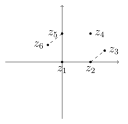
If \(z_2 - z_1 =z_4 - z_5\) and \(z_3-z_2 = z_5 - z_6\) then adding we get \(z_3 - z_1 = z_4 - z_6\) or \(z_4 - z_3 = z_6-z_1\), which is equivalent to \(\overrightarrow{P_{3}P_{4}}=\overrightarrow{P_{1}P_{6}}\,\).
TikZ diagram
\(\textrm{Re}(z) > 1, \textrm{Re}(w) < 0, \textrm{Re}(z) +\textrm{Re}(w)=1\). (We only need one of the first two constraints, since the other is implied by the former). Since \(\overrightarrow{P_{2}P_{4}}\) is perpendicular to \(\overrightarrow{P_{3}P_{6}}\,\) we must have that \(\textrm{Im}(z) = \textrm{Im}(w)\). Combined with the vector logic we must have that \(\textrm{Im}(z) = \frac12\). Let \(z = a + \frac12i\) and \(w = (1-a) + \frac12i\). Since \(w - 1 = k(3-2i)(z-1)\) (the angle constraint) we must have that: \begin{align*} &&-a+\frac12i &= k(3-2i)((a-1) \frac12i) \\ &&&= k( 3 a - 2+(\frac72 - 2 a)i) \\ \Rightarrow && \frac{3a-2}{-a} &= \frac{\frac72-2a}{\frac12} \\ \Rightarrow && 3a-2&= 4a^2-7a \\ \Rightarrow && 0 &= 4a^2-10a+2 \\ \Rightarrow && a &= \frac{5 \pm \sqrt{17}}{4} \end{align*} Since \(a > 1, a = \frac{5 +\sqrt{17}}{4}\) and the distance is: \begin{align*} \left | z - w \right | &= | a+\frac12i - ((1-a) +\frac12i ) | \\ &= |2a-1| \\ &= \frac{5+\sqrt{17}}{2}-1 \\ &= \frac{3+\sqrt{17}}{2} \end{align*}