Problems
Filters
3 problems found
2015 Paper 3 Q13
Each of the two independent random variables \(X\) and \(Y\) is uniformly distributed on the interval~\([0,1]\).
- By considering the lines \(x+y =\) \(\mathrm{constant}\) in the \(x\)-\(y\) plane, find the cumulative distribution function of \(X+Y\).
- Hence show that the probability density function \(f\) of \((X+Y)^{-1}\) is given by \[ \f(t) = \begin{cases} 2t^{-2} -t^{-3} & \text{for \( \tfrac12 \le t \le 1\)} \\ t^{-3} & \text{for \(1\le t <\infty\)}\\ 0 & \text{otherwise}. \end{cases} \] Evaluate \(\E\Big(\dfrac1{X+Y}\Big)\,\).
- Find the cumulative distribution function of \(Y/X\) and use this result to find the probability density function of \(\dfrac X {X+Y}\). Write down \(\E\Big( \dfrac X {X+Y}\Big)\) and verify your result by integration.
Solution:
- \(\mathbb{P}(X + Y \leq c) \) is the area between the \(x\)-axis, \(y\)-axis and the line \(x + y = c\). There are two cases for this: \[\mathbb{P}(X + Y \leq c) = \begin{cases} 0 & \text{ if } c \leq 0 \\ \frac{c^2}{2} & \text{ if } c \leq 1 \\ 1- \frac{(2-c)^2}{2} & \text{ if } 1 \leq c \leq 2 \\ 1 & \text{ otherwise} \end{cases}\]
- \begin{align*} && \mathbb{P}((X + Y)^{-1} \leq t) &= 1- \mathbb{P}(X + Y \leq \frac1{t}) \\ \Rightarrow && f_{(X+Y)^{-1}}(t) &= 0 -\begin{cases} 0 & \text{ if } \frac1{t} \leq 0 \\ \frac{\d}{\d t}\frac{1}{2t^2} & \text{ if } \frac{1}{t} \leq 1 \\ \frac{\d}{\d t} \l 1- \frac{(2-\frac1t)^2}{2} \r & \text{ if } 1 \leq \frac{1}{t} \leq 2 \\ 0 & \text{ otherwise}\end{cases} \\ && &= \begin{cases} t^{-3} & \text{ if } t \geq 1 \\ (2-\frac1t)t^{-2} & \text{ if } \frac12 \leq t \leq 1\\ 0 & \text{ otherwise}\end{cases} \\ && &= \begin{cases} t^{-3} & \text{ if } t \geq 1 \\ 2t^{-2}-t^{-3} & \text{ if } \frac12 \leq t \leq 1\\ 0 & \text{ otherwise}\end{cases} \end{align*} Therefore, \begin{align*} \E \Big(\dfrac1{X+Y}\Big) &= \int_{\frac12}^{\infty} t f_{(X+Y)^{-1}}(t) \, \d t \\ &= \int_{\frac12}^{1} t f_{(X+Y)^{-1}}(t) \, \d t + \int_{1}^{\infty} t f_{(X+Y)^{-1}}(t) \d t\\ &= \int_{\frac12}^{1} \l 2t^{-1} - t^{-2} \r \, \d t + \int_{1}^{\infty} t^{-2} \d t\\ &= \left [ 2 \ln (t) + t^{-1} \right]_{\frac12}^{1} + \left [ -t^{-1} \right ]_{1}^{\infty} \\ &= 1 + 2 \ln 2 -2 + 1 \\ &= 2 \ln 2 \end{align*}
- \begin{align*} &&\mathbb{P} \l \frac{Y}{X} \leq c \r &= \mathbb{P}( Y \leq c X) \\ &&&= \begin{cases} 0 & \text{if } c \leq 0 \\ \frac{c}{2} & \text{if } 0 \leq c \leq 1 \\ 1-\frac{1}{2c} & \text{if } 1 \leq c \end{cases} \\ \\ \Rightarrow && \mathbb{P} \l \frac{X}{X+Y} \leq t\r &= \mathbb{P} \l \frac{1}{1+\frac{Y}{X}} \leq t\r \\ &&&= \mathbb{P} \l \frac{1}{t} \leq 1+\frac{Y}{X}\r \\ &&&= \mathbb{P} \l \frac{1}{t} - 1\leq \frac{Y}{X}\r \\ &&&= 1- \mathbb{P} \l \frac{Y}{X} \leq \frac{1}{t} - 1\r \\ &&&= 1 - \begin{cases} 0 & \text{if } \frac1{t} \leq 0 \\ \frac{1}{2t} - \frac{1}{2} & \text{if } 0 \leq \frac1{t} \leq 1 \\ 1-\frac{t}{2-2t} & \text{if } 1 \leq \frac1{t} \end{cases} \\ && f_{\frac{X}{X+Y}}(t) &= \begin{cases} 0 & \text{if } \frac1{t} \leq 0 \\ \frac{1}{2t^2} & \text{if } t \geq 1 \\ \frac{1}{2(1-t)^2} & \text{if } 0 \leq t \leq 1 \end{cases} \\ \Rightarrow && \mathbb{E} \l \frac{X}{X+Y} \r &= \int_0^\infty t f(t) \d t \\ &&&= \int_0^1 \frac{1}{2(1-t)^2} \d t + \int_1^\infty \frac{1}{t^2} \d t \\ &&& = \frac{1}{4} + \frac{1}{4} = \frac{1}{2} \\ \\ && \mathbb{E} \l \frac{X}{X+Y} \r &= \int_0^1 \int_0^1 \frac{x}{x+y} \d y\d x \\ &&&= \int_0^1 \l x \ln (x+1) - x \ln x \r \d x \\ &&&= \left [\frac{x^2}2 \ln(x+1) - \frac{x^2}{2} \ln(x) \right]_0^1 -\int_0^1 \l \frac{x^2}{2(x+1)} - \frac{x}{2} \r \d x \\ &&&= \frac{\ln 2}{2} + \frac{1}{4} - \int_0^1 \frac{x^2-1+1}{2(x+1)}\d x \\ &&&= \frac{\ln 2}{2} + \frac{1}{4} - \int_0^1 \frac{x -1}{2} + \frac{1}{2(x+1)}\d x \\ &&&= \frac{\ln 2}{2} + \frac{1}{4} - \frac{1}{4} + \frac{1}{2} - \frac{\ln 2}{2} \\ &&&= \frac{1}{2} \end{align*} We can also notice that \(1 = \mathbb{E} \l \frac{X+Y}{X+Y} \r = \mathbb{E} \l \frac{X}{X+Y} \r + \mathbb{E} \l \frac{Y}{X+Y} \r = 2 \mathbb{E} \l \frac{X}{X+Y} \r\) so it's clearly true as long as we can show that the integral converges.
2007 Paper 2 Q14
The random variable \(X\) has a continuous probability density function \(\f(x)\) given by \begin{equation*} \f(x) = \begin{cases} 0 & \text{for } x \le 1 \\ \ln x & \text{for } 1\le x \le k\\ \ln k & \text{for } k\le x \le 2k\\ a-bx & \text{for } 2k \le x \le 4k \\ 0 & \text{for } x\ge 4k \end{cases} \end{equation*} where \(k\), \(a\) and \(b\) are constants.
- Sketch the graph of \(y=\f(x)\).
- Determine \(a\) and \(b\) in terms of \(k\) and find the numerical values of \(k\), \(a\) and \(b\).
- Find the median value of \(X\).
Solution:

- Since \(f(x)\) is continuous, \(a -bx\) joins \((2k, \ln k)\) and \((4k ,0)\). ie it has a gradient of \(\frac{-\ln k}{2k}\) and is zero at \(4k\), hence \(\displaystyle b = -\frac{\ln k}{2k}, a = 2\ln k\). The \(3\) sections have areas \(\int_1^k \ln x \d x = k \ln k -k +1\), \(k \ln k, k \ln k\). Therefore \begin{align*} &&1&= 3k\ln k - k +1 \\ \Rightarrow &&0 &= k(3\ln k - 1) \\ \Rightarrow &&\ln k &= \frac13 \\ \Rightarrow &&k &= e^{1/3} \\ && a &= \frac23 \\ && b&= -\frac16e^{-1/3} \end{align*}
- Clearly \(1 > k \ln k > \frac{1}{3}\), therefore the median must lie between \(k\) and \(2k\). So we need, \(\frac12\) to be the area of the rectangle + the triangle, ie: \begin{align*} && \frac12 &= k \ln k + (2k-M) \ln k \\ &&&= \frac13 k + \frac13 (2k - M) \\ \Rightarrow && M &= 3k - \frac32 \\ \Rightarrow && M &= 3e^{1/3} - \frac32 \end{align*}
2001 Paper 3 Q14
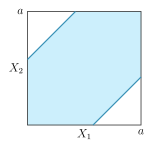
A random variable \(X\) is distributed uniformly on \([\, 0\, , \, a\,]\). Show that the variance of \(X\) is \({1 \over 12} a^2\). A sample, \(X_1\) and \(X_2\), of two independent values of the random variable is drawn, and the variance \(V\) of the sample is determined. Show that \(V = {1 \over 4} \l X_1 -X_2 \r ^2\), and hence prove that \(2 V\) is an unbiased estimator of the variance of X. Find an exact expression for the probability that the value of \(V\) is less than \({1 \over 12} a^2\) and estimate the value of this probability correct to one significant figure.
Solution: \begin{align*} && \E[X] &= \frac{a}{2}\tag{by symmetry} \\ &&\E[X^2] &= \int_0^a \frac{1}{a} x^2 \d x \\ &&&= \frac{a^3}{3a} = \frac{a^2}{3} \\ \Rightarrow && \var[X] &= \frac{a^2}{3} - \frac{a^2}{4} = \frac{a^2}{12} \\ \end{align*} \begin{align*} && V &=\frac{1}{2} \left ( \left ( X_1 - \frac{X_1+X_2}{2} \right )^2+\left ( X_2- \frac{X_1+X_2}{2} \right )^2 \right ) \\ &&&= \frac{1}{8} ((X_1 - X_2)^2 + (X_2 - X_1)^2 ) \\ &&&= \frac14 (X_1-X_2)^2 \\ \\ && \E[2V] &= \E \left [ \frac12 (X_1 - X_2)^2 \right] \\ &&&= \frac12 \E[X_1^2] - \E[X_1X_2] + \frac12 \E[X_2^2] \\ &&&= \frac{a^2}{3} - \frac{a^2}{4} = \frac{a^2}{12} \end{align*} Therefore \(2V\) is an unbiased estimator of the variance of \(X\).