Problems

Filters
Clear Filters

6 problems found

2022 Paper 2 Q9
D: 1500.0 B: 1500.0

A rectangular prism is fixed on a horizontal surface. A vertical wall, parallel to a vertical face of the prism, stands at a distance \(d\) from it. A light plank, making an acute angle \(\theta\) with the horizontal, rests on an upper edge of the prism and is in contact with the wall below the level of that edge of the prism and above the level of the horizontal plane. You may assume that the plank is long enough and the prism high enough to make this possible. The contact between the plank and the prism is smooth, and the coefficient of friction at the contact between the plank and the wall is \(\mu\). When a heavy point mass is fixed to the plank at a distance \(x\), along the plank, from its point of contact with the wall, the system is in equilibrium.

  1. Show that, if \(x = d\sec^3\theta\), then there is no frictional force acting between the plank and the wall.
  2. Show that, if \(x > d\sec^3\theta\), it is necessary that \[\mu \geqslant \frac{x - d\sec^3\theta}{x\tan\theta}\] and give the corresponding inequality if \(x < d\sec^3\theta\).
  3. Show that \[\frac{x}{d} \geqslant \frac{\sec^3\theta}{1 + \mu\tan\theta}\,.\] Show also that, if \(\mu < \cot\theta\), then \[\frac{x}{d} \leqslant \frac{\sec^3\theta}{1 - \mu\tan\theta}\,.\]
  4. Show that if \(x\) is such that the point mass is fixed to the plank somewhere between the edge of the prism and the wall, then \(\tan\theta < \mu\).

2015 Paper 1 Q11
D: 1500.0 B: 1484.0

Two long circular cylinders of equal radius lie in equilibrium on an inclined plane, in \mbox{contact} with one another and with their axes horizontal. The weights of the upper and lower \mbox{cylinders} are \(W_1\) and \(W_2\), respectively, where \(W_1>W_2\)\,. The coefficients of friction \mbox{between} the \mbox{inclined} plane and the upper and lower cylinders are \(\mu_1\) and \(\mu_2\), respectively, and the \mbox{coefficient} of friction \mbox{between} the two cylinders is \(\mu\). The angle of inclination of the plane is~\(\alpha\) (which is positive).

  1. Let \(F\) be the magnitude of the frictional force between the two cylinders, and let \(F_1\) and \(F_2\) be the magnitudes of the frictional forces between the upper cylinder and the plane, and the lower cylinder and the plane, respectively. Show that \(F=F_1=F_2\,\).
  2. Show that \[ \mu \ge \dfrac{W_1+W_2}{W_1-W_2} \,,\] and that \[ \tan\alpha \le \frac{ 2 \mu_1 W_1}{(1+\mu_1)(W_1+ W_2)}\,. \]

2013 Paper 2 Q9
D: 1600.0 B: 1485.6

The diagram shows three identical discs in equilibrium in a vertical plane. Two discs rest, not in contact with each other, on a horizontal surface and the third disc rests on the other two. The angle at the upper vertex of the triangle joining the centres of the discs is \(2\theta\).

\psset{xunit=0.7cm,yunit=0.7cm,algebraic=true,dimen=middle,dotstyle=o,dotsize=3pt 0,linewidth=0.3pt,arrowsize=3pt 2,arrowinset=0.25} \begin{pspicture*}(-7,-0.42)(7,6.86) \psline(-7,0)(7,0) \pscircle(-3,2){1.4} \pscircle(3,2){1.4} \pscircle(0,4.64){1.4} \psline(0,4.64)(-3,2) \psline(0,4.64)(3,2) \psline(0,4.64)(0,0.9) \parametricplot{-1.5707963267948966}{-0.722030440522891}{1*cos(t)+0|1*sin(t)+4.64} \rput[tl](0.16,4.25){\(\theta\)} \end{pspicture*}
\noindent The weight of each disc is \(W\). The coefficient of friction between a disc and the horizontal surface is \(\mu\) and the coefficient of friction between the discs is also \(\mu\).
  1. Show that the normal reaction between the horizontal surface and a disc in contact with the surface is \(\frac32 W\,\).
  2. Find the normal reaction between two discs in contact and show that the magnitude of the frictional force between two discs in contact is \(\dfrac{W\sin\theta}{2(1+\cos\theta)}\,\).
  3. Show that if \(\mu <2- \surd3\,\) there is no value of \(\theta\) for which equilibrium is possible.

2000 Paper 3 Q10
D: 1700.0 B: 1500.0

A sphere of radius \(a\) and weight \(W\) rests on horizontal ground. A thin uniform beam of weight \(3\sqrt3\,W\) and length \(2a\) is freely hinged to the ground at \(X\), which is a distance \({\sqrt 3} \, a\) from the point of contact of the sphere with the ground. The beam rests on the sphere, lying in the same vertical plane as the centre of the sphere. The coefficients of friction between the beam and the sphere and between the sphere and the ground are \(\mu_1\) and \(\mu_2\) respectively. Given that the sphere is on the point of slipping at its contacts with both the ground and the beam, find the values of \(\mu_1\) and \(\mu_2\).


Solution:

TikZ diagram
The first important thing to observe is the angle at \(X\) is \(60^{\circ}\). Now we can start resolving: \begin{align*} \overset{\curvearrowleft}{X}: && 3\sqrt{3} W \cos 60^{\circ} a - R_1\sqrt{3}a &= 0 \tag{\(1\)}\\ \overset{\curvearrowleft}{O}: && \mu_2 R_2 a - \mu_1R_1a &= 0 \tag{\(2\)} \\ \text{N2}(\rightarrow): && \mu_2 R_2 + \mu_1R_1 \cos 60^{\circ} - R_1 \cos 30^{\circ} &= 0 \tag{\(3\)} \\ \text{N2}(\uparrow): && R_2 - W - \mu_1 R_1 \cos 30^{\circ} - R_1 \cos 60^{\circ} &= 0 \tag{\(4\)} \\ \Rightarrow && \frac{3}{2}W &= R_1 \tag{\((5)\) from \((1)\)} \\ && \mu_1 R_1 &= \mu_2 R_2 \tag{\(2\)}\\ && \mu_1 R_1 \l 1 + \frac{1}{2} \r - R_1 \frac{\sqrt{3}}2 &= 0 \tag{\((3)\) and \((2)\)} \\ && \mu_1 &= \frac{1}{\sqrt3} \\ \\ && R_2 - W - \frac{1}{\sqrt3} \frac{3}{2}W \frac{\sqrt3}{2} - \frac{3}2W \frac12 &= 0 \\ \Rightarrow && R_2 &= W \l 1 + \frac{3}{2}\r \tag{\(6\)} \\ \Rightarrow && \mu_2 &= \frac{\mu_1 R_1}{R_2} = \frac{1}{\sqrt{3}} \frac{3}{5} = \frac{\sqrt3}{5} \tag{\((5)\) and \((6)\)} \end{align*}

1995 Paper 1 Q11
D: 1500.0 B: 1500.0

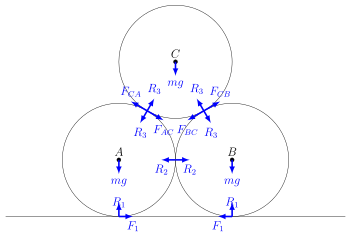
Two identical uniform cylinders, each of mass \(m,\) lie in contact with one another on a horizontal plane and a third identical cylinder rests symmetrically on them in such a way that the axes of the three cylinders are parallel. Assuming that all the surfaces in contact are equally rough, show that the minimum possible coefficient of friction is \(2-\sqrt{3}.\)


Solution:
TikZ diagram
First observe that many forces are equal by symmetry. Also notice that \(A\) and \(B\) are trying to roll in opposite directions, therefore there is no friction between \(A\) and \(B\). Considering the system as a whole \(R_1 = \frac32 mg\). \begin{align*} \text{N2}(\uparrow,C): && 0 &= -mg +2R_3\cos 30^{\circ} + 2F_{CA} \cos 60^{\circ} \\ \Rightarrow && mg &= \sqrt{3}R_3 + F_{CA} \\ \\ \text{N2}(\uparrow, A): && 0 &= -mg + \frac32mg-R_3\cos 30^{\circ} -F_{AC} \cos 60^\circ \\ \Rightarrow && mg &= \sqrt{3}R_3+F_{AC} \\ \text{N2}(\rightarrow, A): && 0 &= F_{AC}\cos 30^{\circ}+F_1-R_3 \cos 60^\circ -R_2 \\ \Rightarrow && 0 &=F_{AC}\sqrt{3}+2F_1-R_3-2R_2 \\ \overset{\curvearrowleft}{A}: && 0 &= F_1 - F_{AC} \end{align*} Since \(F_1 = F_{AC} = F_{CA}\) we can rewrite everything in terms of \(F= F_1\) so. \begin{align*} && mg &= \sqrt{3}R_3 + F \\ && 0 &= (2+\sqrt{3})F -R_3-2R_2 \\ \Rightarrow && (2+\sqrt3)F &\geq R_3 \\ \Rightarrow && F &\geq (2-\sqrt{3})R_3 \\ \Rightarrow && \mu & \geq 2 - \sqrt{3} \end{align*}

1993 Paper 2 Q12
D: 1600.0 B: 1484.0

TikZ diagram
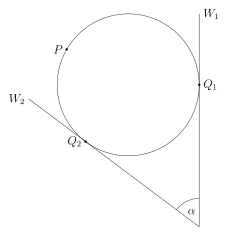
A uniform sphere of mass \(M\) and radius \(r\) rests between a vertical wall \(W_{1}\) and an inclined plane \(W_{2}\) that meets \(W_{1}\) at an angle \(\alpha.\) \(Q_{1}\) and \(Q_{2}\) are the points of contact of the sphere with \(W_{1}\) and \(W_{2}\) resectively, as shown in the diagram. A particle of mass \(m\) is attached to the sphere at \(P\), where \(PQ_{1}\) is a diameter, and the system is released. The sphere is on the point of slipping at \(Q_{1}\) and at \(Q_{2}.\) Show that if the coefficients of friction between the sphere and \(W_{1}\) and \(W_{2}\) are \(\mu_{1}\) and \(\mu_{2}\) respectively, then \[ m=\frac{\mu_{2}+\mu_{1}\cos\alpha-\mu_{1}\mu_{2}\sin\alpha}{(2\mu_{1}\mu_{2}+1)\sin\alpha+(\mu_{2}-2\mu_{1})\cos\alpha-\mu_{2}}M. \] If the sphere is on the point of rolling about \(Q_{2}\) instead of slipping, show that \[ m=\frac{M}{\sec\alpha-1}. \]


Solution:

TikZ diagram
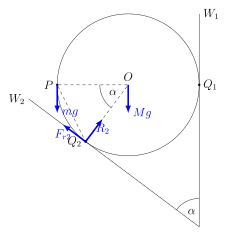
Since the sphere is on the point of slipping at both \(Q_1\) and \(Q_2\), \(F_{r1} = \mu_1 R_1\) and \(F_{r2} = \mu_2 R_2\) \begin{align*} \text{N2}(\uparrow): && -mg-Mg-\mu_1 R_1 + R_2 \sin \alpha + \mu_2 R_2 \cos \alpha &= 0 \\ \text{N2}(\rightarrow): && -R_1 + R_2 \cos \alpha - \mu_2 R_2 \sin \alpha &= 0 \\ \\ \Rightarrow && R_2 \cos \alpha - \mu_2 R_2 \sin \alpha &= R_1 \\ % && -mg-Mg+\mu_1 (R_2 \cos \alpha - \mu_2 R_2 \sin \alpha) + R_2 \sin \alpha + \mu_2 R_2 \cos \alpha &= 0 \\ % \\ \overset{\curvearrowleft}{O}: && mg - \mu_1 R_1 - \mu_2R_2 &= 0 \\ \Rightarrow && \mu_1 R_2 \l \cos \alpha - \mu_2 \sin \alpha \r - \mu_2 R_2 &= -mg \\ && \mu_1 (R_2 \cos \alpha - \mu_2 R_2 \sin \alpha) + R_2 \sin \alpha + \\ && \quad \quad \mu_2 R_2 \cos \alpha - \mu_1 R_2 \l \cos \alpha - \mu_2 \sin \alpha \r - \mu_2 R_2 &= Mg \\ \Rightarrow && \frac{\mu_2+\mu_1 \l \cos \alpha - \mu_2 \sin \alpha \r }{\mu_1 ( \cos \alpha - \mu_2 \sin \alpha) + \sin \alpha + \mu_2 \cos \alpha - \mu_1 \l \cos \alpha - \mu_2 \sin \alpha \r - \mu_2 } &= \frac{m}{M} \\ && \frac{\mu_2+\mu_1 \cos \alpha - \mu_1\mu_2 \sin \alpha }{\cos \alpha (-2\mu_1+\mu_2) + \sin \alpha (1 +2\mu_1\mu_2) -\mu_2} &= \frac{m}{M} \end{align*} If instead the sphere is about to roll about \(Q_2\), then the forces at \(Q_1\) will be \(0\), we can then take moments about \(Q_2\).
TikZ diagram
Looking at perpendicular distances from \(Q_2\) to \(O\) and \(P\) we have \(r \cos \alpha\) and \(r(1-\cos \alpha)\) \begin{align*} \overset{\curvearrowleft}{Q_2}: && mg (1 - \cos \alpha) - Mg \cos \alpha &= 0 \\ \Rightarrow && \frac{1}{\sec \alpha-1} &= \frac{m}{M} \end{align*}