Problems
Filters
4 problems found
2016 Paper 3 Q10
A smooth plane is inclined at an angle \(\alpha\) to the horizontal. A particle \(P\) of mass \(m\) is attached to a fixed point \(A\) above the plane by a light inextensible string of length \(a\). The particle rests in equilibrium on the plane, and the string makes an angle \(\beta\) with the plane. The particle is given a horizontal impulse parallel to the plane so that it has an initial speed of \(u\). Show that the particle will not immediately leave the plane if \(ag\cos(\alpha + \beta)> u^2 \tan\beta\). Show further that a necessary condition for the particle to perform a complete circle whilst in contact with the plane is \(6\tan\alpha \tan \beta < 1\).
2014 Paper 3 Q11
A particle \(P\) of mass \(m\) is connected by two light inextensible strings to two fixed points \(A\) and \(B\), with \(A\) vertically above \(B\). The string \(AP\) has length \(x\). The particle is rotating about the vertical through \(A\) and \(B\) with angular velocity \(\omega\), and both strings are taut. Angles \(PAB\) and \(PBA\) are \(\alpha\) and \(\beta\), respectively. Find the tensions \(T_A\) and \(T_B\) in the strings \(AP\) and \(BP\) (respectively), and hence show that \(\omega^2 x\cos\alpha \ge g\). Consider now the case that \(\omega^2 x\cos\alpha = g\). Given that \(AB=h\) and \(BP=d\), where \(h>d\), show that \(h\cos\alpha \ge \sqrt{h^2-d^2}\). Show further that \[ mg < T_A \le \frac{mgh}{\sqrt{h^2-d^2}\,}\,. \] Describe the geometry of the strings when \(T_A\) attains its upper bound.
Solution:


1997 Paper 1 Q10
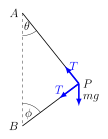
The point \(A\) is vertically above the point \(B\). A light inextensible string, with a smooth ring \(P\) of mass \(m\) threaded onto it, has its ends attached at \(A\) and \(B\). The plane \(APB\) rotates about \(AB\) with constant angular velocity \(\omega\) so that \(P\) describes a horizontal circle of radius \(r\) and the string is taut. The angle \(BAP\) has value \(\theta\) and the angle \(ABP\) has value \(\phi\). Show that \[\tan\frac{\phi-\theta}{2}=\frac{g}{r\omega^{2}}.\] Find the tension in the string in terms of \(m\), \(g\), \(r\), \(\omega\) and \(\sin\frac{1}{2}(\theta+\phi)\). Deduce from your results that if \(r\omega^2\) is small compared with \(g\), then the tension is approximately \(\frac{mg}{2}\)
Solution: None \begin{multicols}{2}
1994 Paper 1 Q10
One end \(A\) of a light elastic string of natural length \(l\) and modulus of elasticity \(\lambda\) is fixed and a particle of mass \(m\) is attached to the other end \(B\). The particle moves in a horizontal circle with centre on the vertical through \(A\) with angular velocity \(\omega.\) If \(\theta\) is the angle \(AB\) makes with the downward vertical, find an expression for \(\cos\theta\) in terms of \(m,g,l,\lambda\) and \(\omega.\) Show that the motion described is possible only if \[ \frac{g\lambda}{l(\lambda+mg)}<\omega^{2}<\frac{\lambda}{ml}. \]