Problems
Filters
1 problem found
2008 Paper 2 Q4
A curve is given by \[x^2+y^2 +2axy = 1,\] where \(a\) is a constant satisfying \(0 < a < 1\). Show that the gradient of the curve at the point \(P\) with coordinates \((x,y)\) is \[\displaystyle - \frac {x+ay}{ax+y}\,,\] provided \(ax+y \ne0\). Show that \(\theta\), the acute angle between \(OP\) and the normal to the curve at \(P\), satisfies \[ \tan\theta = a\vert y^2-x^2\vert\;. \] Show further that, if \(\ \displaystyle \frac{\d \theta}{\d x}=0\) at \(P\), then:
- \(a(x^2+y^2)+2xy=0\,\);
- \((1+a)(x^2+y^2+2xy)=1\,\);
- \(\displaystyle \tan\theta = \frac a{\sqrt{1-a^2}}\,\).
Solution: \begin{align*} && 1 &= x^2 + y^2 + 2axy \\ \frac{\d}{\d x}: && 0 &= 2x + 2y \frac{\d y}{\d x} + 2ay + 2ax \frac{\d y}{\d x} \\ &&&= (2x+2ay) + \frac{\d y}{\d x} \left (2ax + 2y \right) \\ \Rightarrow && \frac{\d y}{\d x} &= -\frac{x+ay}{ax+y} \end{align*}
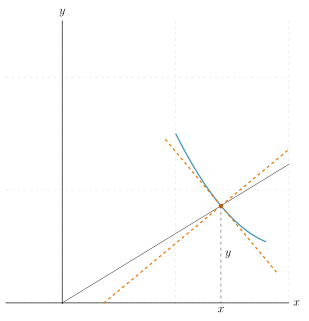
- \(\,\) \begin{align*} && \sec^2 \theta \frac{\d \theta}{\d x} &= \pm a \left (2y \frac{\d y}{\d x} - 2 x\right) \\ \Rightarrow && 0 &= a \left (y \cdot \frac{x+ay}{ax+y} + x \right) \\ &&&=a \left ( \frac{xy+ay^2+ax^2+xy}{ax+y} \right) \\ \Rightarrow && 0 &= a(x^2+y^2)+2xy \end{align*}
- \(\,\) \begin{align*} && 0 &=a(x^2+y^2)+2xy \\ && 1 &= x^2+y^2 + 2axy \\ \Rightarrow && 1 &= (a+1)(x^2+y^2) + (a+1)(2xy) \\ &&&= (a+1)(x^2+y^2+2xy) \end{align*}
- \(\,\) \begin{align*} && 1 &= (a+1)(x+y)^2 \\ \Rightarrow && x +y &= \pm \frac{1}{\sqrt{1+a}} \\ && 0 &=a(x^2+y^2)+2xy \\ && 1 &= x^2+y^2 + 2axy \\ \Rightarrow && 1 &= (1-a)(x^2+y^2) + (a-1)(2xy) \\ &&&= (1-a)(x^2+y^2-2xy)\\ \Rightarrow && x-y &= \pm \frac{1}{\sqrt{1-a}} \\ \Rightarrow && \frac{\d \theta}{\d x} &= a|y^2-x^2| \\ &&&= a|(y-x)(x+y)| \\ &&&= \frac{a}{\sqrt{1-a^2}} \end{align*}