Problems
Filters
86 problems found
2025 Paper 3 Q12
- Show that, for any functions \(f\) and \(g\), and for any \(m \geq 0\), $$\sum_{r=1}^{m+1} f(r)\sum_{s=r-1}^m g(s) = \sum_{s=0}^m g(s)\sum_{r=1}^{s+1} f(r)$$
- The random variables \(X_0, X_1, X_2, \ldots\) are defined as follows:
- \(X_0\) takes the value \(0\) with probability \(1\);
- \(X_{n+1}\) takes the values \(0, 1, \ldots, X_n + 1\) with equal probability, for \(n = 0, 1, \ldots\)
- Write down \(E(X_1)\). Find \(P(X_2 = 0)\) and \(P(X_2 = 1)\) and show that \(P(X_2 = 2) = \frac{1}{6}\). Hence calculate \(E(X_2)\).
- For \(n \geq 1\), show that $$P(X_n = 0) = \sum_{s=0}^{n-1} \frac{P(X_{n-1} = s)}{s+2}$$ and find a similar expression for \(P(X_n = r)\), for \(r = 1, 2, \ldots, n\).
- Hence show that \(E(X_n) = \frac{1}{2}(1 + E(X_{n-1}))\). Find an expression for \(E(X_n)\) in terms of \(n\), for \(n = 1, 2, \ldots\)
Solution:
- \begin{align*} \sum_{r=1}^{m+1} \left (f(r) \sum_{s=r-1}^m g(s) \right) &= \sum_{r=1}^{m+1} \sum_{s=r-1}^m f(r)g(s) \\ &= \sum_{(r,s) \in \{(r,s) : 1 \leq r \leq m+1, 0 \leq s \leq m, s \geq r-1\}} f(r)g(s) \\ &= \sum_{(r,s) \in \{(r,s) : 0 \leq s \leq m, 1 \leq r \leq m+1, r \leq s+1\}} f(r)g(s) \\ &= \sum_{s=0}^m \sum_{r=1}^{s+1} f(r)g(s) \\ &= \sum_{s=0}^m \left ( g(s) \sum_{r=1}^{s+1} f(r) \right) \end{align*}
- \(X_1\) takes the values \(0, 1\) with equal probabilities (since \(X_0 = 0\)). Therefore \(\mathbb{E}(X_1) = \frac12\).
- \begin{align*} \mathbb{P}(X_2 = 0) &= \mathbb{P}(X_2 = 0 | X_1 = 0) \mathbb{P}(X_1 = 0) + \mathbb{P}(X_2 = 0 | X_1 = 1) \mathbb{P}(X_1 = 1) \\ &= \frac12 \cdot \frac12 + \frac13 \cdot \frac12 \\ &= \frac5{12} \\ \\ \mathbb{P}(X_2 = 1) &= \mathbb{P}(X_2 = 1 | X_1 = 0) \mathbb{P}(X_1 = 0) + \mathbb{P}(X_2 = 1 | X_1 = 1) \mathbb{P}(X_1 = 1) \\ &= \frac12 \cdot \frac12 + \frac13 \cdot \frac12 \\ &= \frac5{12} \\ \\ \mathbb{P}(X_2 = 3) &= 1 - \mathbb{P}(X_2 = 0) - \mathbb{P}(X_2 = 1) \\ &= 1 - \frac{10}{12} = \frac16 \\ \\ \mathbb{E}(X_2) &= \frac{5}{12} + 2\cdot \frac{1}{6} \\ &= \frac34 \end{align*}
- \begin{align*} \mathbb{P}(X_n = 0) &= \sum_{s=0}^{n-1} \mathbb{P}(X_n = 0 | X_{n-1} = s)\mathbb{P}(X_{n-1} = s) \\ &= \sum_{s=0}^{n-1} \frac{1}{s+2}\mathbb{P}(X_{n-1} = s) \\ \end{align*} as required. (Where \(\mathbb{P}(X_n = 0 | X_{n-1} = s) = \frac{1}{s+2}\) since if \(X_{n-1} = s\) there are \(0, 1, \ldots, s + 1\) values \(X_n\) can take with equal chance (ie \(s+2\) different values). \begin{align*} \mathbb{P}(X_n = r) &= \sum_{s=0}^{n-1} \mathbb{P}(X_n = r | X_{n-1} = s)\mathbb{P}(X_{n-1} = s) \\ &= \sum_{s=r-1}^{n-1} \frac{\mathbb{P}(X_{n-1}=s)}{s+2} \end{align*}
- \begin{align*} \mathbb{E}(X_n) &= \sum_{r=1}^{n} r \cdot \mathbb{P}(X_n = r) \\ &= \sum_{r=1}^{n} r \cdot \sum_{s=r-1}^{n-1} \frac{\mathbb{P}(X_{n-1}=s)}{s+2} \\ &= \sum_{s=0}^{n-1} \frac{\mathbb{P}(X_{n-1}=s)}{s+2} \sum_{r=1}^{s+1} r \\ &= \sum_{s=0}^{n-1} \frac{\mathbb{P}(X_{n-1}=s)}{s+2} \frac{(s+1)(s+2)}{2} \\ &= \frac12 \sum_{s=0}^{n-1} (s+1)\mathbb{P}(X_{n-1}=s) \\ &= \frac12 \sum_{s=0}^{n-1} s\mathbb{P}(X_{n-1}=s) + \frac12 \sum_{s=0}^{n-1} \mathbb{P}(X_{n-1}=s) \\\\ &= \frac12 \left ( \mathbb{E}(X_{n-1}) + 1 \right) \end{align*} Suppose \(\mathbb{E}(X_n) = 1-2^{-n}\), then notice that this expression matches for \(n = 0, 1, 2\) and also: \(\frac12(1 - 2^{-n} + 1) = 1-2^{-n-1}\) satisfies the recusive formula. Therefore by induction (or similar) we can show that \(\mathbb{E}(X_n) = 1- 2^{-n}\).
2024 Paper 2 Q12
In this question, you may use without proof the results \[ \sum_{i=1}^{n} i^2 = \tfrac{1}{6}n(n+1)(2n+1) \quad \text{and} \quad \sum_{i=1}^{n} i^3 = \tfrac{1}{4}n^2(n+1)^2. \] Throughout the question, \(n\) and \(k\) are integers with \(n \geqslant 3\) and \(k \geqslant 2\).
- In a game, \(k\) players, including Ada, are each given a random whole number from \(1\) to \(n\) (that is, for each player, each of these numbers is equally likely and assigned independently of all the others). A player wins the game if they are given a smaller number than all the other players, so there may be no winner in this game. Find an expression, in terms of \(n\), \(k\) and \(a\), for the probability that Ada is given number \(a\), where \(1 \leqslant a \leqslant n-1\), and all the other players are given larger numbers. Hence show that, if \(k = 4\), the probability that there is a winner in this game is \[ \frac{(n-1)^2}{n^2}\,. \]
- In a second game, \(k\) players, including Ada and Bob, are each given a random whole number from \(1\) to \(n\). A player wins the game if they are given a smaller number than all the other players or if they are given a larger number than all the other players, so it is possible for there to be zero, one or two winners in this game. Find an expression, in terms of \(n\), \(k\) and \(d\), for the probability that Ada is given number \(a\) and Bob is given number \(a + d + 1\), where \(1 \leqslant d \leqslant n-2\) and \(1 \leqslant a \leqslant n - d - 1\), and all the other players are given numbers greater than \(a\) and less than \(a + d + 1\). Hence show that, if \(k = 4\), the probability that there are two winners in this game is \[ \frac{(n-2)(n-1)^2}{n^3}\,. \] If \(k = 4\), what is the minimum value of \(n\) for which there are more likely to be exactly two winners than exactly one winner in this game?
Solution:
- Suppose Ada is given \(a\), then she wins if the other \(k-1\) players all get a number between \(a+1\) and \(n\). Since each of these choices are independent, this occurs with probability: \begin{align*} && \mathbb{P}(\text{Ada wins with }a) &= \left ( \frac{n-a}{n} \right)^{k-1} \\ \\ && \mathbb{P}(\text{Ada wins}) &= \sum_{a=1}^{n-1} \mathbb{P}(\text{Ada wins with }a) \mathbb{P}(\text{Ada has }a) \\ &&&= \sum_{a=1}^{n-1}\frac{1}{n}\left ( \frac{n-a}{n} \right)^{3}\\ &&&= \frac{1}{n^4} \sum_{a=1}^{n-1} (n-a)^3 \\ &&&= \frac{1}{n^4} \sum_{a=1}^{n-1} a^3 \\ &&&= \frac{1}{n^4} \tfrac14(n-1)^2n^2 \\ &&&= \frac{(n-1)^2}{4n^2} \end{align*} Since each the game is symmetric, each player is equally likely to win, therefore the probability anyone wins is \(\displaystyle \frac{(n-1)^2}{n^2}\)
- The probability that Ada gets \(a\), Bob gets \(a+d+1\) and the other players are in between is \begin{align*} && \mathbb{P}(\text{event}) &= \mathbb{P}(\text{Ada gets }a) \mathbb{P}(\text{Bob gets }a+d+1) \mathbb{P}(\text{everyone else between}) \\ &&&= \frac1{n^2} \cdot \left ( \frac{d}{n} \right) ^{k-2} \end{align*} Therefore the probability that Ada and Bob jointly win is \begin{align*} && \mathbb{P}(\text{Ada and Bob win}) &= \sum_{d=1}^{n-2} \sum_{a=1}^{n-d-1} \frac{1}{n^4} d^2 \\ &&&= \frac{1}{n^4} \sum_{d=1}^{n-2} (n-1-d) d^2 \\ &&&= \frac{n-1}{n^4} \frac{(n-2)(n-1)(2n-3)}{6} - \frac{1}{n^4} \frac{(n-2)^2(n-1)^2}{4} \\ &&&= \frac{(n-1)^2(n-2)}{12n^4} \left ( 2(2n-3)-3(n-2) \right) \\ &&&= \frac{(n-1)^2(n-2)}{12n^3} \\ \end{align*} There are \(4\) players so there are \(4\) ways to choose the lowest player and \(3\) remaining ways to choose the highest, so we get \(\displaystyle \frac{(n-2)(n-1)^2}{n^3}\) probability of a winner happening. The probability of there being a highest winner is the same as the probability of there being a lowest winner (both \(\frac{(n-1)^2}{n^2}\)) and the probability of there being exactly one winner is therefore \begin{align*} && P_1 &= P_{\geq1}-P_2+P_{\geq1}-P_2 \\ \end{align*} this is less than \(P_2\) iff \begin{align*} && P_{\geq1}+P_{\geq1}-2P_2 &< P_2 \\ \Leftrightarrow && 2P_{\geq 1} & < 3P_2 \\ \Leftrightarrow && \frac{2(n-1)^2}{n^2} &< \frac{3(n-1)^2(n-2)}{n^3} \\ \Leftrightarrow && 2n&<3(n-2) \\ \Leftrightarrow && 6 &< n \end{align*} So \(n = 7\)
2023 Paper 3 Q11
Show that \[\sum_{k=1}^{\infty} \frac{k+1}{k!}\, x^k = (x+1)\mathrm{e}^x - 1\,.\] In the remainder of this question, \(n\) is a fixed positive integer.
- Random variable \(Y\) has a Poisson distribution with mean \(n\). One observation of \(Y\) is taken. Random variable \(D\) is defined as follows. If the observed value of \(Y\) is zero then \(D = 0\). If the observed value of \(Y\) is \(k\), where \(k \geqslant 1\), then a fair \(k\)-sided die (with sides numbered \(1\) to \(k\)) is rolled once and \(D\) is the number shown on the die.
- Write down \(\mathrm{P}(D = 0)\).
- Show, from the definition of the expectation of a random variable, that \[\mathrm{E}(D) = \sum_{d=1}^{\infty} \left[ d \sum_{k=d}^{\infty} \left( \frac{1}{k} \cdot \frac{n^k}{k!}\, \mathrm{e}^{-n} \right) \right].\] Show further that \[\mathrm{E}(D) = \sum_{k=1}^{\infty} \left( \frac{1}{k} \cdot \frac{n^k}{k!}\, \mathrm{e}^{-n} \sum_{d=1}^{k} d \right).\]
- Show that \(\mathrm{E}(D) = \frac{1}{2}(n + 1 - \mathrm{e}^{-n})\).
- Random variables \(X_1, X_2, \ldots, X_n\) all have Poisson distributions. For each \(k \in \{1, 2, \ldots, n\}\), the mean of \(X_k\) is \(k\).
A fair \(n\)-sided die, with sides numbered \(1\) to \(n\), is rolled. When \(k\) is the number shown, one observation of \(X_k\) is recorded. Let \(Z\) be the number recorded.
- Find \(\mathrm{P}(Z = 0)\).
- Show that \(\mathrm{E}(Z) > \mathrm{E}(D)\).
2022 Paper 2 Q11
A batch of \(N\) USB sticks is to be used on a network. Each stick has the same unknown probability \(p\) of being infected with a virus. Each stick is infected, or not, independently of the others. The network manager decides on an integer value of \(T\) with \(0 \leqslant T < N\). If \(T = 0\) no testing takes place and the \(N\) sticks are used on the network, but if \(T > 0\), the batch is subject to the following procedure.
- Each of \(T\) sticks, chosen at random from the batch, undergoes a test during which it is destroyed.
- If any of these \(T\) sticks is infected, all the remaining \(N - T\) sticks are destroyed.
- If none of the \(T\) sticks is infected, the remaining \(N - T\) sticks are used on the network.
- Find an expression in terms of \(N\), \(T\), \(D\) and \(q\), where \(q = 1 - p\), for the expected net loss.
- Let \(\alpha = \dfrac{DT}{N(N - T + D)}\). Show that \(0 \leqslant \alpha < 1\). Show that, for fixed values of \(N\), \(D\) and \(T\), the greatest value of the expected net loss occurs when \(q\) satisfies the equation \(q^{N-T} = \alpha\). Show further that this greatest value is \(\pounds\dfrac{D(N-T)\,\alpha^k}{N}\), where \(k = \dfrac{T}{N-T}\).
- For fixed values of \(N\) and \(D\), show that there is some \(\beta > 0\) so that for all \(p < \beta\), the expression for the expected loss found in part (i) is an increasing function of \(T\). Deduce that, for small enough values of \(p\), testing no sticks minimises the expected net loss.
2021 Paper 2 Q11
A train has \(n\) seats, where \(n \geqslant 2\). For a particular journey, all \(n\) seats have been sold, and each of the \(n\) passengers has been allocated a seat. The passengers arrive one at a time and are labelled \(T_1, \ldots, T_n\) according to the order in which they arrive: \(T_1\) arrives first and \(T_n\) arrives last. The seat allocated to \(T_r\) (\(r = 1, \ldots, n\)) is labelled \(S_r\). Passenger \(T_1\) ignores their allocation and decides to choose a seat at random (each of the \(n\) seats being equally likely). However, for each \(r \geqslant 2\), passenger \(T_r\) sits in \(S_r\) if it is available or, if \(S_r\) is not available, chooses from the available seats at random.
- Let \(P_n\) be the probability that, in a train with \(n\) seats, \(T_n\) sits in \(S_n\). Write down the value of \(P_2\) and find the value of \(P_3\).
- Explain why, for \(k = 2, 3, \ldots, n-1\), \[ \mathrm{P}\bigl(T_n \text{ sits in } S_n \mid T_1 \text{ sits in } S_k\bigr) = P_{n-k+1}, \] and deduce that, for \(n \geqslant 3\), \[ P_n = \frac{1}{n}\Biggl(1 + \sum_{r=2}^{n-1} P_r\Biggr). \]
- Give the value of \(P_n\) in its simplest form and prove your result by induction.
- Let \(Q_n\) be the probability that, in a train with \(n\) seats, \(T_{n-1}\) sits in \(S_{n-1}\). Determine \(Q_n\) for \(n \geqslant 2\).
2021 Paper 2 Q12
- A game for two players, \(A\) and \(B\), can be won by player \(A\), with probability \(p_A\), won by player \(B\), with probability \(p_B\), where \(0 < p_A + p_B < 1\), or drawn. A match consists of a series of games and is won by the first player to win a game. Show that the probability that \(A\) wins the match is \[ \frac{p_A}{p_A + p_B}. \]
- A second game for two players, \(A\) and \(B\), can be won by player \(A\), with probability~\(p\), or won by player \(B\), with probability \(q = 1 - p\). A match consists of a series of games and is won by the first player to have won two more games than the other. Show that the match is won after an even number of games, and that the probability that \(A\) wins the match is \[ \frac{p^2}{p^2 + q^2}. \]
- A third game, for only one player, consists of a series of rounds. The player starts the game with one token, wins the game if they have four tokens at the end of a round and loses the game if they have no tokens at the end of a round. There are two versions of the game. In the cautious version, in each round where the player has any tokens, the player wins one token with probability \(p\) and loses one token with probability \(q = 1 - p\). In the bold version, in each round where the player has any tokens, the player's tokens are doubled in number with probability \(p\) and all lost with probability \(q = 1 - p\). In each of the two versions of the game, find the probability that the player wins. Hence show that the player is more likely to win in the cautious version if \(1 > p > \tfrac{1}{2}\) and more likely to win in the bold version if \(0 < p < \tfrac{1}{2}\).
2020 Paper 2 Q11
A coin is tossed repeatedly. The probability that a head appears is \(p\) and the probability that a tail appears is \(q = 1 - p\).
- A and B play a game. The game ends if two successive heads appear, in which case A wins, or if two successive tails appear, in which case B wins. Show that the probability that the game never ends is \(0\). Given that the first toss is a head, show that the probability that A wins is \(\dfrac{p}{1 - pq}\). Find and simplify an expression for the probability that A wins.
- A and B play another game. The game ends if three successive heads appear, in which case A wins, or if three successive tails appear, in which case B wins. Show that \[\mathrm{P}(\text{A wins} \mid \text{the first toss is a head}) = p^2 + (q + pq)\,\mathrm{P}(\text{A wins} \mid \text{the first toss is a tail})\] and give a similar result for \(\mathrm{P}(\text{A wins} \mid \text{the first toss is a tail})\). Show that \[\mathrm{P}(\text{A wins}) = \frac{p^2(1-q^3)}{1-(1-p^2)(1-q^2)}.\]
- A and B play a third game. The game ends if \(a\) successive heads appear, in which case A wins, or if \(b\) successive tails appear, in which case B wins, where \(a\) and \(b\) are integers greater than \(1\). Find the probability that A wins this game. Verify that your result agrees with part (i) when \(a = b = 2\).
2019 Paper 3 Q11
The number of customers arriving at a builders' merchants each day follows a Poisson distribution with mean \(\lambda\). Each customer is offered some free sand. The probability of any given customer taking the free sand is \(p\).
- Show that the number of customers each day who take sand follows a Poisson distribution with mean \(p\lambda\).
- The merchant has a mass \(S\) of sand at the beginning of the day. Each customer who takes the free sand gets a proportion \(k\) of the remaining sand, where \(0 \leq k < 1\). Show that by the end of the day the expected mass of sand taken is $$\left(1 - e^{-kp\lambda}\right)S.$$
- At the beginning of the day, the merchant's bag of sand contains a large number of grains, exactly one of which is made from solid gold. At the end of the day, the merchant's assistant takes a proportion \(k\) of the remaining sand. Find the probability that the assistant takes the golden grain. Comment on the case \(k = 0\) and on the limit \(k \to 1\). In the case \(p\lambda > 1\) find the value of \(k\) which maximises the probability that the assistant takes the golden grain.
Solution:
- Let \(X\) be the number of people arriving on a given day, and \(Y\) be the number taking sand, then \begin{align*} && \mathbb{P}(Y = k) &= \sum_{x=k}^{\infty} \mathbb{P}(x \text{ arrive and }k\text{ of them take sand}) \\ &&&= \sum_{x=k}^{\infty} \mathbb{P}(X=x)\mathbb{P}(k \text{ out of }x\text{ of them take sand})\\ &&&= \sum_{x=k}^{\infty} e^{-\lambda} \frac{\lambda^x}{x!}\binom{x}{k}p^k(1-p)^{x-k}\\ &&&= e^{-\lambda} \left ( \frac{p}{1-p} \right)^k \sum_{x=k}^{\infty} \frac{((1-p)\lambda)^x}{k!(x-k)!} \\ &&&= e^{-\lambda} \left ( \frac{p}{1-p} \right)^k \frac{((1-p)\lambda)^k}{k!} \sum_{x=0}^{\infty} \frac{((1-p)\lambda)^x}{x!} \\ &&&= e^{-\lambda} \left ( \frac{p}{1-p} \right)^k \frac{((1-p)\lambda)^k}{k!}e^{(1-p)\lambda)} \\ &&&= e^{-p\lambda} \frac{(p\lambda)^k}{k!} \end{align*} which is precisely a Poisson with parameter \(p\lambda\). Alternatively, \(Y = B_1 + B_2 + \cdots + B_X\) where \(B_i \sim Bernoulli(p)\) so \(G_Y(t) = G_X(G_B(t)) = G_X(1-p+pt) = e^{-\lambda(1-(1-p+pt))} = e^{-p\lambda(1-t)}\) so \(Y \sim Po(\lambda)\) Alternatively, alternatively, let \(Z\) be the number of people not taking sand, so \begin{align*} && \mathbb{P}(Y = y, Z= z) &= \mathbb{P}(X=y+z) \cdot \binom{y+z}{y} p^y(1-p)^z \\ &&&= e^{-\lambda} \frac{\lambda^{y+z}}{(y+z)!} \frac{(y+z)!}{y!z!} p^y(1-p)^z \\ &&&=\left ( e^{-p\lambda} \frac{(p\lambda)^y}{y!} \right) \cdot \left ( e^{-(1-p)\lambda} \frac{((1-p)\lambda)^z}{z!}\right) \end{align*} So clearly \(Y\) and \(Z\) are both (independent!) Poisson with parameters \(p\lambda \) and \((1-p)\lambda\)
- The amount taken is \(Sk + S(1-k)k + \cdots +Sk(1-k)^{Y-1} = Sk\cdot \frac{1-(1-k)^Y}{k} = S(1-(1-k)^Y)\) so \begin{align*} \E[\text{taken sand}] &= \E \left [ S(1-(1-k)^Y)\right] \\ &= S-S\E\left [(1-k)^Y \right] \\ &= S - SG_Y(1-k)\\ &=S - Se^{-p\lambda(1-(1-k))} \tag{pgf for Poisson} \\ &= S\left (1-e^{-kp\lambda} \right) \end{align*}
- The fraction of grains the assistant takes home is: \((1-k)^Yk\), which has expected value \(ke^{-kp\lambda}\). This the the probability he takes home the golden grain. When \(k = 0\) the probability is \(0\) which makes sense (no-one takes home any sand, including the merchant's assistant). As \(k \to 1\) we get \(e^{-p\lambda}\) which is the probability that no-one gets any sand other than him. \begin{align*} && \frac{\d }{\d k} \left ( ke^{-kp\lambda} \right) &= e^{-kp\lambda} - (p\lambda)ke^{-kp\lambda} \\ &&&= e^{-kp\lambda}(1 - (p\lambda)k) \end{align*} Therefore maximised at \(k = \frac{1}{p\lambda}\). (Clearly this is a maximum just by sketching the function)
2018 Paper 1 Q12
A multiple-choice test consists of five questions. For each question, \(n\) answers are given (\(n\ge2\)) only one of which is correct and candidates either attempt the question by choosing one of the \(n\) given answers or do not attempt it. For each question attempted, candidates receive two marks for the correct answer and lose one mark for an incorrect answer. No marks are gained or lost for questions that are not attempted. The pass mark is five. Candidates A, B and C don't understand any of the questions so, for any question which they attempt, they each choose one of the \(n\) given answers at random, independently of their choices for any other question.
- Candidate A chooses in advance to attempt exactly \(k\) of the five questions, where \(k=0, 1, 2, 3, 4\) or \(5\). Show that, in order to have the greatest probability of passing the test, she should choose \(k=4\,\).
- Candidate B chooses at random the number of questions he will attempt, the six possibilities being equally likely. Given that Candidate B passed the test find, in terms of \(n\), the probability that he attempted exactly four questions. [Not on original test: Show that this probability is an increasing function of \(n\).]
- For each of the five questions Candidate C decides whether to attempt the question by tossing a biased coin. The coin has a probability of \(\frac n{n+1}\) of showing a head, and she attempts the question if it shows a head. Find the probability, in terms of \(n\), that Candidate C passes the test.
Solution:
- Her probability of passing if she answers \(k \leq 2\) is \(0\), since she can attain at most \(4\) marks. If she attempts \(3\) questions, she needs to get all of them right, hence \(\mathbb{P}(\text{gets all }3\text{ correct}) = \frac{1}{n^3}\). If she attempts \(4\) questions, we can afford to get one wrong \begin{align*} && \mathbb{P}(\text{passes}|\text{attempts }4) &=\mathbb{P}(4/4) +\mathbb{P}(3/4) \\ &&&= \frac{1}{n^4} + 4\cdot\frac{1}{n^3} \cdot \frac{n-1}{n} \\ &&&= \frac{4n-3}{n^4} \end{align*} If she attempts \(5\) questions she can get \(5\) right (10), \(4\) right, \(1\) wrong (7), but \(3\) right will not work (\(6 - 2 = 4< 5\)), hence: \begin{align*} && \mathbb{P}(\text{passes}|\text{attempts }5) &=\mathbb{P}(5/5) +\mathbb{P}(4/5) \\ &&&= \frac{1}{n^5} + 5\cdot\frac{1}{n^4} \cdot \frac{n-1}{n} \\ &&&= \frac{5n-4}{n^5} \end{align*} If \(4n-3 > n \Leftrightarrow n \geq 2\) then \(4\) attempts is better than \(3\). If \(4n^2-3n > 5n-4 \Leftrightarrow 4n^2-8n+4 = 4(n-1)^2 > 0 \Leftrightarrow n \geq\) then \(4\) is better than \(5\), but \(n\) is \(\geq 2\) so, \(4\) is the best option.
- \(\,\) \begin{align*} && \mathbb{P}(\text{passes}) &= \frac16 \cdot 0 + \frac16 \cdot 0 + \frac16 \cdot 0 + \frac16 \cdot \frac1{n^3} + \frac16 \frac{4n-3}{n^4} + \frac16 \frac{5n-4}{n^5} \\ &&&= \frac{n^2+4n^2-3n+5n-4}{6n^5} \\ &&&= \frac{5n^2+2n-4}{6n^5} \\ && \mathbb{P}(\text{answered }4|\text{passes}) &= \frac{\mathbb{P}(\text{answered }4\text{ and passes})}{ \mathbb{P}(\text{passes})} \\ &&&= \frac{\frac16 \cdot \frac{4n-3}{n^4}}{\frac{5n^2-2n-4}{6n^5} } \\ &&&= \frac{4n^2-3n}{5n^2+2n-4} \end{align*} Notice that the function takes all values for \(n\) between the roots of the denominator (which are either side of \(0\) and below \(3/4\). Therefore after \(3/4\) the function must be increase since otherwise we would have a quadratic equation with more than \(2\) roots.
- \(\,\) \begin{align*} &&\mathbb{P}(C \text{ passes}) &= \binom{5}{3} \left ( \frac{n}{n+1} \right)^3 \left ( \frac{1}{n+1}\right)^2 \frac{1}{n^3} + \binom{5}{4} \left ( \frac{n}{n+1} \right)^4 \left ( \frac{1}{n+1}\right) \frac{4n-3}{n^4} +\\ &&&\quad \quad + \binom{5}{5} \left ( \frac{n}{n+1} \right)^5 \frac{5n-4}{n^5} \\ &&&= \frac{10}{(n+1)^5} + \frac{5(4n-3)}{(n+1)^5} + \frac{(5n-4)}{(n+1)^5} \\ &&&= \frac{10+20n-15+5n-4}{(n+1)^5}\\ &&&= \frac{25n-9}{(n+1)^5}\\ \end{align*}
2017 Paper 1 Q13
I have a sliced loaf which initially contains \(n\) slices of bread. Each time I finish setting a STEP question, I make myself a snack: either toast, using one slice of bread; or a sandwich, using two slices of bread. I make toast with probability \(p\) and I make a sandwich with probability \(q\), where \(p+q=1\), unless there is only one slice left in which case I must, of course, make toast. Let \(s_r\) (\(1 \le r \le n\)) be the probability that the \(r\)th slice of bread is the second of two slices used to make a sandwich and let \(t_r\) (\(1 \le r \le n\)) be the probability that the \(r\)th slice of bread is used to make toast. What is the value of \(s_1\)? Explain why the following equations hold: \begin{align*} \phantom{\hspace{2cm} (2\le r \le n-1)} t_r &= (s_{r-1}+ t_{r-1})\,p \hspace{2cm} (2\le r \le n-1)\,; \\ \phantom{\hspace{1.53cm} (2\le r \le n) } s_r &= 1- (s_{r-1} + t_{r-1}) \hspace{1.53cm} ( 2\le r \le n )\,. \end{align*} Hence, or otherwise, show that \(s_{r} = q(1-s_{r-1})\) for \(2\le r\le n-1\). Show further that \[ \phantom{\hspace{2.7cm} (1\le r\le n)\,,} s_r = \frac{q+(-q)^r}{1+q} \hspace{2.7cm} (1\le r\le n-1)\,, \, \hspace{0.14cm} \] and find the corresponding expression for \(t_r\). Find also expressions for \(s_n\) and \(t_n\) in terms of \(q\).
Solution: The \(1\)st slice of bread can only be the first slice in a sandwich or a slice of toast. Therefore \(s_1 = 0\) \begin{align*} && t_r &= \underbrace{s_{r-1}}_{r-1\text{th is the end of a sandwich}} \cdot \underbrace{p}_{\text{and we make toast}} + \underbrace{t_{r-1}}_{r-1\text{th is toast}} \cdot \underbrace{p}_{\text{and we make toast}} \\ &&&= (s_{r-1}+t_{r-1})p \\ \\ && s_r &= 1-\mathbb{P}(\text{previous slice is not the first of a sandwich}) \\ &&&= 1-(s_{r-1} + t_{r-1}) \\ \\ \Rightarrow && s_r &= 1 - \frac{t_r}{p} \\ \Rightarrow && t_r &= p - ps_r \\ \Rightarrow && s_r &= 1 - s_{r-1} - (p-ps_{r-1}) \\ &&&= 1 -p -(1-p)s_{r-1} \\ &&&= q(1-s_{r-1}) \end{align*} Therefore since \(s_r + qs_{r-1} = q\) we should look for a solution of the form \(s_r = A(-q)^r + B\). The particular solution will have \((1+q)B = q \Rightarrow B = \frac{q}{1+q}\), the initial condition will have \(s_1 = \frac{q}{1+q} +A(-q) = 0 \Rightarrow q = \frac{1}{1+q}\), so we must have \begin{align*} && s_r &= \frac{q+(-q)^r}{1+q}\\ \Rightarrow && t_r &= p(1-s_r) \\ &&&= p \frac{1+q-q-(-q)^r}{1+q} \\ &&&= \frac{(1-q)(1-(-q)^r)}{1+q} \\ && s_n &= 1-\frac{q+(-q)^{n-1}}{1+q} - \frac{p(1-(-q)^{n-1})}{1+q} \\ &&&= 1-\frac{1+(1-p)(-q)^{n-1}}{1+q}\\ &&&= 1-\frac{1-(-q)^n}{1+q}\\ &&&= \frac{q+(-q)^n}{1+q}\\ && t_n &=1-s_n \\ &&&=\frac{1-(-q)^n}{1+q} \end{align*}
2016 Paper 1 Q12
- Alice tosses a fair coin twice and Bob tosses a fair coin three times. Calculate the probability that Bob gets more heads than Alice.
- Alice tosses a fair coin three times and Bob tosses a fair coin four times. Calculate the probability that Bob gets more heads than Alice.
- Let \(p_1\) be the probability that Bob gets the same number of heads as Alice, and let~\(p_2\) be the probability that Bob gets more heads than Alice, when Alice and Bob each toss a fair coin \(n\) times. Alice tosses a fair coin \(n\) times and Bob tosses a fair coin \(n+1\) times. Express the probability that Bob gets more heads than Alice in terms of \(p_1\) and \(p_2\), and hence obtain a generalisation of the results of parts (i) and (ii).
Solution:
- There are several possibilities \begin{array}{c|c|c} \text{Alice} & \text{Bob} & P \\ \hline 0 & 1 & \frac1{2^2} \cdot 3 \cdot \frac{1}{2^3} = \frac{3}{2^5} \\ 0 & 2 & \frac1{2^2} \cdot 3 \cdot \frac{1}{2^3} = \frac{3}{2^5} \\ 0 & 3 & \frac1{2^2} \cdot \frac{1}{2^3} = \frac{1}{2^5} \\ 1 & 2 & 2 \cdot \frac1{2^2} \cdot 3 \cdot \frac{1}{2^3} = \frac{6}{2^5} \\ 1 & 3 & 2\cdot \frac1{2^2} \cdot \frac{1}{2^3} = \frac{2}{2^5} \\ 2 & 3 & \frac1{2^2} \cdot \frac{1}{2^3} = \frac{1}{2^5} \\ \hline && \frac{1}{2^5}(3+3+1+6+2+1) = \frac{16}{2^5} = \frac12 \end{array}
- There are several possibilities \begin{array}{c|c|c} A & B & \text{count} \\ \hline 0 & 1 & 4 \\ 0 & 2 & 6 \\ 0 & 3 & 4 \\ 0 & 4 & 1 \\ 1 & 2 & 3\cdot6 \\ 1 & 3 & 3\cdot4 \\ 1 & 4 & 3 \\ 2 & 3 & 3\cdot4 \\ 2 & 4 & 3 \\ 3 & 4 & 1 \\ \hline && 64 \end{array} Therefore the total probability is \(\frac12\)
- \(\mathbb{P}(\text{Bob more than Alice}) = p_1 \cdot \underbrace{\frac12}_{\text{he wins by breaking the tie on his last flip}} + p_2\) If \(p_3\) is the probability that Alice gets more heads than Bob, then by symmetry \(p_3 = p_2\) and \(p_1 + p_2 + p_3 = 1\). Therefore \(p_1 + 2p_2 = 1\). ie \(\frac12 p_1 + p_2 = \frac12\) therefore the answer is always \(\frac12\) for all values of \(n\).
2015 Paper 1 Q12
The number \(X\) of casualties arriving at a hospital each day follows a Poisson distribution with mean 8; that is, \[ \P(X=n) = \frac{ \e^{-8}8^n}{n!}\,, \ \ \ \ n=0, \ 1, \ 2, \ \ldots \ . \] Casualties require surgery with probability \(\frac14\). The number of casualties arriving on any given day is independent of the number arriving on any other day and the casualties require surgery independently of one another.
- What is the probability that, on a day when exactly \(n\) casualties arrive, exactly \(r\) of them require surgery?
- Prove (algebraically) that the number requiring surgery each day also follows a Poisson distribution, and state its mean.
- Given that in a particular randomly chosen week a total of 12 casualties require surgery on Monday and Tuesday, what is the probability that 8 casualties require surgery on Monday? You should give your answer as a fraction in its lowest terms.
Solution:
- \(\mathbb{P}(r \text{ need surgery}|n \text{ casualties}) = \binom{n}{r} \left ( \frac14\right)^r \left ( \frac34\right)^{n-r}\)
- \(\,\) \begin{align*} && \mathbb{P}(r \text{ need surgery}) &= \sum_{n=r}^{\infty} \mathbb{P}(r \text{ need surgery} |n \text{ casualties}) \mathbb{P}(n \text{ casualties}) \\ &&&= \sum_{n=r}^{\infty} \binom{n}{r}\left ( \frac14\right)^r \left ( \frac34\right)^{n-r} \frac{e^{-8} 8^n}{n!} \\ &&&= \sum_{n=r}^{\infty} \frac{n!}{(n-r)!r!}\left ( \frac14\right)^r \left ( \frac34\right)^{n-r} \frac{e^{-8} 8^n}{n!} \\ &&&= \frac{e^{-8}8^r}{r!}\left ( \frac14\right)^r \sum_{n=r}^{\infty} \frac{8^{n-r}}{(n-r)} \left ( \frac34\right)^{n-r} \\ &&&= \frac{e^{-8}8^r}{r!}\left ( \frac14\right)^r \sum_{n=r}^{\infty} \frac{6^{n-r}}{(n-r)} \\ &&&= \frac{e^{-8}2^r}{r!} e^6 \\ &&&= \frac{e^{-2}2^r}{r!} \end{align*} Therefore the number requiring surgery is \(Po(2)\) with mean \(2\).
- \(\,\) \begin{align*} && \mathbb{P}(X_1 = 8| X_1 + X_2 =12) &= \frac{\mathbb{P}(X_1 = 8,X_2 =4)} {\mathbb{P}(X_1+X_2 = 12)}\\ &&&= \frac{\frac{e^{-2}2^8}{8!} \cdot \frac{e^{-2}2^4}{4!}}{\frac{e^{-4}4^{12}}{12!}} \\ &&&= \frac{12!}{8!4!} \frac{1}{2^{12}} \\ &&&= \binom{12}4 \left ( \frac12 \right)^4\left ( \frac12 \right)^8 \\ &&&= \frac{495}{4096} \end{align*}
2015 Paper 1 Q13
A fair die with faces numbered \(1, \ldots, 6\) is thrown repeatedly. The events \(A\), \(B\), \(C\), \(D\) and \(E\) are defined as follows. \begin{align*} A: && \text{the first 6 arises on the \(n\)th throw.}\\ B: && \text{at least one 5 arises before the first 6.} \\ C: && \text{at least one 4 arises before the first 6.}\\ D: && \text{exactly one 5 arises before the first 6.}\\ E: && \text{exactly one 4 arises before the first 6.} \end{align*} Evaluate the following probabilities:
- \(\P(A)\)
- \(\P(B)\)
- \(\P(B\cap C)\)
- \(\P(D)\)
- \(\P(D\cup E)\)
Solution:
- \(\,\) \begin{align*} \mathbb{P}(A) &= \mathbb{P}(\text{the first 6 arises on the \(n\)th throw.}) \\ &= \mathbb{P}(\text{\(n-1\) not 6s, followed by a 6.})\\ &= \left ( \frac56\right)^{n-1} \cdot \frac16 = \frac{5^{n-1}}{6^n} \end{align*}
- There is nothing special about \(5\) or \(6\), so which comes first is \(50:50\), therefore this probability is \(\frac12\)
- There is nothing special about \(4\), \(5\) or \(6\) so this is the probability that \(6\) appears last out of these three numbers, hence \(\frac13\)
- \(\,\) \begin{align*} \mathbb{P}(D) &= \mathbb{P}(\text{exactly one 5 arises before the first 6.}) \\ &=\sum_{n=2}^{\infty} \mathbb{P}(\text{exactly one 5 arises before the first 6 which appears on the \(n\)th roll.}) \\ &= \sum_{n=2}^{\infty} \binom{n-1}{1} \left ( \frac46 \right)^{n-2} \frac16 \cdot \frac16 \\ &= \frac1{36} \sum_{n=2}^{\infty} (n-1) \left ( \frac23 \right)^{n-2} \\ &= \frac1{36} \sum_{n=1}^{\infty} n \left ( \frac23 \right)^{n-1} \\ &= \frac1{36} \frac{1}{\left ( 1- \frac23 \right)^2} = \frac14 \end{align*}
- \(\,\) \begin{align*} \mathbb{P}(D \cup E) &= \mathbb{P}(D) + \mathbb{P}(E) - \mathbb{P}(D \cap E) \\ &= \frac12 - \mathbb{P}(D \cap E) \\ &=\frac12 - \sum_{n=3}^{\infty} \mathbb{P}(\text{exactly one 5 and one 4 arises before the first 6 which appears on the \(n\)th roll.}) \\ &=\frac12 - \sum_{n=3}^{\infty} 2\binom{n-1}{2} \left ( \frac36 \right)^{n-3}\cdot \frac16 \cdot \frac16 \cdot \frac16 \\ &=\frac12 - \frac2{6^3}\sum_{n=3}^{\infty} \frac{(n-1)(n-2)}{2} \left ( \frac12 \right)^{n-3} \\ &=\frac12 - \frac2{6^3}\frac{1}{(1-\tfrac12)^3}\\ &= \frac12 - \frac{2}{27} \\ &= \frac{23}{54} \end{align*}
2015 Paper 2 Q12
Four players \(A\), \(B\), \(C\) and \(D\) play a coin-tossing game with a fair coin. Each player chooses a sequence of heads and tails, as follows: Player A: HHT; Player B: THH; Player C: TTH; Player D: HTT. The coin is then tossed until one of these sequences occurs, in which case the corresponding player is the winner.
- Show that, if only \(A\) and \(B\) play, then \(A\) has a probability of \(\frac14\) of winning.
- If all four players play together, find the probabilities of each one winning.
- Only \(B\) and \(C\) play. What is the probability of \(C\) winning if the first two tosses are TT? Let the probabilities of \(C\) winning if the first two tosses are HT, TH and HH be \(p\), \(q\) and \(r\), respectively. Show that \(p=\frac12 +\frac12q\). Find the probability that \(C\) wins.
Solution:
- The only way \(A\) can win is if the sequence starts HH, if it does not start like this, then the only way HHT can appear is after a sequence of THH...H, but then THH has already appeared and \(B\) has won. Therefore the probability is \(\frac14\)
- If HH appears before TT then either \(A\) or \(B\) will win. If HH appears first, then \(A\) has a \(\frac14\) probability of winning. So \(A\): \(\frac18\), \(B:\), \(\frac38\), \(C:\), \(\frac18\), \(D: \frac38\)
- If the first two tosses are TT then \(C\) will win. If the first two tosses are HT, then either the next toss is T and \(C\) wins, or the next toss is H, and it's as if we started TH. ie \(p = \frac12 + \frac12 q\). If the first two tosses are TH, then either the next toss is H and \(C\) losses or the next toss is T and it's like starting HT. So \(q = \frac12 p\). Therefore \(p = \frac12 + \frac14p \Rightarrow p = \frac13\) If the first two tosses are HH, then eventually a T appears, and it's the same as starting HT. Therefore the probability \(C\) wins is: \(\frac14 + \frac14 \cdot \frac13 + \frac14 \cdot \frac16 + \frac14 \cdot \frac13 = \frac{11}{24}\)
2014 Paper 2 Q12
The lifetime of a fly (measured in hours) is given by the continuous random variable \(T\) with probability density function \(f(t)\) and cumulative distribution function \(F(t)\). The hazard function, \(h(t)\), is defined, for \(F(t) < 1\), by \[ h(t) = \frac{f(t)}{1-F(t)}\,. \]
- Given that the fly lives to at least time \(t\), show that the probability of its dying within the following \(\delta t\) is approximately \(h (t) \, \delta t\) for small values of \(\delta t\).
- Find the hazard function in the case \(F(t) = t/a\) for \(0< t < a\). Sketch \(f(t)\) and \(h(t)\) in this case.
- The random variable \(T\) is distributed on the interval \(t > a\), where \(a>0\), and its hazard function is \(t^{-1}\). Determine the probability density function for \(T\).
- Show that \(h(t)\) is constant for \(t > b\) and zero otherwise if and only if \(f(t) =ke^{-k(t-b)}\) for \(t > b\), where \(k\) is a positive constant.
- The random variable \(T\) is distributed on the interval \(t > 0\) and its hazard function is given by \[ h(t) = \left(\frac{\lambda}{\theta^\lambda}\right)t^{\lambda-1}\,, \] where \(\lambda\) and \(\theta\) are positive constants. Find the probability density function for \(T\).
Solution:
- \(\,\) \begin{align*} && \mathbb{P}(T > t + \delta t | T > t) &= \frac{\mathbb{P}(T < t + \delta t)}{\mathbb{P}(T > t )} \\ &&&= \frac{\int_t^{t+\delta t} f(s) \d s}{1-F(t)} \\ &&&\approx \frac{f(t)\delta t}{1-F(t)} \\ &&&= h(t) \delta t \end{align*}
- If \(F(t) = t/a\) then \(f(t) = 1/a\) and \(h(t) = \frac{1/a}{1-t/a} = \frac{1}{a-t}\)
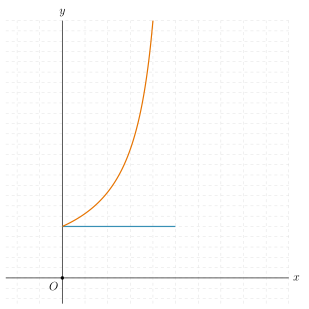
- \(\,\) \begin{align*} && \frac{F'}{1-F} &= \frac{1}{t} \\ \Rightarrow && -\ln (1-F) &= \ln t + C\\ \Rightarrow && 1-F &= \frac{A}{t} \\ && F &= 1 - \frac{A}{t} \\ F(a) = 0: && F &= 1 - \frac{a}{t} \\ && f(t) &= \frac{a}{t^2} \end{align*}
- (\(\Rightarrow\)) \begin{align*} && \frac{F'}{1-F} &= k \\ \Rightarrow && -\ln(1-F) &= kt+C \\ \Rightarrow && 1-F &= Ae^{-kt} \\ F(b) = 0: && 1 &= Ae^{-kb} \\ \Rightarrow && 1-F &= e^{-k(t-b)}\\ \Rightarrow && f &= ke^{-k(t-b)} \\ \end{align*} (\(\Leftarrow\)) \(f(t) = ke^{-k(t-b)} \Rightarrow F(t) = 1-e^{-k(t-b)}\) and the result is clear.
- \(\,\) \begin{align*} && \frac{F'}{1-F} &= \left ( \frac{\lambda}{\theta^{\lambda}} \right) t^{\lambda-1} \\ \Rightarrow && -\ln(1-F) &= \left ( \frac{t}{\theta} \right)^{\lambda} +C\\ \Rightarrow && F &= 1-A\exp \left (- \left ( \frac{t}{\theta} \right)^{\lambda} \right) \\ F(0) = 0: && 0 &= 1-A \\ \Rightarrow && F &= 1 - \exp \left (- \left ( \frac{t}{\theta} \right)^{\lambda} \right) \\ \Rightarrow && f &= \lambda t^{\lambda -1} \theta^{-\lambda} \exp \left (- \left ( \frac{t}{\theta} \right)^{\lambda} \right) \end{align*}