Problems
Filters
1 problem found
2015 Paper 3 Q3
D: 1700.0
B: 1484.0
polar coordinates
conchoid of Nicomedes
locus
curve sketching
integration
area in polar coordinates
sec function
absolute value
In this question, \(r\) and \(\theta\) are polar coordinates with \(r \ge0\) and \(- \pi < \theta\le \pi\), and \(a\) and \(b\) are positive constants. Let \(L\) be a fixed line and let \(A\) be a fixed point not lying on \(L\). Then the locus of points that are a fixed distance (call it \(d\)) from \(L\) measured along lines through \(A\) is called a conchoid of Nicomedes.
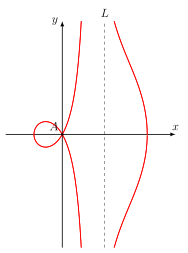
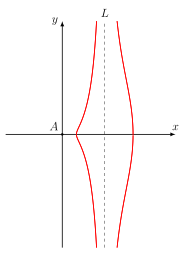
- Show that if \[ \vert r- a \sec\theta \vert = b\,, \tag{\(*\)} \] where \(a>b\), then \(\sec\theta >0\). Show that all points with coordinates satisfying (\(*\)) lie on a certain conchoid of Nicomedes (you should identify \(L\), \(d\) and \(A\)). Sketch the locus of these points.
- In the case \(a < b\), sketch the curve (including the loop for which \(\sec\theta<0\)) given by \[ \vert r- a \sec\theta \vert = b\, . \] Find the area of the loop in the case \(a=1\) and \(b=2\). [Note: $ %\displaystyle \int \! \sec\theta \,\d \theta = \ln \vert \sec\theta + \tan\theta \vert + C \,. $]
Solution:
- \(r = a \sec \theta \pm b\). The points on \(r = a \sec \theta \Leftrightarrow r \cos \theta = a \Leftrightarrow x = a\) are points on the line \(x = a\). Therefore points on the curve \(r = a \sec \theta \pm b\) are points which are a distance \(b\) from the line \(x = a\) measured towards \(O\). So \(A\) is the origin and \(d = b\).
- The loop starts and ends when \(r = a \sec \theta - b = 0 \Rightarrow \cos \theta = \frac{a}{b}\), so when \(a = 1, b = 2\), this is \(-\frac{\pi}{3}\) to \(\frac{\pi}{3}\) \begin{align*} && A &= \frac12 \int r^2 \d \theta \\ &&&= \frac12 \int_{-\pi/3}^{\pi/3} \left ( \sec \theta - 2 \right)^2 \d \theta \\ &&&= \frac12 \int_{-\pi/3}^{\pi/3} \left (\sec^2 \theta - 4 \sec \theta + 4\right)\d \theta \\ &&&= \frac12 \left [ \tan \theta -4 \ln | \sec \theta + \tan \theta| + 4 \theta \right]_{-\pi/3}^{\pi/3} \\ &&&= \frac12 \left (\left (\tan \frac{\pi}3 - 4 \ln | \sec \frac{\pi}3 + \tan \frac{\pi}3 | + 4\left ( \frac{\pi}3 \right)\right) - \left (\tan \left (-\frac{\pi}3 \right) - 4 \ln | \sec \left (-\frac{\pi}3 \right)+ \tan\left ( -\frac{\pi}3 \right) | + 4\left ( -\frac{\pi}3 \right)\right) \right) \\ &&&= \frac12 \left ( 2\sqrt{3} - 4 \ln |2 + \sqrt{3}| + 4 \ln |2-\sqrt{3}| + \frac{8\pi}3 \right) \\ &&&= \sqrt{3} + 2\ln \frac{2-\sqrt{3}}{2+\sqrt{3}} + \frac{4\pi}3 \\ &&&= \sqrt{3} + 4 \ln (2 - \sqrt{3})+ \frac{4\pi}3 \end{align*}